
Euler's Eyes
2022-10-08
Equiprobable Events
In this post we will talk about equiprobable events. This concept is what we cover in teaching children and is the starting point for the concept of probability.

What is an equiprobable event?
Equiprobable events are events with the same probability of occurring, that is, they have the same chance of occurring. It appears a lot in probability theory. This way, we will define it as:
Definition (Equiprvable Events): Let there be a sample space $\Omega$ and a random experiment from this space. When we take a class of events from this finite space $\mathcal{A}=\\{e_1, e_2,\dots,e_n\\}$. Events are equiprobable if these events have the same probability of occurring.
$$\mathbb{P}(e_1) = \mathbb{P}(e_1) = \dots = \mathbb{P}(e_n) =\dfrac{\text{número de eventos favoráveis} }{\text{total de casos} }$$

Coin Toss Example
In order to exemplify equiprobable events, let’s assume a fair coin. This way:
- Sample Space: $$\Omega=\\{\text{cara}, \text{coroa}\\}$$
- Equiprobable events:
- The chance of heads falling is the same as tails $$\mathbb{P}(\\{\text{cara}\\}) = \mathbb{P}(\\{\text{coroa}\\}) = \dfrac{1}{2}$$

$$\mathbb{P}(\\{\text{cara}\\}) = \dfrac{1 }{2}$$Question:
- What is the probability of heads falling.
In terms of percentage we have
$$\text{Chance } = \dfrac{1 \color{red}{~.~50} }{2 \color{red}{~.~50} } = \dfrac{50}{100} = 50\\%$$Example of Rolling a Dice
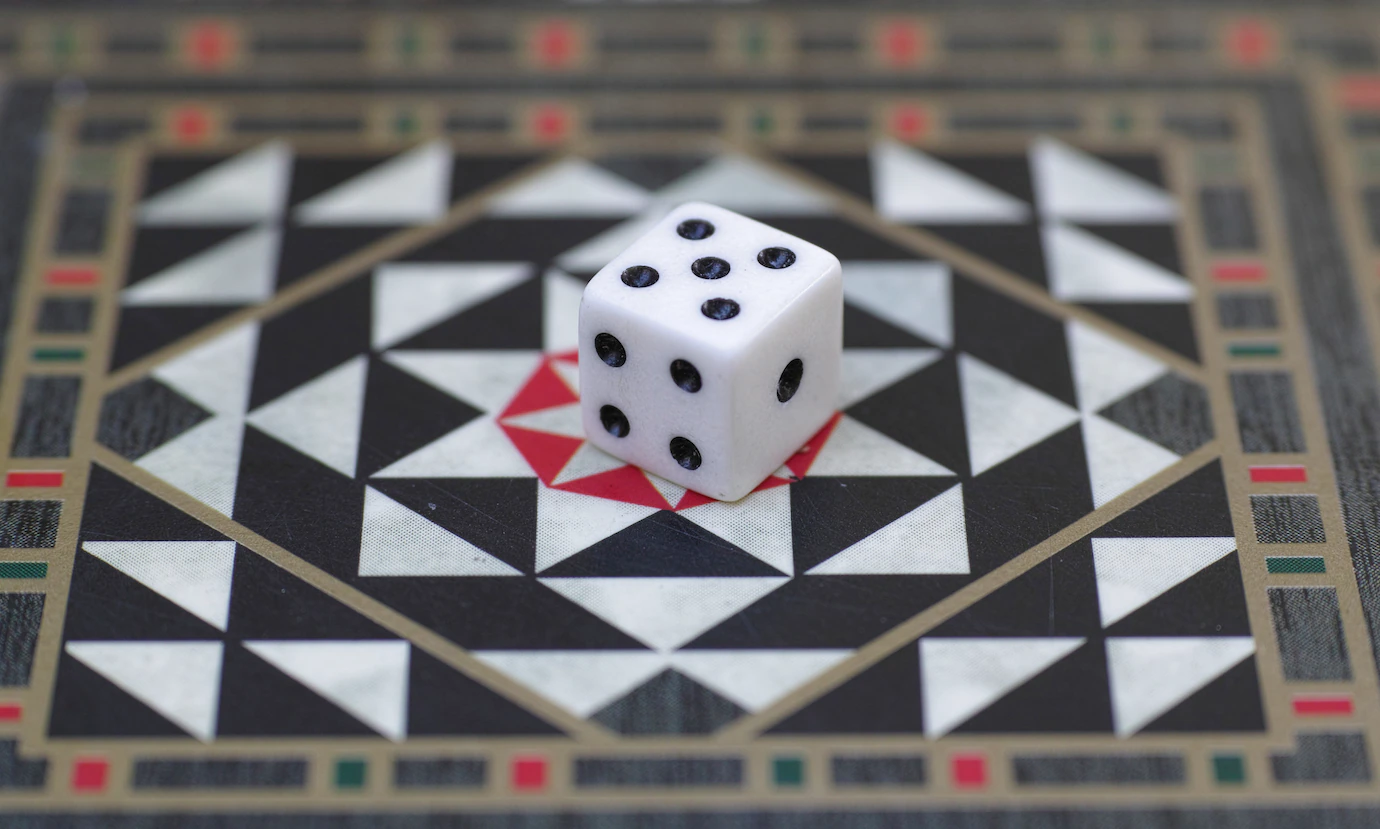
In order to exemplify equiprobable events, let’s assume honest data. This way:
- Sample Space: $$\Omega=\\{1,2,3,4,5,6\\}$$
- Equiprobable events:
- Chance of dropping 1 is the same as 2, 3, 4, 5 and 6 $$\mathbb{P}(\\{1\\}) = \mathbb{P}(\\{2\\}) = \mathbb{P}(\\{3\\}) = \mathbb{P}(\\{4\\}) = \mathbb{P}(\\{5\\}) = \mathbb{P}(\\{6\\}) = \dfrac{1}{6}$$
1 million dollar question:
- What is the probability that the dice will land an even number.
First, we must define the event even numbers of data $B=\\{ 2, 4, 6 \\}$.
Dropping number 2 is independent of dropping 4 or 6.
Therefore, the probability of landing is the same as flipping the coin.
Example of Rolling Two Dice
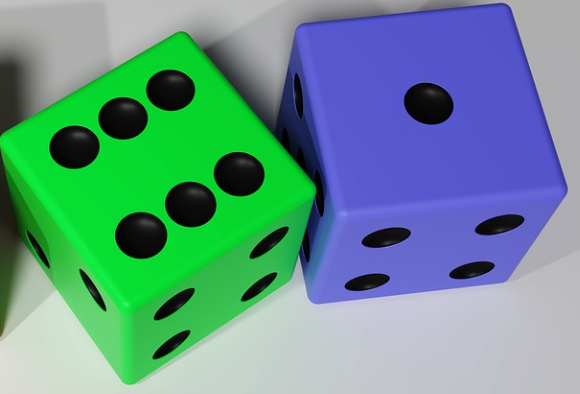
In a game of dice, two fair dice are rolled simultaneously. For a player to win, the following event must occur:
Question: “sum of the two faces must be equal to 7”.
| $1$ | $2$ | $3$ | $4$ | $5$ | $6$ | |
|---|---|---|---|---|---|---|
| $1\quad$ | $(1,1)\quad$ | $(1,2)\quad$ | $(1,3)\quad$ | $(1,4)\quad$ | $(1,5)\quad$ | $(1,6)\quad$ |
| $2\quad$ | $(2,1)\quad$ | $(2,2)\quad$ | $(2,3)\quad$ | $(2,4)\quad$ | $(2,5)\quad$ | $(2,6)\quad$ |
| $3\quad$ | $(3,1)\quad$ | $(3,2)\quad$ | $(3,3)\quad$ | $(3,4)\quad$ | $(3,5)\quad$ | $(3,6)\quad$ |
| $4\quad$ | $(4,1)\quad$ | $(4,2)\quad$ | $(4,3)\quad$ | $(4,4)\quad$ | $(4,5)\quad$ | $(4,6)\quad$ |
| $5\quad$ | $(5,1)\quad$ | $(5,2)\quad$ | $(5,3)\quad$ | $(5,4)\quad$ | $(5,5)\quad$ | $(5,6)\quad$ |
| $6\quad$ | $(6,1)\quad$ | $(6,2)\quad$ | $(6,3)\quad$ | $(6,4)\quad$ | $(6,5)\quad$ | $(6,6)\quad$ |
This way:
- Sample Space: 36 elements
$$\Omega=\\{ (1,1),(1,2),(1,3),(1,4),(1,5), \dots, (6,6)\\}$$
- For example:
- Even (1,1) the sum is $1+1=2$
- Even (1,2) the sum is $1+2=3$
- $\vdots$
- Even (1,6) the sum is $1+6=4$
- $\vdots$
- Even (6,6) the sum is $6+6=12$
- For example:

- Equiprobable events:
- Chance of falling sum equals 7
| $1$ | $2$ | $3$ | $4$ | $5$ | $6$ | |
|---|---|---|---|---|---|---|
| $1\quad$ | $(1,1)\quad$ | $(1,2)\quad$ | $(1,3)\quad$ | $(1,4)\quad$ | $(1,5)\quad$ | $\color{red}{(1,6)}\quad$ |
| $2\quad$ | $(2,1)\quad$ | $(2,2)\quad$ | $(2,3)\quad$ | $(2,4)\quad$ | $\color{red}{(2,5)}\quad$ | $(2,6)\quad$ |
| $3\quad$ | $(3,1)\quad$ | $(3,2)\quad$ | $(3,3)\quad$ | $\color{red}{(3,4)}\quad$ | $(3,5)\quad$ | $(3,6)\quad$ |
| $4\quad$ | $(4,1)\quad$ | $(4,2)\quad$ | $\color{red}{(4,3)}\quad$ | $(4,4)\quad$ | $(4,5)\quad$ | $(4,6)\quad$ |
| $5\quad$ | $(5,1)\quad$ | $\color{red}{(5,2)}\quad$ | $(5,3)\quad$ | $(5,4)\quad$ | $(5,5)\quad$ | $(5,6)\quad$ |
| $6\quad$ | $\color{red}{(6,1)}\quad$ | $(6,2)\quad$ | $(6,3)\quad$ | $(6,4)\quad$ | $(6,5)\quad$ | $(6,6)\quad$ |
Firstly, we must define:
- the event numbers with sum 7 of the data;
- 6 elements;
- $B=\\{ (1,6), (2,5), (3,4),(4,4), (5,2), (6,1) \\}$.
 $$\mathbb{P}(B) = \dfrac{\text{número de elementos favoráveis de B} }{\text{total de elementos do espaço amostral} } = \dfrac{6 }{36} = \dfrac{1 }{6}$$
So far we have talked about examples of equiprobable events. Wait for the next posts.