
Euler's Eyes
2022-07-22
Operations with Rational Numbers
Positive rational numbers were widely used in Egypt in the centuries before Christ. After years as nomads, homo sapiens began the agricultural revolution and with it, the need to use rational numbers. Their use in land markings was the main need for the use of these numbers.
On the Nile River, land flooding forced land to be re-marked. In this way, rational numbers were used to remark the lands.
Definition
Until now, in the history of mathematics, we have noticed that rational numbers are represented by a fraction in which:
- the numerator is an integer $p\in \mathbb{Z}$.
- the denominator is an integer $q\in \mathbb{Z}$.
- the denominator is non-zero $q\neq 0$.
Without loss of generality, let’s start with the definition of positive rational numbers. Therefore, the set of rational numbers can be written as:
Definition: Let $p$ and $q$ be positive integers with $q\neq 0$, then $\dfrac{p}{q}$ is a positive rational number. The set of positive rational numbers is given by:
$$\mathbb{Q} = \left\\{ \dfrac{p}{q}, \quad \text{com p e q inteiros positivos e q diferente de zero} \right\\}$$
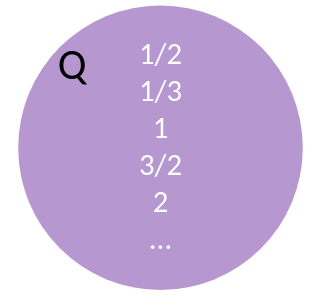
So we construct our third set of numbers. The order of construction of the numbers were:
- natural numbers $\mathbb{N} = \\{0,1,2,3,\dots\\}$
- integers $\mathbb{Z} = \\{\dots, -3,-2,-1,0,1,2,3,\dots\\}$
- rational numbers $\mathbb{Q} = \left\\{\dots, -\dfrac{3}{2},-1, -\dfrac{1}{2}, 0,\dfrac{1}{2},1,\dfrac{3}{2},2,\dots \right\\}$
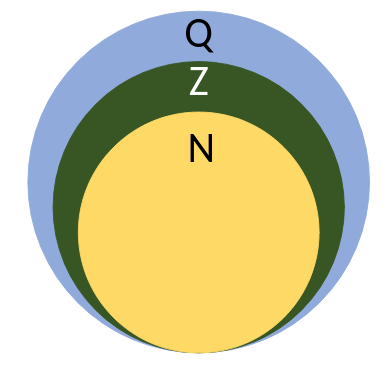
Another way to represent rational numbers
In the previous section, we represented a rational number as $\frac{p}{q}.$. Here we will represent a rational number as the division of the unit into q equal parts. Let $p$ and $q$ be positive integers, we take $p$ parts of the division of the unit:
$$p~.~\dfrac{1}{q} = \dfrac{p}{q}$$where $p$ is the number of parts of the division of the unit which can be seen as:
$$p~.~\dfrac{1}{q} = \dfrac{1}{q} + \dfrac{1}{q} + \dots + \dfrac{1}{q} \qquad p\text{ vezes}$$Example 1: The representations of $1$ and $\dfrac{1}{3}$ are:

Example 2: The representation of $\dfrac{2}{3}$ is:
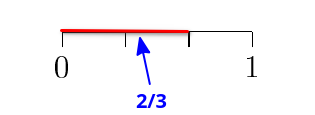 $$2~.~\dfrac{1}{3} = \dfrac{1}{3} + \dfrac{1}{3} =\dfrac{2}{3}$$
Equivalent Fractions
On certain occasions, we can obtain equivalent fractions. Using the balance principle we can obtain these equivalent fractions.

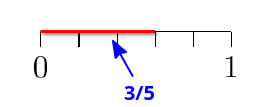
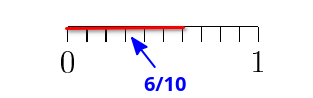
Example 3: equivalent fractions:
| $$\dfrac{3}{5}$$ | $$\dfrac{6}{10}$$ |
|---|---|
|
|
Are these equivalent fractions?
In fact, it is worth remembering that $\dfrac{2}{2}=1$
$$\dfrac{3}{5} \overset{\text{balança} }{=} \dfrac{3}{5} \dfrac{ {\color{red}{\times 2} } }{ {\color{red}{\times 2} } } = \dfrac{6}{10}$$Definition: Let $p$, $q$, $a$ and $b$ be positive integers, then $\dfrac{p}{q}$ is a fraction equivalent to $\dfrac{a}{b}$ if and only if $\dfrac{p}{q}=\dfrac{a}{b}$.
From the example 3, note that::
$$\dfrac{6}{10} \overset{\text{balança} }{=} \dfrac{6}{10} \dfrac{ {\color{red}{\div 2} } }{ {\color{red}{\div 2} } } = \dfrac{3}{5}$$Therefore, they are actually equivalent.
Sum of fractions
In adding fractions, the first rule is that the denominator must be the same. Observe the example:
$$\dfrac{3}{5} + \dfrac{1}{5} = \dfrac{4}{5}$$And when the denominators are different?
Method 1: Scale
The next step is to leave the same denominator for both fractions. For this, we can use the scale method.
$$\dfrac{3}{5} + \dfrac{1}{3} \overset{\text{balança} }{=} \dfrac{3}{5} \dfrac{ {\color{red}{\times 3} } }{ {\color{red}{\times 3} } } + \dfrac{1}{3} \dfrac{ {\color{red}{\times 5} } }{ {\color{red}{\times 5} } } = \dfrac{9}{15} + \dfrac{5}{15} = \dfrac{14}{15}$$In general, we have:
$$\dfrac{p}{q} + \dfrac{a}{b} \overset{\text{balança} }{=} \dfrac{p}{q} \dfrac{ {\color{red}{\times b} } }{ {\color{red}{\times b} } } + \dfrac{a}{b} \dfrac{ {\color{red}{\times q} } }{ {\color{red}{\times q} } } = \dfrac{p ~.~b}{q~.~b} + \dfrac{a~.~q}{q~.~b} = \dfrac{pb + aq}{qb}$$with $q, b$ non-zero,
Method 2: Least common multiple
The least common multiple method is done as follows:
$$\dfrac{3}{5} + \dfrac{1}{3}$$Now let’s calculate the least common multiple between the denominators:
$$\mathcal{D}(3)=\\{3,6,9,12,{\color{red}{15} },18,\dots\\}$$$$\mathcal{D}(5)=\\{5,10,{\color{red}{15} },20\dots\\}$$
$$mmc(3,5) = \min \\{\mathcal{D}(3)\cap \mathcal{D}(5)\\} = 15$$
Therefore, the least common multiple between the denominators is 15. So, we can do the sum:
$$\dfrac{3}{5} + \dfrac{1}{3}= \dfrac{3 {\color{red}{\times 3} } }{15} + \dfrac{1 {\color{red}{\times 5} } }{15} = \dfrac{9}{15} + \dfrac{5}{15} =\dfrac{14}{15}$$Subtraction of fractions
In subtracting fractions, the first rule is that the denominator must be the same. Observe the example:
$$\dfrac{3}{5} - \dfrac{1}{5} = \dfrac{2}{5}$$And when the denominators are different?
Method 1: Scale
The next step is to leave the same denominator for both fractions. For this, we can use the scale method.
$$\dfrac{3}{5} - \dfrac{1}{3} \overset{\text{balança} }{=} \dfrac{3}{5} \dfrac{ {\color{red}{\times 3} } }{ {\color{red}{\times 3} } } - \dfrac{1}{3} \dfrac{ {\color{red}{\times 5} } }{ {\color{red}{\times 5} } } = \dfrac{9}{15} - \dfrac{5}{15} = \dfrac{4}{15}$$In general, we have:
$$\dfrac{p}{q} - \dfrac{a}{b} \overset{\text{balança} }{=} \dfrac{p}{q} \dfrac{ {\color{red}{\times b} } }{ {\color{red}{\times b} } } - \dfrac{a}{b} \dfrac{ {\color{red}{\times q} } }{ {\color{red}{\times q} } } = \dfrac{p ~.~b}{q~.~b} - \dfrac{a~.~q}{q~.~b} = \dfrac{pb - aq}{qb}$$with $q, b$ non-zero,
Method 2: Least common multiple
The least common multiple method is done as follows:
$$\dfrac{3}{5} - \dfrac{1}{3}$$Now let’s calculate the least common multiple between the denominators:
$$\mathcal{D}(3)=\\{3,6,9,12,{\color{red}{15} },18,\dots\\}$$$$\mathcal{D}(5)=\\{5,10,{\color{red}{15} },20\dots\\}$$
$$mmc(3,5) = \min \\{\mathcal{D}(3)\cap \mathcal{D}(5)\\} = 15$$
Therefore, the least common multiple between the denominators is 15. So, we can do the sum:
$$\dfrac{3}{5} - \dfrac{1}{3}= \dfrac{3 {\color{red}{\times 3} } }{15} - \dfrac{1 {\color{red}{\times 5} } }{15} = \dfrac{9}{15} - \dfrac{5}{15} =\dfrac{4}{15}$$Multiplication of fractions
In multiplying fractions, the only rule for the denominator is that the number must be non-zero. Observe the example:
$$\dfrac{1}{3} ~.~ \dfrac{1}{2} = \dfrac{1 ~.~ 1}{3~.~2}= \dfrac{1}{6}$$In general, we have:
$$\dfrac{p}{q} ~.~ \dfrac{a}{b} = \dfrac{p ~.~ a}{q~.~b}$$Division of fractions
In dividing fractions, the only rule for the denominator is that the number must be non-zero. Observe the example:
$$\dfrac{1}{3} ~\div~ \dfrac{1}{2} = \dfrac{\dfrac{1}{3} }{\dfrac{1}{2} }= \dfrac{\dfrac{1}{3} {\color{red}{\times 2} } }{\underbrace{\dfrac{1}{2} {\color{red}{\times 2} } }_{=1} } = \dfrac{\dfrac{2}{3} }{1} = \dfrac{2}{3}$$In general, we have:
$$\dfrac{p}{q} ~\div~ \dfrac{a}{b} = \dfrac{\dfrac{p}{q} {\color{red}{\times \dfrac{b}{a} } } }{ \underbrace{\dfrac{a}{b} {\color{red}{\times \frac{b}{a} } } }_{1} } = \dfrac{p }{q}~.~ \dfrac{b}{a}$$