
Euler's Eyes
2026-10-11
Leibniz's machine: turning sums into motion
In 1642 the young Blaise Pascal built a machine to help his father, a tax collector. The Pascaline added and subtracted by turning gears. To multiply, however, you had to repeat the addition by hand, many times.
Leibniz saw a Pascaline in Paris and wanted to go further: a machine that would multiply and divide on its own.
Multiplying is adding and shifting
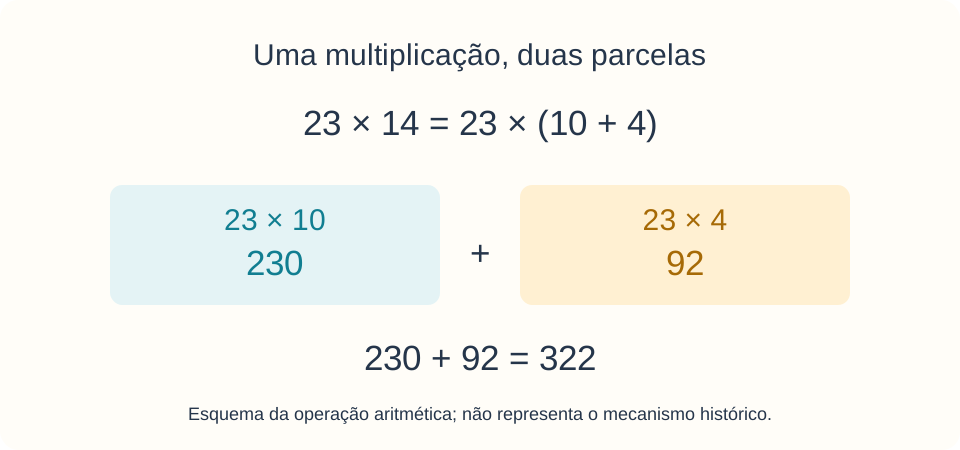
The trick is the same as in long multiplication at school. To multiply $23\times14$, we split 14 into $4+10$:
$$23\times14=23\times4+23\times10=92+230=322.$$Multiplying by 4 means adding 23 four times. Multiplying by 10 just means shifting the number one place to the left. A machine that adds well and can shift the number can therefore multiply anything.
The stepped drum
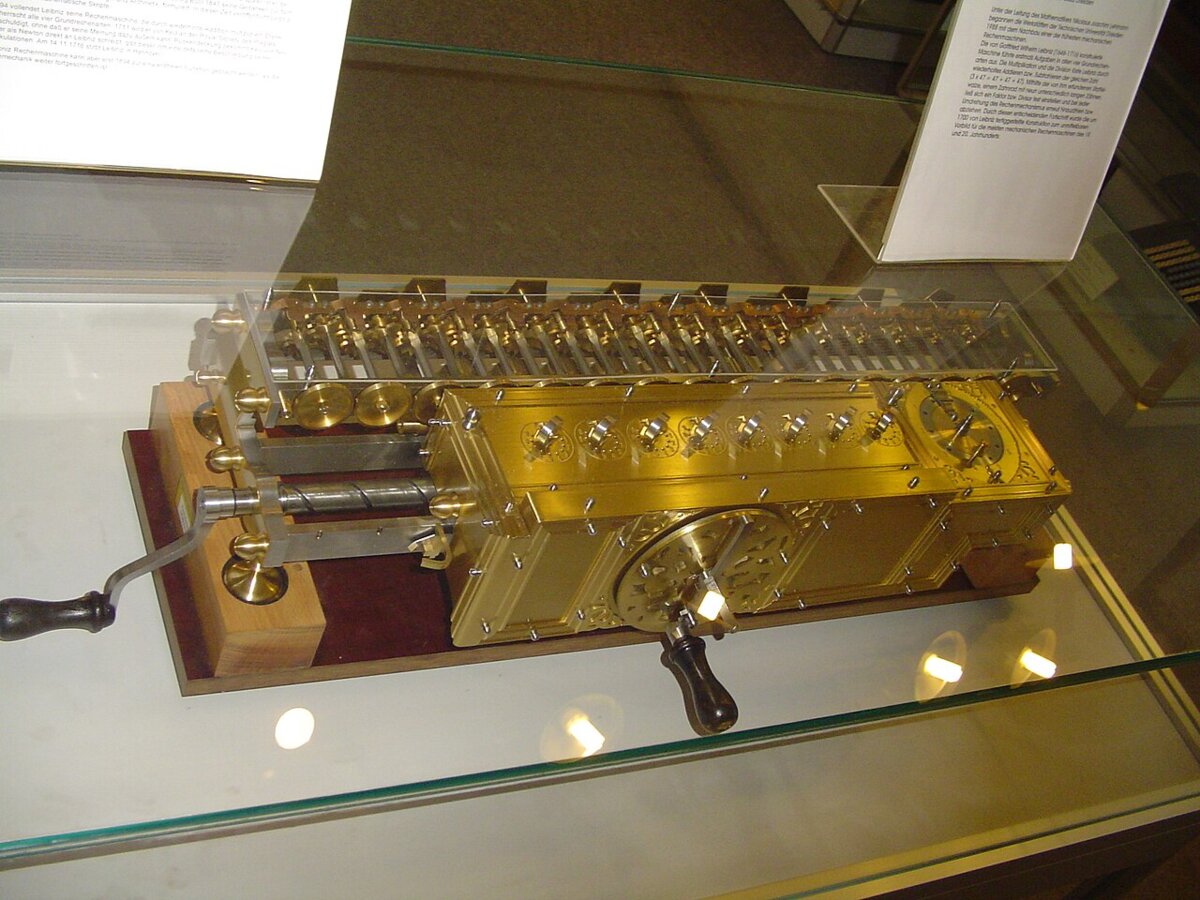
The problem was to make the machine add the same number several times without the operator entering it again. Leibniz’s solution was the stepped drum, in German Staffelwalze: a cylinder with nine teeth of different lengths, like a staircase wrapped around it.
A small gear slides alongside the drum. If it sits at the height of “3”, then on each turn of the drum only three teeth reach it, and it turns three positions. If it sits at “7”, it turns seven. So by positioning the gear you store a digit in the machine. Each turn of the crank adds that digit again.
For $23\times4$, we set 2 and 3 and turn the crank four times. Then we shift the moving part of the machine one place and turn once, to add $23\times10$. The result appears on the dial: 322.
The carry problem
Adding 1 to 9 on a decimal gear sends the dial back to 0 and requires the next gear to advance one position: the “carry”. In $9999+1$, four gears must pass the carry along in sequence, at the right moment. With the imprecise parts of the 17th century, this was the hardest point.
Leibniz presented an incomplete wooden model to the Royal Society in 1673. He spent more than twenty years refining the design with clockmakers and spent a small fortune. When the machine was examined in detail at the end of the 19th century, it turned out that the carry mechanism failed in certain cases. The mathematical idea was right; it was the mechanical execution that was hard.
A mechanism that lasted three centuries
The stepped drum was the machine’s great legacy. In 1820 the Frenchman Thomas de Colmar used the same idea in the arithmometer, the first mass-produced calculator, sold until the early 20th century. In 1948 the small Austrian Curta calculator, which fitted in the palm of a hand, still worked with a stepped drum. It was only retired by electronic calculators in the 1970s.
For Leibniz, the machine had a purpose beyond saving clerks’ time. It showed that a line of reasoning, if written with precise rules, can be carried out by a mechanism. The same idea appears in his dream of calculating with reasoning.
Exercise: split 37 × 12 as the machine would
$37\times12=37\times2+37\times10=74+370=444$. On the machine: two turns with 37, one shift and one more turn.
Exercise: how many turns of the crank does the machine need for 58 × 203?
$203=3+0\cdot10+2\cdot100$. That is 3 turns in the units, none in the tens and 2 in the hundreds: 5 turns in all, plus the shifts. Result: $58\times203=11{,}774$.
Sources: Leibniz exhibition at Leibniz Universität Hannover · MacTutor biography.
All Leibniz topics · ← Binary arithmetic: writing numbers with 0 and 1 · The Leibniz series for π: a simple, slow sum →