
Euler's Eyes
2020-06-19
OBMEP 2018 - Second Phase
In this post we will resolve the OBMEP 2018 questions with comments.
Question 1
A crazy machine turns two fruits into one fruit, as follows:
- Turns two apples into an orange;
- Turns two oranges into one orange;
- Turns an apple and an orange into an apple.

Q1 Item a
a) How many times should the machine be used to turn three apples into one apple?
Data: Initially we have 3 apples.
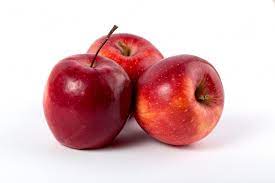
Step 1
- We put two of these apples in the machine
- Turn it into an orange.
- End result:
- 1 apple and 1 orange.

Step 2
- We put in the machine:
- an apple;
- an orange.
- Result: an apple.

Answer: The machine must be used twice.
Q1 Item b
b) Explain how to use this machine a few times to turn three apples and four oranges into one apple.
| Step 1 | Step 2 | Step 3 | Step 4 |
|---|---|---|---|

|

|

|

|
Step 1:
- 2 oranges turns into 1 orange;
- 2 oranges turns into 1 orange;
- There are 2 oranges left;
Step 2:
- 2 apples turn into 1 orange and 1 apple;
- 1 apple does nothing;
- That leaves 1 orange and 1 apple;
Step 3:
- Leftover from step 1:
- 2 oranges turns into 1 orange;
- 1 apple does nothing;
- 1 orange does nothing;
Step 4:
- Leftover from step 3:
- 3 oranges and 1 apple;
- 2 oranges turns into 1 orange;
- 3 oranges and 1 apple;
- 1 oranges and 1 apple turns into 1 apple;
Therefore, there is 1 apple left.
Q1 Item c
c) Starting with 2018 oranges and 517 apples, the machine was used repeatedly until only one fruit was left. Explain why this fruit can only be an apple.
This is an exercise on the rule of signs.
Be
- $m=$apple$=-1$ and
- $l=$orange$=+1$
| Multiplication of Terms | $$\Rightarrow$$ | Rule of Signs |
|---|---|---|
| $$(+1) \times (+1) \quad = \quad + (1)$$ | $$\Rightarrow$$ | $$(+)\quad \times \quad (+) \quad = \quad (+) $$ |
| $$(+1) \times (-1) \quad = \quad - (1)$$ | $$\Rightarrow$$ | $$(+)\quad \times \quad (-) \quad = \quad (-) $$ |
| $$(-1) \times (+1) \quad = \quad - (1)$$ | $$\Rightarrow$$ | $$(-)\quad \times \quad (+) \quad = \quad (-) $$ |
| $$(-1) \times (-1) \quad = \quad + (1)$$ | $$\Rightarrow$$ | $$(-)\quad \times \quad (-) \quad = \quad (+) $$ |
With this, we have the algorithm:
- Step 1 (oranges):
- Step 2 (apples):
- 517 odd apples $= (-1)^{516} \times (-1) $
- 516 apples (machine) and 1 apple (leftover)
- Step 3 (apple, orange)
Question 2
Joãozinho bought an album in which numbered stickers must be pasted in ascending order, starting on page 2 and ending on page 61. On the even numbered pages, 5 stickers must be pasted and on the odd numbered pages, 6 stickers.

Q2 Item a
a) In total, how many stickers should be glued to the album?
The even pages of the album are given by the sets:
$$\text{par} = \\{2,4,6, \dots, 60\\}$$$$\text{ímpar} = \\{3,5,7, \dots, 61\\}$$
On every even page we have an odd equivalent. This way, just calculate the number of even pages:
$$\text{páginas} = \dfrac{60}{2}=30$$
For the glued stickers we have:
$$\text{página par} = 30 \text{ páginas }\times 5 \text{ figurinhas} = 150 \text{ figurinhas}$$$$\text{página ímpar} =30 \text{ páginas }\times 6 \text{ figurinhas} = 180 \text{ figurinhas}$$Therefore, the total is $150+180=330$ stickers.
Q2 Item b
b) On which page should the sticker number 196 be pasted?
In each set of two pages we have:
- pair 5 stickers
- odd 6 stickers
- total 11 stickers
Now let’s apply the page search. For ist0 we will calculate a division:
$$196 \div 11 = \dfrac{196}{11} = 17,\dots$$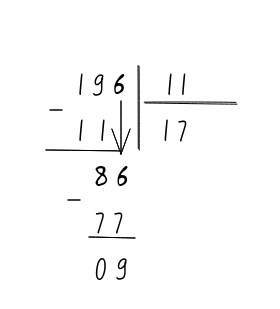
The remainder of this division is 9.
As we fall on the odd page we have:
- 6 stickers can fit on the odd page;
- let’s go to page 18 which is even;
- position 4 of page 18.
But it’s worth remembering that:
- the album starts on page 2
- we calculate for pairs of pages so the total number of pages is:
- $18\times 2 = 36$ pages
- starts at page 2 then $36+1=37$ pages.
Therefore, the sticker 196 goes on page 37.
Q2 Item c
c) To complete his album, Joãozinho bought many packs of stickers. After gluing the last missing sticker, the number of repeated stickers was eight times the number of glued stickers.
If the album cost 20 reais and each package with 5 stickers cost 2 reais, how much did Joãozinho spend to have his album? full?
Joãozinho has the following situation:
- bought 330 stickers (letter a) that were glued and
- (Statement): 8 times 330 glued stickers that were repeated.
- He bought $\underbrace{(8+1)}_{\text{8 repetidas e 1 colada} } \times 330 = 9\times 330 = 2970$ stickers,
- Total packages $2970 \div 5 = 594$ packages, as each package has 5 stickers.
- As each package cost 2 reais:
- He spent $594\text{ pacotes } \times 2\text{ reais} = 1188$ reais buying the stickers.
- Album cost 20 reais,
Joãozinho spent
- $20 + 1188 = 1208$ reais to complete the album.
Question 3
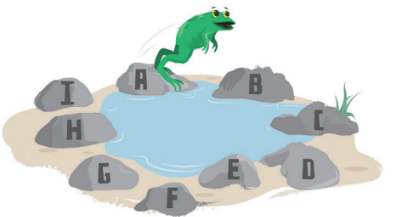
The little frog in the figure jumps from one rock to a neighboring rock, going around around the lake. For example, if he jumps twice from stone A, clockwise, he will end up at stone C.
Q3 Item a
a) Starting from stone A, which stone will the frog end up on after jumping 15 times clockwise?
From the figure and statement we have:
- Home stone A
- frog arrives at stone A again after 9 jumps
- frog will follow with more 6 jumps
- the frog stops at stone G
- A to A 9 jumps
- A to G 6 jumps.
- A to G (9+6) =15 jumps

Q3 Item b
b) Again, starting from A and starting clockwise, the frog jumps 2018 times and always changes direction each time the number of jumps is a multiple of 8. Which rock will he end up on?

In the figure we notice that:
- 8 clockwise jumps ($A \longrightarrow I$)
- 8 counterclockwise jumps ($I \longrightarrow A$)
- 16 total skips

After 2018 jumps we have:
- $2018 \div 16 = 126$ with remainder 2.
- After going back and forth between 126 jumps, you will end up on stone A
- little frog ends up on stone C.
- as the remainder of the division is 2, it goes from A to C.

Q3 Item c
c) Finally, starting from A and starting clockwise, the little frog jumps 810 times and always changes direction each time since the number of hops is a multiple of 8 or a multiple of 12. Which rock will he end up on?

Frog steps:
- Home stone A;
- 8 jumps to stone I;
- Change direction
- jumps 4 rocks ($8 + 4 = 12$);
- arrives at stone E;
- Change direction
- jumps 4 rocks ($12 + 4 = 16$);
- arrives again at stone I;
- Change direction
- jumps 8 rocks ($16 + 8 = 24$);
- returns stone A;
- Start the entire route again
- always returns to stone A after 24 jumps.
Now let’s calculate the routine.

Steps:
- As $810 \div 24 = 33$ with remainder 18,
- After $24 \times 33 = 792$ jumps you reach stone A
- It remains to jump even more 18 times.

Stone retractant:
- Start in A
- Remainder $18 = 8 + 4 + 4 + 2$
- 8 stones to stone I;
- Change direction 4 jumps to stone E;
- Change direction 4 jump back to stone I;
- Change direction, remaining 2 jumps, from I to stone G.
Question 4
Marília has seven wooden pieces, as illustrated below.

She plays by covering all the squares on rectangular boards with these pieces, without placing one piece on top of another. Each piece must cover exactly 4 squares on the board.
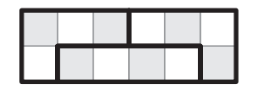
See how Marília covered a board 2 x 6:
Q4 Item a
a) Cover the board below using three Marília pieces.
There are many possibilities for example:

Q4 Item b
b) Which piece does not cover the same number of white squares and gray squares on a board?
Let the numbers inside the squares of the piece be the number of neighbors.
- 1 has 1 neighbor
- 2 has 2 neighbors
- 3 has 3 neighbors

The only piece that has more than 2 neighbors is the T piece, as it has a house with 3 neighbors.
Therefore, the T piece does not cover the same number of white squares as gray squares.
Q4 Item c
c) Explain why Marília will never be able to cover the board below.
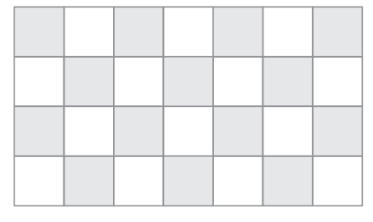
The complete board has:
- 28 houses;
- 14 white;
- 14 ash;
From letter b we saw that the T piece is a problem for covering boards.
In this way, we are going to assume an absurdity, that is, we are not going to use the T-piece.
So, we have your situation:
- 6 pieces
- Board cover
- $6\times 4 =24$ covered houses
- Remains:
- 2 white squares and 2 black squares or
- 2 black squares and 2 white squares

All that’s left is the T-piece they have:
- 3 black squares and 1 white or
- 3 white and 1 black squares
This makes it impossible to cover the remaining houses.
Question 5
A “mathematician” tests a new magic with Helena. He tells her:

- think of two numbers from 1 to 9, one even and one odd;
- calculate the sum of the numbers you thought of;
- Now calculate the difference between the largest and smallest of the numbers in which you thought;
- multiply the sum by the difference;
- tell me what the result of this multiplication was and I will find out what numbers you thought of.
Q5 Item a
a) If Helena thinks about the numbers 4 and 9, what number will she tell the mathematician?

According to the statement:
- 4 + 9 = 13 e
- 9 – 4 = 5.
Helena will explain it as follows:
- multiplication of 13 and 5
- the magician will hear the number 65.
Q5 Item b
b) If Helena says 21, what numbers did she think of?
The number 21 can be written as a product of two natural numbers in two ways.
- The first is 1 x 21
- in this case it doesn’t work, we don’t have two numbers between 1 and 9 whose sum is 21.
- The second is 3 x 7.
- If we choose 3 for the sum:
- we only have 1 and 2 as choices;
- the difference is 1;
- it does not give.
- If we choose 3 for the difference:
- 3 should be the difference between the numbers sought and
- the sum of these numbers must be 7.
- If we choose 3 for the sum:
In this case, the possibilities for the sum 7 are as follows:
- 1 e 6;
- $6 - 1 = 5 \neq 3$
- 2 e 5;
- $5 - 2 = 3$
- 3 e 4;
- $4 - 3 = 1 \neq 3$

Therefore, Helena thought about the numbers 2 and 5.
Q5 Item c
c) Explain why Helena will always say an odd number.

Rules described by the “mathematician”:
- Helena must always think of an even number and an odd number.
- The sum or difference of two numbers (even, odd) is always an odd number (see the post odd and even numbers);
- The product of two odd numbers is an odd number;
- Helena will never say an even number.
Q5 Item d
d) Explain why, if Helena says 15, the mathematician will be in doubt about which numbers she he thought.
If Helena says 15, the possibilities:
- for the product of the sum and difference of the numbers thought are 1 x 15 or 3 x 5
- In the first possibility (1x15)
- the sum of the numbers thought should be 15 and the difference 1;
- for the sum to be 15,
- the numbers thought can be 6 and 9 or 7 and 8.
- As 9 – 6 = 3 and 8 – 7 = 1,
- the numbers thought by Helena are 7 and 8.
- In the second possibility (3 x 5)
- the sum of the numbers thought should be sum 5 and the difference 3,
- the numbers can be 2 and 3 or 1 and 4.
- In this case, as 3 – 2 = 1 and 4 – 1 = 3,
- the numbers thought by Helena are 1 and 4.
- the sum of the numbers thought should be sum 5 and the difference 3,
- In the first possibility (1x15)
Given the two possible answers (7 and 8 or 1 and 4), the “mathematician” will not be sure about the numbers Helena thought of.
Question 6
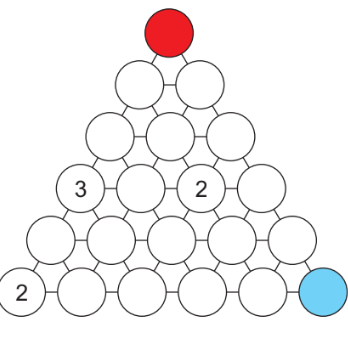
Natural numbers must be written inside each empty circle in the figure, so that the sum of the numbers written in three aligned and consecutive circles is always the same.
Q6 Item a
a) What number should be written in the red circle?

statement,
- the sum of the numbers written in three aligned and consecutive circles is always the same.
- Let x be any natural number,
- in the two circles between the circles on which the numbers 2 and 3 are written.
The next step is:
- After 3 get the first number in the sequence which is 2
- Followed by X
- Therefore, the number in the red circle is 3.
Q6 Item b
b) Show that the sum of all written numbers is a multiple of 7.

When completing the fields:
- 7 times the number 2 (count of 2);
- 7 times the number 3 (count of 3);
- 7 times the number x (count of x);
- Therefore, the sum of all numbers is a multiple of 7.
Q6 Item c
c) For the sum of all written numbers to be 63, which number should be written in the blue circle?
From item b) we have that the blue circle is $x$.
The sum of all written numbers is equal to 63