
Euler's Eyes
2022-06-15
Multiplication of naturals
Groups that saw multiplication tables


Check out the discovery
13 = 8 + 4 + 1. We add 48 + 24 + 6 = 78. The 2 group line does not enter this sum.
In this post, we will talk about multiplying natural numbers. It is worth remembering that multiplication is a special case of addition. In fact, just add equal portions.
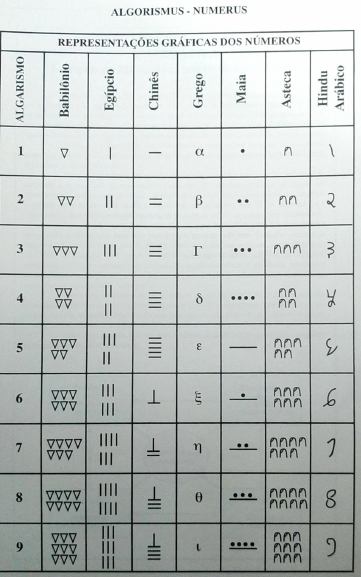
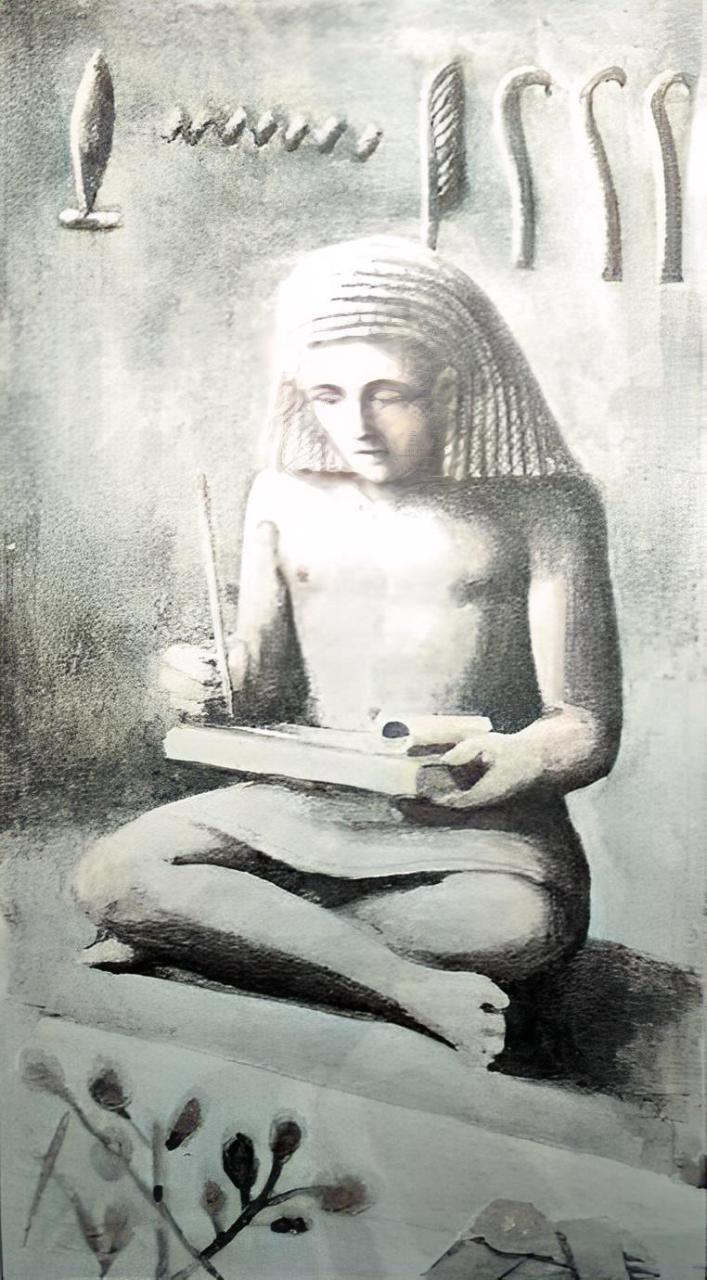
Multiplication is taught at elementary level from 3° year of elementary school. This subject was studied by Egyptians, the East (Japan and China) and Hindus.
| Writing | Art of Writing |
|---|---|
|
|
Adding equal installments brings us to concepts of double, triple, among others.
-
Double \(a\) is \(2a = a + a\)
- Double \(2\) is \(2~.~2 = 2 + 2 = 4\)
-
Triple of \(a\) is \(3a = a+ a+ a\)
- Triple of \(5\) is \(3~.~5 = 5 + 5 + 5 = 15\)
-
And so on.
In short, multiply a natural number \(a\) by a natural number \(n\), that is, we add \(n\) installments equal to \(a\).
$$na = \underbrace{a+a+\dots+a}_{\text{n vezes} }$$$$n~.~a = \underbrace{a+a+\dots+a}_{\text{n vezes}}$$$$n\times a = \underbrace{a+a+\dots+a}_{\text{n vezes}}$$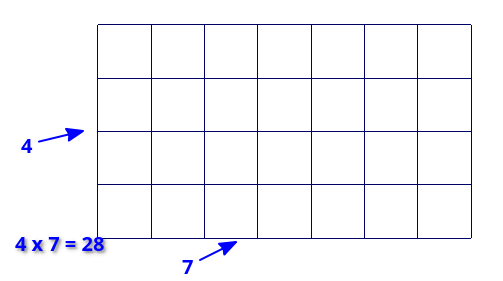
The quadruple of \(7\) is \(4~.~7 = 7 + 7 + 7 + 7 = 28\).
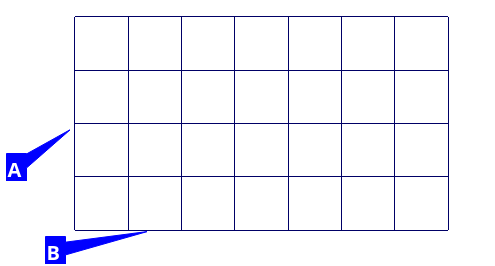
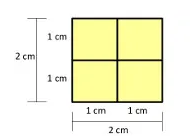
The multiplication method using the visual method (squares) is as follows:
- we take the square numbers on the side a
- we multiply by the number of squares on the side b
- the result is obtained from counting the squares of the complete square.
Help us build the math website. Donate as much as you can.

Multiplication property
Have you ever heard that the tractor order doesn’t change the viaduct?
| Viaduct | Tractors |
|---|---|

|

|
But what does this have to do with multiplication? The true sentence is that the order of the factors does not change the product.
- Impa Portal: Multiplication, counting objects arranged in rectangular shape
Commutative Property
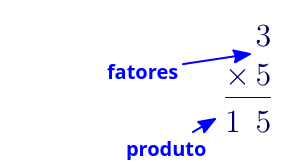
This means that:
$$3\times 5 = 5 \times 3 = 15$$In general:
$$a\times b = b \times a \quad \text{para quaisquer números naturais a e b.}$$
This property is the commutative property.
Distributive Property
| Property | Distributive |
|---|---|
|
|
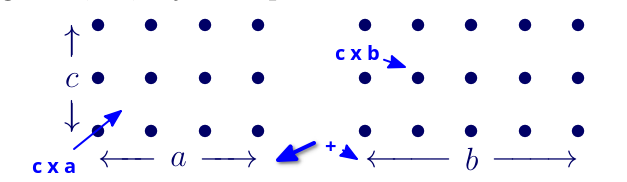
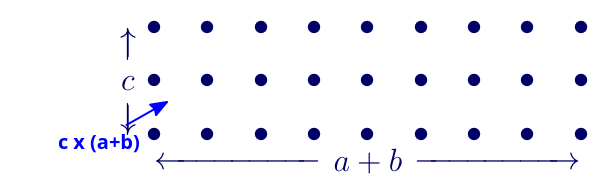
From the figure we note that the distributive property holds:
Therefore:
$$c\times (a+b) = (c\times a) + (c\times b) \quad \text{para quaisquer números naturais a, b e c.}$$
- Impa Portal: Distributive property
Associative property
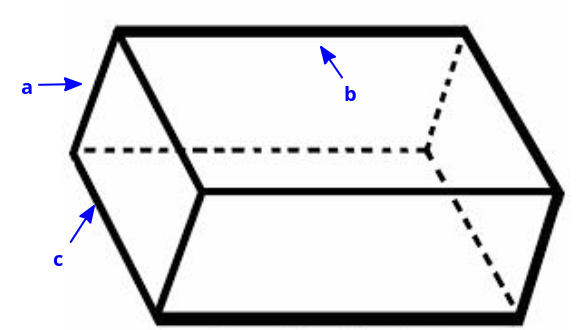
The associative property is obtained from a parallelepiped-type arrangement.
| Paving stone | Cobblestone area |
|---|---|

|
|
The dimensions of the parallelepiped are given by the sides a, b and c. The area of the parallelepiped is given by:
$$A_{\text{paralelepípedo} } = a\times b\times c = (a\times b)\times c = a\times (b\times c) $$Therefore:
$$a\times b\times c = (a\times b)\times c = a\times (b\times c) \quad \text{para quaisquer números naturais a, b e c.}$$
Power property
The power property is obtained from the multiplication of repeated values. For example:
$$\underbrace{a \times a \times\dots \times a}_{\text{a multiplicado n vezes} } = a^n \quad \text{a multiplicado por ele mesmo n vezes}$$
Square root property
Current teaching is based on a process, in which information has been lost over time. The Children learn in a completely wrong way or with a lot of loss of information. For example, information that I have from my children, is that the square root of a number is extremely difficult. But quite the opposite NO.
The word
- square root
In Latin it represents
- side of the square
For example, we take \( \sqrt{4}=2\), the answer is in modules. However, at this time we were not aware of negative numbers. This is information that has been lost over time, that is, we have become a sterile notation. The reader will see that the Semiotically active notations are those that evolved for the advancement of mathematics.
The square root from the perspective of the Latin language (Latin)
radix quadratum 4 aequalis 2
Which we translate as:
the side of the square of area 4 is equal to 2
As stated, the information was lost over time:
radix quadratum 4 aequalis 2
rad quad 4 aq 2
ra qua 4 aq 2
r q 4 aq 2
Suddenly the r swallows the number:
$$ \sqrt{4}=2$$
Multiplication Tables
Multiplication tables are what we currently know as multiplication tables, which serve as a torture weapon for elementary school teachers. However, it has always been used for good and not evil, by modern teachers. The following figure shows the multiplication table from 1 to 10.
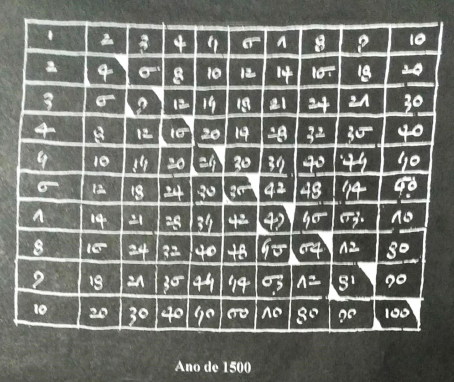
Note that the diagonal of multiplying the row by the column is what other mathematicians used as the square root (side of the square), as stated in the introduction section. In effect:
$$\text{radix quadratum (lado do quadrado)}~ 4~\text{aequalis (igual)}~2 \qquad \Rightarrow \qquad \sqrt{4}=2$$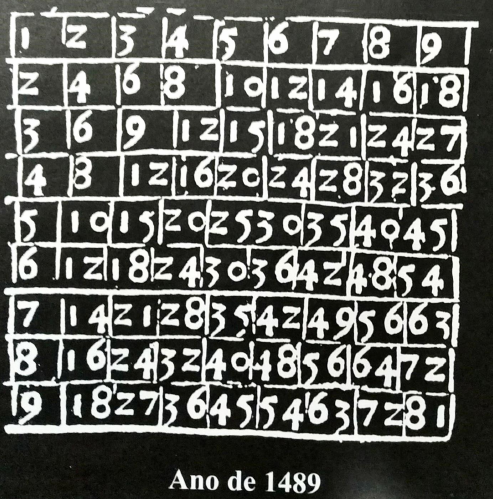
Mathematics is not magic, it is an art and it is not memorized in elementary school. How can we observe art in the multiplication table?
- The diagonal of the multiplication table is made up of the power property by 2.
- Power property $$2^2 = 4, \quad 3^2=9, \quad 4^2 = 16, \quad \dots 9^2=81$$
- The 2 multiplication table is made up of even numbers only.
- As for 3, it is interspersed between even and odd numbers.
- That of 4, in addition to just pairs, is twice the multiplication table of 2.
- The 5 ends in 0 or 5.
- The one in 6, in addition to being interspersed between even and odd numbers, is double the multiplication table in 3.
- For 7, just add the multiplication table for 6 by the line to be multiplied.
- That of 8, has the same properties as the multiplication tables of 2 and 4 and is twice the multiplication table of 4.
- Finally, 9, the ten increases from zero, while the unit decreases from 9.
The 9 multiplication table in particular:
$$\text{unidades:} ~~ 0 \rightarrow 1 \rightarrow 2 \rightarrow \dots \rightarrow 9$$$$\text{dezenas:} ~~ 9 \rightarrow 8 \rightarrow 7 \rightarrow \dots \rightarrow 0$$
For example, for \(9\times 7\) we have:
$$\text{unidades:} ~~ 0 \rightarrow 1 \rightarrow 2 \rightarrow 3 \rightarrow 4 \rightarrow 5 \rightarrow 6$$ $$\text{dezenas:} ~~ 9 \rightarrow 8 \rightarrow 7 \rightarrow 6 \rightarrow 5 \rightarrow 4 \rightarrow 3$$Therefore, the result is:
$$9\times 7 = 63$$
Multiplication Algorithms
Next we will present some multiplication algorithms. Now which choice is up to the user, because in mathematics, we have different ways of calculating and the choice is up to the person who will use it.
- Impa Portal: Multiplication
Decomposition Method
Next we will present the decomposition algorithm. For this, we take 10 x 273, observe the following method:
Now, let’s look at the next example that will serve as motivation for the method taught in traditional schools.
Remodeled Decomposition Method
Next, we will present the remodeled decomposition algorithm. For this, we take 35 x 273, observe the following method:
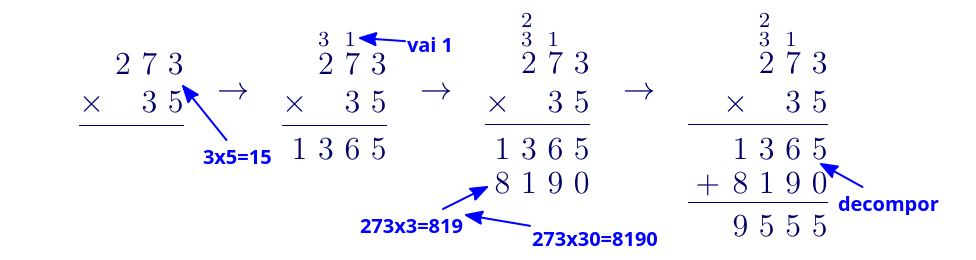
To make it easier for children to understand, teachers remove the zero and replace it with blank spaces.
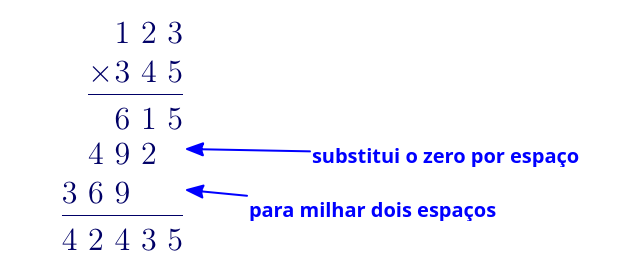
- Impa Portal: Multiplication with 2 digits
Multiplication of the Egyptians
The Egyptian numbering system was symbolic in that order did not matter. This is a disadvantage when we have very large numbers. The main arithmetic operations were addition and multiplication carried out by successive doublings.
The operations were derived from the sum, more specifically, multiplication is obtained through the successive doubling of quantities when using two columns. The first is one of the product factors we want to calculate. The algorithm is given below:
- Each row of the table is filled with twice the values of the previous row;
- The numbers on the left do not need to exceed the number to be multiplied, we must take the closest value;
- After successive duplications, we add the column on the right, in which the corresponding values from the column on the left reach the number to be multiplied.
Example: Next calculate 21 x 37
| $$2^{\text{número da linha}}$$ | $$\text{Valor multiplicado}~\times 2$$ |
|---|---|
1 |
37 |
| 2 | 74 |
4 |
148 |
| 8 | 296 |
16 |
592 |
Note that 1 + 4 + 16 = 21, for the left column. In the right column 37 + 148 + 592 = 777. Therefore,
$$21 \times 37 = 777$$Is this mysticism?
Many ask if this Egyptian method is right. But is this the case?
I, Euler, as a mathematician, must show that it is true. In fact:
$$a = a_n~.~b^n + a_{n-1}~.~b^{n-1} + a_{n-2}~.~b^{n-2} + \dots + a_{2}~.~b^{2} + a_{1}~.~b^{1} + a_0$$
Teorema:Given an integer b (base number), greater than unity (one), we have that each positive integer a can be written in a unique way given by:where each \(a_i\) belongs to the range \([0,b)\), with \(a_n\) non-zero and n greater than or equal to zero.
Without loss of generality, we take the decomposition in the binary system, that is, the base 2. In this way, we have:
$$a = a_n~.~2^n + a_{n-1}~.~2^{n-1} + a_{n-2}~.~2^{n-2} + \dots + a_{2}~.~2^{2} + a_{1}~.~2^{1} + a_0~.~2^0$$When decomposing a natural number to the base 2, the coefficients that appear are binary, that is, zero or one, as \(a_i\) belongs to the interval \([0,2)\). This is because the divisor of 2 implies a remainder of one if the number is odd and a remainder of zero if the number is even. Like \(a_i=0\) or \(a_i=1\) for every index \(i\) between 0 and \(n\).
Back to the example, observe:
$$21=16+4+1=1~.~2^4 + 0~.~2^3 + 1~.~2^2 + 0~.~2^1 + 1~.~2^0$$Now, we calculate:
$$21 \times 37 = (16+4+1)\times 37 = 592+148+37=777$$Multiplication adopted by Lucas Pacioli
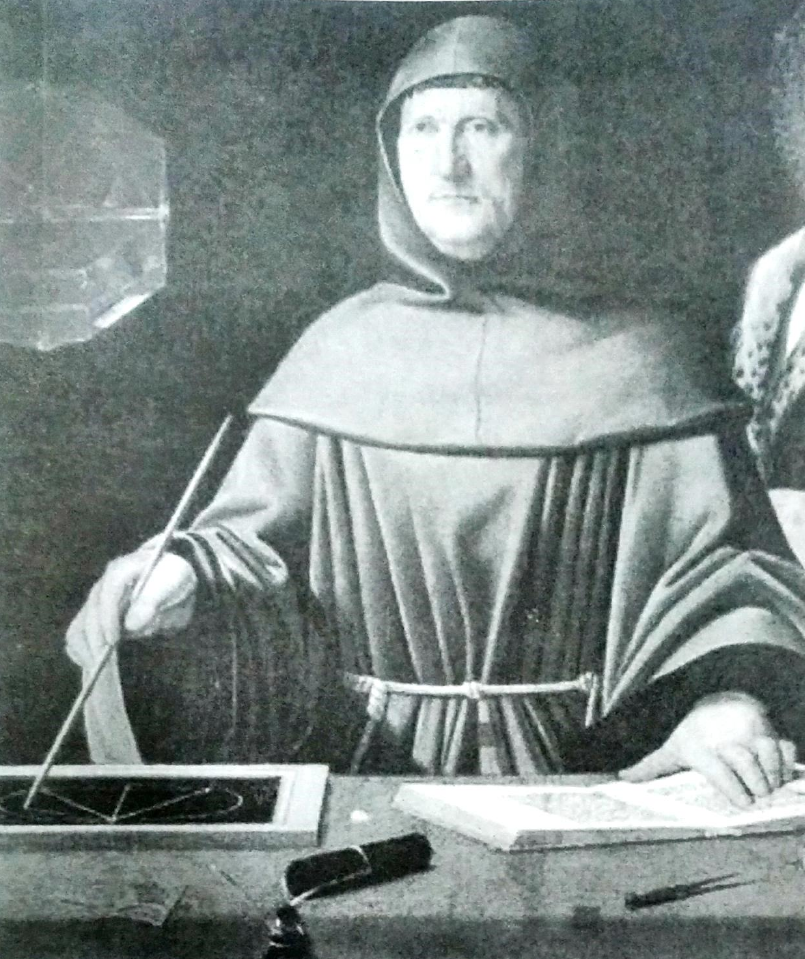
Multiplicha
Lucas Pacioli’s main work is:
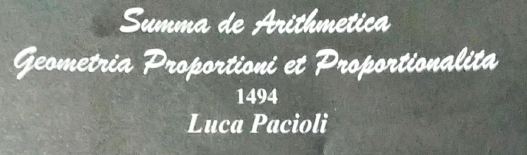
Procedure for multiplying
$$23\times 12 = 276$$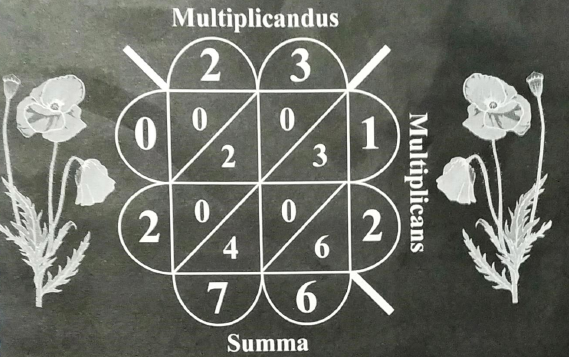
The procedure for this calculation is done as follows:
We multiply the row by the column, for example, in the first row we have \(1\times 2 = 02\) and \(1\times 3 = 03\)
Similarly, in the second line we have \(2\times 2 = 04\) and \(2\times 3 = 06\)
When we add the diagonals, we have the first diagonal \(0\), the second \(0+2+0=2\), the third \(3+0+4=7\) and the last \(6\)
Therefore, we have \(0276\), that is, \(23\times 12 = 276\)
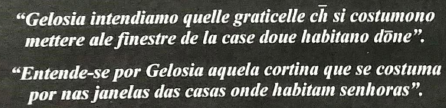
This technique became known as Gelosia, as said by Lucas Pacioli:

Another mysticism?
When we return to Lucas Pacioli’s example:
| Break down the numbers | Hundred | Ten | Unit |
|---|---|---|---|
| $$20\times 10=$$ | 2 | 0 | 0 |
| $$3\times 10=$$ | 0 | 3 | 0 |
| $$20\times 2=$$ | 0 | 4 | 0 |
| $$3\times 2=$$ | 0 | 0 | 6 |
| Total | 2 | 7 | 6 |
Visual Pacioli method (Japanese method)
To make it more educational, several YouTube videos were used to help understand Pacioli’s method. Here we will use the video by professor Luciana Fernandes:
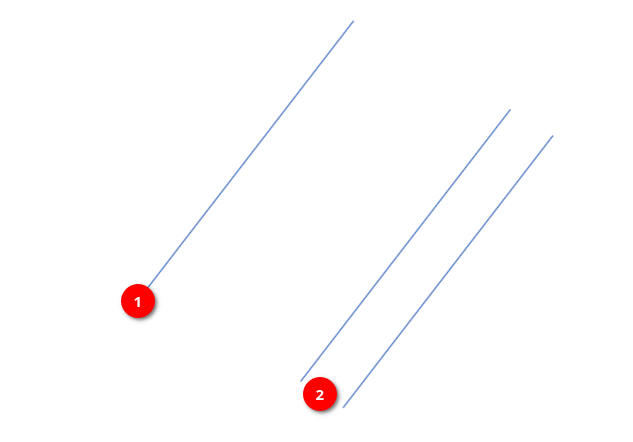
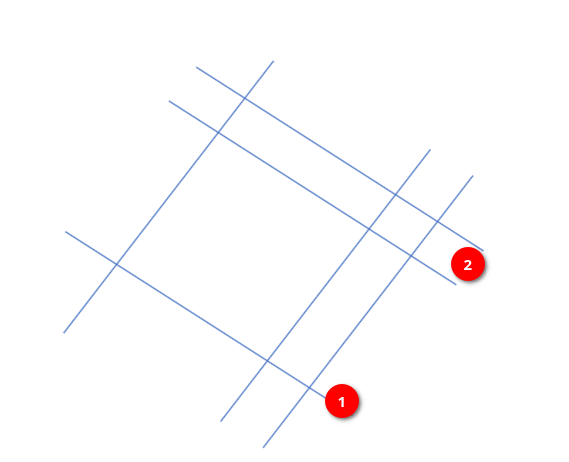
As an example we take the multiplication of \(12 \times 12\)
| Construction of 12 | Construction of the 12x12 |
|---|---|
|
|
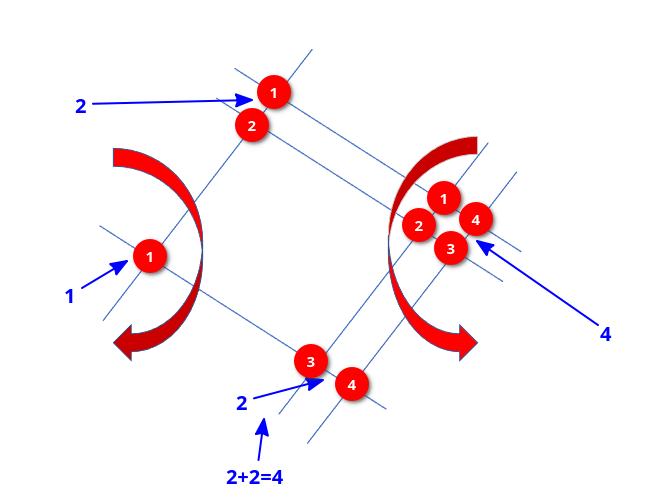
To perform multiplication we have to separate the crossings of hundreds, tens and units:
- Unit intersections (right side), we have a total of 4 intersections;
- Ten intersections (center), we have a total of 4 intersections;
- Hundred crossings (left side), we have a total of 1 crossing;
- Result 144.
| Result |
|---|
|
The important thing is to observe the semiotics of mathematics and not memorize it like a pet.
Training
Time to practice! Answer and see how many stars you get.