
Euler's Eyes
2026-11-03
EJU 2020 (2nd session) – Mathematics Course 1 solved
Source: JASSO – Mathematics paper in English, in Japanese and official answer key. Files on the page for the 2nd session of 2020.
Course 1 is the basic mathematics paper of the EJU. Each letter $\boxed{\text{A}}$, $\boxed{\text{B}}$, … is a digit from 0 to 9 or the minus sign; a group such as $\boxed{\text{BC}}$ is a two-digit number. The statements below are summarized from the official English version.
Answer key
| Question | Topic | Answers |
|---|---|---|
| I Q1 | Translated parabola | A=1, B=4, C=4, D=2, E=2, FG=48, H=6, I=8, J=2, K=9, LM=40, N=5, O=9 |
| I Q2 | Climbing a staircase | P=4, QR=35, ST=87, U=6, VW=21, XY=40 |
| II Q1 | $(m + n\sqrt2)^3$ | A=6, B=3, C=2, D=0, E=2, F=0, G=2, H=1, IJ=99, K=3, L=2 |
| II Q2 | Maximum of $\lvert x^2 - 2x\rvert$ | M=0, N=2, O=1, P=1, Q=1, R=3, S=2, T=2, U=1, V=3, W=2 |
| III | $14a + 9b = 147$ | A=3, BC=49, D=3, E=7, FG=21, H=2, I=2, J=3, K=7, L=2, M=1, N=6, O=7, P=9, Q=6, RS=14, T=7, U=2, VW=24, XY=21 |
| IV | Inscribed quadrilateral | AB=−1, C=4, DEF=180, G=4, H=5, IJK=180, L=1, M=4, N=4, OP=31, QR=16, ST=20, UV=31, WXY=100 |
Question I
Q1: a translated parabola
Statement. Let $a > 0$. Translating the graph of $y = \frac14x^2$ we obtain a parabola that meets the $x$-axis at $(-2a, 0)$ and $(4a, 0)$. Let $y = f(x)$ be its equation.
- $f(x) = \dfrac{\boxed{\text{A}}}{\boxed{\text{B}}}\left(x - \boxed{\text{C}}\,a\right)\left(x + \boxed{\text{D}}\,a\right)$.
- The values of $x$ with $f(x) \le 10a^2$ come from the inequality $x^2 - \boxed{\text{E}}\,ax - \boxed{\text{FG}}\,a^2 \le 0$, and they are $-\boxed{\text{H}}\,a \le x \le \boxed{\text{I}}\,a$.
- The segment that the line $y = 10a$ cuts off on the graph has length 10. Since $\boxed{\text{J}}\sqrt{\boxed{\text{K}}\,a^2 + \boxed{\text{LM}}\,a} = 10$, $a = \dfrac{\boxed{\text{N}}}{\boxed{\text{O}}}$.
Solution.
1. Translation does not change the leading coefficient, and the roots are $-2a$ and $4a$: $f(x) = \frac14(x - 4a)(x + 2a)$.
2. $\frac14(x^2 - 2ax - 8a^2) \le 10a^2$ gives $x^2 - 2ax - 48a^2 \le 0$, that is, $(x - 8a)(x + 6a) \le 0$, or $-6a \le x \le 8a$.
3. $f(x) = 10a$ gives $x^2 - 2ax - 8a^2 - 40a = 0$. The distance between the roots is $\sqrt{\Delta} = \sqrt{4a^2 + 4(8a^2 + 40a)} = 2\sqrt{9a^2 + 40a}$. Setting it equal to 10: $9a^2 + 40a - 25 = 0$, whose positive root is $a = \frac{-40 + 50}{18} = \frac59$.
Answers: A=1, B=4, C=4, D=2, E=2, FG=48, H=6, I=8, J=2, K=9, LM=40, N=5, O=9.
Q2: ways of climbing a staircase
Statement. A staircase has 10 steps. We can climb one step at a time or two steps at a time, but each way must be used at least once.
- Suppose we may climb two steps at a time twice or more in a row.
- If we climb two steps at a time exactly 3 times, we climb one step at a time exactly $\boxed{\text{P}}$ times, and there are $\boxed{\text{QR}}$ ways to climb.
- In all, there are $\boxed{\text{ST}}$ ways to climb.
- Suppose now that we may not climb two steps at a time twice or more in a row.
- If we climb two steps at a time exactly twice, we climb one step at a time $\boxed{\text{U}}$ times, and there are $\boxed{\text{VW}}$ ways.
- In all, there are $\boxed{\text{XY}}$ ways.
Solution. With $k$ double steps, $10 - 2k$ single steps remain. Since both kinds appear, $1 \le k \le 4$.
1. No restriction. A way to climb is a sequence with $k$ double steps and $10 - 2k$ single ones.
- (i) $k = 3$: $4$ singles, and $\binom{7}{3} = 35$ orders.
- (ii) $\binom91 + \binom82 + \binom73 + \binom64 = 9 + 28 + 35 + 15 = 87$.
2. No two consecutive double steps. Place the single steps first; the double steps go in the gaps between them (or at the ends), at most one per gap. With $s$ single steps there are $s + 1$ gaps.
- (i) $k = 2$: $6$ singles, $7$ gaps, $\binom72 = 21$.
- (ii) $k = 1$: $\binom91 = 9$; $k = 2$: $21$; $k = 3$: $4$ singles, $\binom53 = 10$; $k = 4$: $2$ singles, $\binom34 = 0$. Total $40$.
Answers: P=4, QR=35, ST=87, U=6, VW=21, XY=40.
Question II
Q1: the integer part of (m + n√2)³
Statement. Let $m$ and $n$ be positive integers with $0 < m - n\sqrt2 < 1$. Let $a$ be the integer part and $b$ the fractional part of $(m + n\sqrt2)^3$.
- We prove that $a$ is odd and that $(m - n\sqrt2)^3 = 1 - b$. If $(m + n\sqrt2)^3 = p + q\sqrt2$ with $p, q$ integers, then $p = m^3 + \boxed{\text{A}}\,mn^2$ and $q = \boxed{\text{B}}\,m^2n + \boxed{\text{C}}\,n^3$, and $(m - n\sqrt2)^3 = p - q\sqrt2$. The integer part of $(m - n\sqrt2)^3$ is $\boxed{\text{D}}$; calling its fractional part $c$, $p + q\sqrt2 = a + b$ and $p - q\sqrt2 = c$. Hence $\boxed{\text{E}}\,p - a = b + c$. The left-hand side is an integer and $\boxed{\text{F}} < b + c < \boxed{\text{G}}$, so $b + c = \boxed{\text{H}}$. Therefore $a = \boxed{\text{E}}\,p - \boxed{\text{H}}$, which is odd, and $(m - n\sqrt2)^3 = 1 - b$.
- If $a = 197$, then $p = \boxed{\text{IJ}}$, that is, $m^3 + \boxed{\text{A}}\,mn^2 = \boxed{\text{IJ}}$, and $m = \boxed{\text{K}}$, $n = \boxed{\text{L}}$.
Solution.
1. Expanding. $(m + n\sqrt2)^3 = m^3 + 3m^2n\sqrt2 + 3m\cdot2n^2 + 2\sqrt2\,n^3$, so $p = m^3 + 6mn^2$ and $q = 3m^2n + 2n^3$. Replacing $\sqrt2$ by $-\sqrt2$ gives $(m - n\sqrt2)^3 = p - q\sqrt2$.
2. The fractional parts. Since $0 < m - n\sqrt2 < 1$, its cube is also in $(0, 1)$: integer part $0$ and $c = (m - n\sqrt2)^3$. Adding the two identities, $2p = a + b + c$, or $2p - a = b + c$.
3. Why $b + c = 1$. $b$ and $c$ are in $[0, 1)$, and neither is zero (the numbers are irrational). So $0 < b + c < 2$, and since $b + c = 2p - a$ is an integer, $b + c = 1$. Thus $a = 2p - 1$ is odd and $c = 1 - b$.
4. With $a = 197$. $p = 99$, or $m(m^2 + 6n^2) = 99$. $m$ divides $99$: with $m = 1$, $6n^2 = 98$ (no); with $m = 3$, $9 + 6n^2 = 33$, $n = 2$; with $m \ge 9$, $m^2 > 99/m$. Check: $3 - 2\sqrt2 \approx 0.17$ is in $(0, 1)$, and $(3 + 2\sqrt2)^3 = 99 + 70\sqrt2 \approx 197.99$.
Answers: A=6, B=3, C=2, D=0, E=2, F=0, G=2, H=1, IJ=99, K=3, L=2.
Q2: the maximum of |x² − 2x| on a moving interval
Statement. Let $a \ge 0$. We want the maximum value $M$ of $f(x) = |x^2 - 2x|$ on $a \le x \le a + 1$, as a function of $a$, and the smallest value of $M$ for $a \ge 0$.
- Without the absolute value: if $x \le \boxed{\text{M}}$ or $x \ge \boxed{\text{N}}$,
$f(x) = x^2 - 2x$; if $\boxed{\text{M}} < x < \boxed{\text{N}}$, $f(x) = -x^2 + 2x$. The
maximum on $[a, a + 1]$ is:
- $M = \boxed{\text{P}}$ if $0 \le a \le \boxed{\text{O}}$;
- $M = -a^2 + \boxed{\text{T}}\,a$ if $\boxed{\text{O}} < a \le \dfrac{\boxed{\text{Q}} + \sqrt{\boxed{\text{R}}}}{\boxed{\text{S}}}$;
- $M = a^2 - \boxed{\text{U}}$ if $a > \dfrac{\boxed{\text{Q}} + \sqrt{\boxed{\text{R}}}}{\boxed{\text{S}}}$.
- The smallest value of $M$ for $a \ge 0$ is $\dfrac{\sqrt{\boxed{\text{V}}}}{\boxed{\text{W}}}$.
Solution.
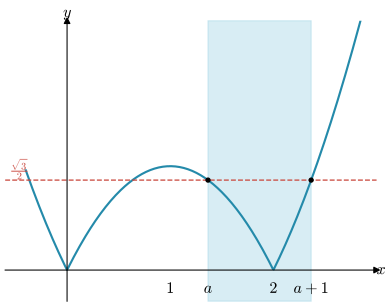
1. Without the absolute value. $x^2 - 2x = x(x - 2)$ is negative only between $0$ and $2$. So $f = x^2 - 2x$ for $x \le 0$ or $x \ge 2$, and $f = 2x - x^2$ in between. The graph has a “hill” of height 1 at $x = 1$ and rises without bound after $x = 2$.
2. Case $0 \le a \le 1$. The interval contains $x = 1$ and lies inside $[0, 2]$, where $f \le 1$. So $M = 1$.
3. Case $a > 1$. The interval starts to the right of the top of the hill. On $[a, 2]$, $f$ decreases from $f(a) = 2a - a^2$; after $2$, it rises to $f(a + 1) = (a + 1)^2 - 2(a + 1) = a^2 - 1$. The maximum is the larger of the two:
$$2a - a^2 \ge a^2 - 1 \iff 2a^2 - 2a - 1 \le 0 \iff a \le \frac{1 + \sqrt3}{2}.$$(For $a \ge 2$, $f$ is increasing on the interval and $M = a^2 - 1$, the same formula.)
4. The smallest $M$. $M = 1$ on $[0, 1]$; then $-a^2 + 2a$ decreases up to $a = \frac{1 + \sqrt3}{2}$; then $a^2 - 1$ increases. The minimum is at the switch point:
$$a^2 - 1 = \frac{4 + 2\sqrt3}{4} - 1 = \frac{\sqrt3}{2}.$$Answers: M=0, N=2, O=1, P=1, Q=1, R=3, S=2, T=2, U=1, V=3, W=2.
Question III: the equation 14a + 9b = 147
Statement. Consider the integers $a$ and $b$ with $14a + 9b = 147$ ①.
- Positive integers. Since $14a = \boxed{\text{A}}\left(\boxed{\text{BC}} - \boxed{\text{D}}\,b\right)$ and $9b = \boxed{\text{E}}\left(\boxed{\text{FG}} - \boxed{\text{H}}\,a\right)$, $a$ is a multiple of $\boxed{\text{A}}$ and $b$ is a multiple of $\boxed{\text{E}}$. With $a = \boxed{\text{A}}\,m$ and $b = \boxed{\text{E}}\,n$, ① gives $\boxed{\text{I}}\,m + \boxed{\text{J}}\,n = \boxed{\text{K}}$. The positive integers are $m = \boxed{\text{L}}$, $n = \boxed{\text{M}}$, so $a = \boxed{\text{N}}$, $b = \boxed{\text{O}}$.
- Solutions with $0 < a + b < 5$. From $14(a - \boxed{\text{N}}) = 9(\boxed{\text{O}} - b)$, and since 14 and 9 are coprime, $a = \boxed{\text{P}}\,k + \boxed{\text{Q}}$ and $b = -\boxed{\text{RS}}\,k + \boxed{\text{T}}$, with $k$ an integer. From $0 < a + b < 5$, $k = \boxed{\text{U}}$, and $a = \boxed{\text{VW}}$, $b = -\boxed{\text{XY}}$.
Solution.
1. Divisibility. $147 = 3\cdot 7^2$. So $14a = 147 - 9b = 3(49 - 3b)$; since $\gcd(14, 3) = 1$, $3 \mid a$. Likewise, $9b = 147 - 14a = 7(21 - 2a)$, and $7 \mid b$.
2. Positive. With $a = 3m$ and $b = 7n$: $42m + 63n = 147$, or $2m + 3n = 7$. With $m, n \ge 1$: $n = 1$, $m = 2$. So $a = 6$ and $b = 7$.
3. The general solution. Subtracting $14\cdot6 + 9\cdot7 = 147$ from ①: $14(a - 6) = 9(7 - b)$. Since $9 \mid 14(a - 6)$ and $\gcd(14, 9) = 1$, $a - 6 = 9k$, and then $7 - b = 14k$:
$$a = 9k + 6, \qquad b = -14k + 7.$$4. The condition. $a + b = 13 - 5k$, and $0 < 13 - 5k < 5$ gives $\frac85 < k < \frac{13}{5}$, that is, $k = 2$: $a = 24$ and $b = -21$. (Check: $336 - 189 = 147$.)
Answers: A=3, BC=49, D=3, E=7, FG=21, H=2, I=2, J=3, K=7, L=2, M=1, N=6, O=7, P=9, Q=6, RS=14, T=7, U=2, VW=24, XY=21.
Question IV: an inscribed quadrilateral
Statement. Triangle $ABC$, inscribed in circle $O$, has $AB = 2$, $BC = 3$ and $CA = 4$. We denote the area of triangle $PQR$ by $\triangle PQR$.
- $\cos\angle ABC = \dfrac{\boxed{\text{AB}}}{\boxed{\text{C}}}$.
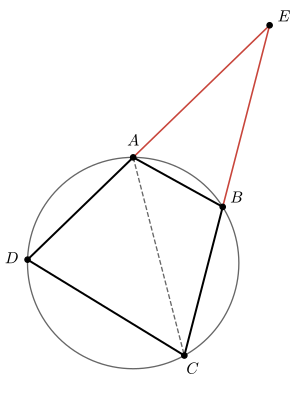
- Take $D$ on the circle, on the side of $AC$ opposite to $B$, with $\dfrac{\triangle ABD}{\triangle BCD} = \dfrac{8}{15}$ ①. We want $AD$ and $CD$. Since $\angle BAD = \boxed{\text{DEF}}^\circ - \angle BCD$, we have $\sin\angle BAD = \sin\angle BCD$, and from ①, $\dfrac{AD}{CD} = \dfrac{\boxed{\text{G}}}{\boxed{\text{H}}}$. Setting $AD = \boxed{\text{G}}\,k$ and $CD = \boxed{\text{H}}\,k$ ($k > 0$), and since $\angle ADC = \boxed{\text{IJK}}^\circ - \angle ABC$, $\cos\angle ADC = \dfrac{\boxed{\text{L}}}{\boxed{\text{M}}}$. Hence $k = \dfrac{\boxed{\text{N}}}{\sqrt{\boxed{\text{OP}}}}$, $AD = \dfrac{\boxed{\text{QR}}\sqrt{\boxed{\text{OP}}}}{\boxed{\text{OP}}}$ and $CD = \dfrac{\boxed{\text{ST}}\sqrt{\boxed{\text{OP}}}}{\boxed{\text{OP}}}$.
- If $E$ is the intersection of lines $DA$ and $CB$, $\dfrac{\triangle ABE}{\triangle CDE} = \dfrac{\boxed{\text{UV}}}{\boxed{\text{WXY}}}$.
Solution.
1. Law of cosines: $16 = 4 + 9 - 12\cos B$, so $\cos\angle ABC = -\frac14$.
2. Opposite angles. $ABCD$ is inscribed, with $B$ and $D$ on opposite sides of $AC$, so opposite angles are supplementary: $\angle BAD = 180^\circ - \angle BCD$ and $\angle ADC = 180^\circ - \angle ABC$.
3. The ratio $AD : CD$. With equal sines,
$$\frac{\triangle ABD}{\triangle BCD} = \frac{\frac12\,AB\cdot AD\sin\angle BAD}{\frac12\,CB\cdot CD\sin\angle BCD} = \frac{2\,AD}{3\,CD} = \frac{8}{15} \implies \frac{AD}{CD} = \frac45.$$4. $k$. $\cos\angle ADC = -\cos\angle ABC = \frac14$. In triangle $ADC$:
$$16 = 16k^2 + 25k^2 - 2\cdot4k\cdot5k\cdot\frac14 = 31k^2 \implies k = \frac{4}{\sqrt{31}}.$$So $AD = \frac{16}{\sqrt{31}} = \frac{16\sqrt{31}}{31}$ and $CD = \frac{20\sqrt{31}}{31}$.
5. Triangles $EAB$ and $ECD$. $E$ lies outside the circle, on the extensions of $DA$ and $CB$. The angle at $E$ is common, and $\angle EAB = 180^\circ - \angle BAD = \angle BCD = \angle ECD$. So triangles $EAB$ and $ECD$ are similar, with $AB \leftrightarrow CD$:
$$\frac{\triangle ABE}{\triangle CDE} = \left(\frac{AB}{CD}\right)^2 = \left(\frac{2\sqrt{31}}{20}\right)^2 = \frac{31}{100}.$$Answers: AB=−1 (A is the minus sign, B=1), C=4, DEF=180, G=4, H=5, IJK=180, L=1, M=4, N=4, OP=31, QR=16, ST=20, UV=31, WXY=100.