
Euler's Eyes
2026-11-02
MEXT 2019 – Mathematics (A) solved
Source: MEXT / Study in Japan – Mathematics (A) paper and official answers. Files on the past exams page.
In 2019, Mathematics (A) was the mathematics paper for all undergraduate applicants in the humanities. It lasts 60 minutes and has three fill-in questions: each box $\boxed{\text{1-1}}$, $\boxed{\text{1-2}}$, … takes a number or an expression. The statements below follow the original English.
Answer key
| Question | Topic | Answers |
|---|---|---|
| 1 | Eleven short items | see the table in the question |
| 2 | Triangle with an angle of $\frac{\pi}{12}$ | $\sqrt6;\ 6;\ 56;\ 4\sqrt2$ |
| 3 | Function defined by an integral | $-1;\ -2a, 4a;\ \frac{4a}{3}$ |
Question 1: eleven short items
| Item | Boxes | Answer |
|---|---|---|
| (1) | 1-1 | $\frac{7}{18}$ |
| (2) | 1-2 to 1-4 | $0$, $\frac{2\sqrt3}{9}$, $5$ |
| (3) | 1-5 to 1-7 | $\sin\theta(1 - \cos\theta)$, $\frac{2\pi}{3}$, $\frac{3\sqrt3}{4}$ |
| (4) | 1-8, 1-9 | $2^{k+1}$, $p$ |
| (5) | 1-10 | $\frac{17}{24}$ |
| (6) | 1-11, 1-12 | $\frac{3n^2 - 3n + 2}{2}$, $\frac{n(n^2 + 1)}{2}$ |
| (7) | 1-13, 1-14 | $2\sqrt2$, $2\sqrt2 - 1$ |
| (8) | 1-15 to 1-20 | $x$, $k$; $3$, $n$; $2n$, $3$ |
| (9) | 1-21 to 1-23 | $\sum x_k$, $5$, $5$ |
| (10) | 1-24, 1-25 | $85$, $-84$ |
| (11) | 1-26 to 1-28 | $2$, $-5$, $0$ |
Item (1)
Statement. A point $P$ moves on a line according to the result of a fair die, starting from the origin $O$:
- if 6 comes up, $P$ returns to the origin;
- if 1, 2 or 3 comes up, $P$ moves 1 unit in the positive direction;
- if 4 or 5 comes up, $P$ moves 1 unit in the negative direction.
After rolling the die four times, the probability that $P$ is at the origin is $\boxed{\text{1-1}}$.
Solution. Each roll is “up” ($\frac12$), “down” ($\frac13$) or “reset” ($\frac16$). We split by the position of the last 6.
- No 6. In 4 steps of $\pm1$ we need 2 ups and 2 downs: $\binom42\left(\frac12\right)^2\left(\frac13\right)^2 = \frac{6}{36} = \frac16$.
- Last 6 on the 4th roll. $P$ ends at the origin whatever happened before: $\frac16$.
- Last 6 on the 3rd roll. One step of $\pm1$ remains, which does not return to $0$.
- Last 6 on the 2nd roll. Two steps without a 6 remain, one in each direction: $\frac16\cdot 2\cdot\frac12\cdot\frac13 = \frac{1}{18}$.
- Last 6 on the 1st roll. Three steps of $\pm1$ remain, an odd number: impossible.
Adding up: $\frac16 + \frac16 + \frac1{18} = \frac{7}{18}$.
Answer: $\frac{7}{18}$.
Item (2)
Statement. For a constant $k$, consider the number of distinct real solutions of $x|x^2 - 3x + 2| = k$. The number of solutions is largest for $\boxed{\text{1-2}} < k < \boxed{\text{1-3}}$, and that maximum is $\boxed{\text{1-4}}$.
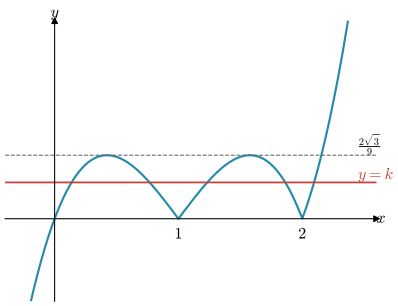
Solution. Let $h(x) = x(x - 1)(x - 2) = x^3 - 3x^2 + 2x$. Then $g(x) = x|x^2 - 3x + 2|$ equals $h$ where $(x - 1)(x - 2) \ge 0$ and $-h$ between $1$ and $2$.
- For $x < 0$, $g$ is negative and increasing.
- On $[0, 1]$, $g = h$ rises from $0$ to a local maximum and returns to $0$.
- On $[1, 2]$, $g = -h$ does the same.
- For $x > 2$, $g = h$ increases from $0$ to $+\infty$.
$h'(x) = 3x^2 - 6x + 2 = 0$ at $x = 1 \pm \frac{1}{\sqrt3}$. Since $h(1 + t) = t^3 - t$ is odd in $t$, the two local maxima of $g$ are equal: $g\left(1 - \frac{1}{\sqrt3}\right) = \frac{1}{\sqrt3} - \frac{1}{3\sqrt3} = \frac{2}{3\sqrt3} = \frac{2\sqrt3}{9}$.
For $0 < k < \frac{2\sqrt3}{9}$, the line $y = k$ crosses the graph twice in $(0, 1)$, twice in $(1, 2)$ and once in $(2, \infty)$: five solutions. In every other case there are fewer.
Answer: $0 < k < \frac{2\sqrt3}{9}$; at most $5$ solutions.
Item (3)
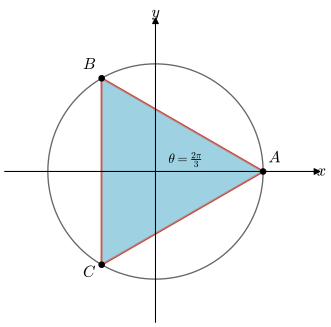
Statement. Let $0 < \theta < \pi$. For the points $A(1, 0)$, $B(\cos\theta, \sin\theta)$ and $C(\cos2\theta, \sin2\theta)$ on the unit circle, the area of triangle $ABC$ is $\boxed{\text{1-5}}$ as a function of $\theta$. At $\theta = \boxed{\text{1-6}}$, the maximum area is $\boxed{\text{1-7}}$.
Solution.
1. The area. With the center $O$, triangle $ABC$ is $[OAB] + [OBC] - [OAC]$ (the central angles are $\theta$, $\theta$ and $2\theta$):
$$S = \frac12\sin\theta + \frac12\sin\theta - \frac12\sin2\theta = \sin\theta - \sin\theta\cos\theta = \sin\theta(1 - \cos\theta).$$The formula also holds for $2\theta > \pi$, because then $\sin2\theta < 0$ and the term $-\frac12\sin 2\theta$ adds the area of $OAC$, which is now on the other side.
2. The maximum. $S'(\theta) = \cos\theta - \cos2\theta = 0$, that is, $2\cos^2\theta - \cos\theta - 1 = (2\cos\theta + 1)(\cos\theta - 1) = 0$. On $(0, \pi)$, $\cos\theta = -\frac12$, $\theta = \frac{2\pi}{3}$, and
$$S = \frac{\sqrt3}{2}\cdot\frac32 = \frac{3\sqrt3}{4}.$$It is the inscribed equilateral triangle, as expected.
Answer: $\sin\theta(1 - \cos\theta)$; $\frac{2\pi}{3}$; $\frac{3\sqrt3}{4}$.
Item (4)
Statement. Let $k$ be a positive integer and $p$ a prime greater than 2. The sum of all divisors of $2^kp$ (including $1$ and the number itself) is $\left(\boxed{\text{1-8}} - 1\right)\left(1 + \boxed{\text{1-9}}\right)$.
Solution. The divisors are $2^i$ and $2^ip$, with $0 \le i \le k$. The sum is
$$(1 + 2 + \dots + 2^k)(1 + p) = (2^{k+1} - 1)(1 + p).$$Answer: $2^{k+1}$ and $p$.
Item (5)
Statement. A box contains 10 cards numbered 1 to 10. Three cards are drawn at once and their numbers, in increasing order, are called $X, Y, Z$. The probability that $X \le 3$ is $\boxed{\text{1-10}}$.
Solution. $X > 3$ when all three cards come from $\{4, \dots, 10\}$: $\frac{\binom73}{\binom{10}{3}} = \frac{35}{120} = \frac{7}{24}$. The complement is $\frac{17}{24}$.
Answer: $\frac{17}{24}$.
Item (6)
Statement. The $n$-th term of the sequence $1, 4, 10, 19, 31, \dots$ is $\boxed{\text{1-11}}$, and the sum of the first $n$ terms is $\boxed{\text{1-12}}$.
Solution. The differences are $3, 6, 9, 12, \dots$, that is, $3k$. Hence
$$a_n = 1 + 3(1 + 2 + \dots + (n - 1)) = 1 + \frac{3n(n - 1)}{2} = \frac{3n^2 - 3n + 2}{2}.$$Summing, with $\sum_{k=1}^n k(k - 1) = \frac{(n - 1)n(n + 1)}{3}$:
$$S_n = n + \frac32\cdot\frac{(n - 1)n(n + 1)}{3} = n + \frac{n(n^2 - 1)}{2} = \frac{n(n^2 + 1)}{2}.$$(Check: $S_3 = 15 = 1 + 4 + 10$.)
Answer: $\frac{3n^2 - 3n + 2}{2}$ and $\frac{n(n^2 + 1)}{2}$.
Item (7)
Statement. Let $a, b > 0$. The expression
$$\frac{4a + b}{2a} + \frac{4a - 3b}{b}$$is smallest when $b = \boxed{\text{1-13}}\,a$, and the minimum is $\boxed{\text{1-14}}$.
Solution. Splitting the fractions: $2 + \frac{b}{2a} + \frac{4a}{b} - 3 = \frac{b}{2a} + \frac{4a}{b} - 1$. By the inequality of arithmetic and geometric means,
$$\frac{b}{2a} + \frac{4a}{b} \ge 2\sqrt{\frac{b}{2a}\cdot\frac{4a}{b}} = 2\sqrt2,$$with equality when $\frac{b}{2a} = \frac{4a}{b}$, that is, $b^2 = 8a^2$, $b = 2\sqrt2\,a$.
Answer: $b = 2\sqrt2\,a$; minimum $2\sqrt2 - 1$.
Item (8)
Statement. For a variable $x$, $(x + 1)^n = \sum_{k=0}^n \binom nk\,\boxed{\text{1-15}}^{\boxed{\text{1-16}}}$. It follows that $\sum_{k=0}^n \binom nk 2^k = \boxed{\text{1-17}}^{\boxed{\text{1-18}}}$. Differentiating the first identity with respect to $x$,
$$\sum_{k=0}^n \binom nk k\,2^k = \frac{\boxed{\text{1-19}}}{\boxed{\text{1-20}}}\sum_{k=0}^n \binom nk 2^k.$$Solution. By the binomial theorem, $(x + 1)^n = \sum\binom nk x^k$. With $x = 2$, $\sum\binom nk 2^k = 3^n$. Differentiating,
$$n(x + 1)^{n-1} = \sum_{k=0}^n \binom nk k\,x^{k-1}.$$With $x = 2$ and multiplying by $2$: $\sum\binom nk k\,2^k = 2n\cdot 3^{n-1} = \frac{2n}{3}\cdot 3^n$.
Answer: $x$, $k$; $3$, $n$; $2n$, $3$.
Item (9)
Statement. For a positive integer $n$, let $x_k$ ($k = 0, 1, \dots, n$) be integers between 0 and 5. We have
$$\sum_{k=0}^n x_k 6^k = \boxed{\text{1-21}} + \boxed{\text{1-22}}\left(\sum_{k=1}^n x_k\sum_{l=0}^{k-1}6^l\right),$$so a number in base 6 is divisible by $\boxed{\text{1-22}}$ if and only if the sum of its digits is divisible by $\boxed{\text{1-23}}$.
Solution. By the geometric series, $6^k - 1 = (6 - 1)(1 + 6 + \dots + 6^{k-1}) = 5\sum_{l=0}^{k-1}6^l$. Hence
$$\sum_{k=0}^n x_k 6^k = \sum_{k=0}^n x_k + 5\sum_{k=1}^n x_k\sum_{l=0}^{k-1}6^l.$$The second term is a multiple of 5, so the number and its digit sum leave the same remainder on division by 5. It is the base‑10 rule for 9, now in base 6.
Answer: $\sum_{k=0}^n x_k$; $5$; $5$.
Item (10)
Statement. Clearly $253x + 256y = 253(x + y) + 3y$. For the pair of integers $x, y$ with $253x + 256y = 1$ and $|x|$ smallest, $x = \boxed{\text{1-24}}$ and $y = \boxed{\text{1-25}}$.
Solution. Euclid in two steps: $256 = 253 + 3$ and $253 = 84\cdot 3 + 1$. Going back,
$$1 = 253 - 84\cdot 3 = 253 - 84(256 - 253) = 85\cdot 253 - 84\cdot 256.$$The general solution is $x = 85 + 256t$, $y = -84 - 253t$. The smallest $|x|$ is $85$ ($t = 0$; with $t = -1$, $x = -171$).
Answer: $x = 85$ and $y = -84$.
Item (11)
Statement. Translating the graph of $y = 2x^2 + 3x + 1$ by $2$ units in the $x$ direction and by $-3$ units in the $y$ direction gives $y = a_2x^2 + a_1x + a_0$. Then $a_2 = \boxed{\text{1-26}}$, $a_1 = \boxed{\text{1-27}}$ and $a_0 = \boxed{\text{1-28}}$.
Solution. Replace $x$ by $x - 2$ and $y$ by $y + 3$:
$$y + 3 = 2(x - 2)^2 + 3(x - 2) + 1 = 2x^2 - 5x + 3 \implies y = 2x^2 - 5x.$$Answer: $2$, $-5$, $0$.
Question 2: the triangle with an angle of π/12
Statement
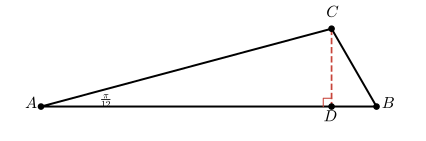
In triangle $ABC$, let $D$ be the point on side $AB$ such that $CD$ is perpendicular to $AB$. Let $\angle BAC = \frac{\pi}{12}$, $AB = 2\sqrt2$ and $AD = \sqrt6$. Simplify as much as possible.
- Since $\frac{\pi}{12} = \frac\pi3 - \frac\pi4$, $\cos\frac{\pi}{12} = \dfrac{\boxed{\text{2-1}} + \sqrt2}{4}$.
- $AC = \boxed{\text{2-2}} - 2\sqrt3$.
- $BC^2 = \boxed{\text{2-3}} - 32\sqrt3$.
- Hence $BC = \boxed{\text{2-4}} - 2\sqrt6$.
Solution
1. By the cosine of a difference,
$$\cos\frac{\pi}{12} = \cos\frac\pi3\cos\frac\pi4 + \sin\frac\pi3\sin\frac\pi4 = \frac{\sqrt2}{4} + \frac{\sqrt6}{4} = \frac{\sqrt6 + \sqrt2}{4}.$$2. In triangle $ADC$, right-angled at $D$:
$$AC = \frac{AD}{\cos(\pi/12)} = \frac{4\sqrt6}{\sqrt6 + \sqrt2} = \frac{4\sqrt6(\sqrt6 - \sqrt2)}{4} = 6 - 2\sqrt3.$$3. $CD = \sqrt{AC^2 - AD^2} = \sqrt{(48 - 24\sqrt3) - 6} = \sqrt{42 - 24\sqrt3}$, so $CD^2 = 42 - 24\sqrt3$. And $DB = AB - AD = 2\sqrt2 - \sqrt6 > 0$, with $DB^2 = 8 - 4\sqrt{12} + 6 = 14 - 8\sqrt3$. In triangle $CDB$, right-angled at $D$:
$$BC^2 = CD^2 + DB^2 = 56 - 32\sqrt3.$$4. We look for $BC = a - 2\sqrt6$ with $(a - 2\sqrt6)^2 = a^2 + 24 - 4a\sqrt6$. For the radical to become $\sqrt3$, $a$ must be a multiple of $\sqrt2$; with $a = 4\sqrt2$: $32 + 24 - 16\sqrt{12} = 56 - 32\sqrt3$. ✓ And $4\sqrt2 > 2\sqrt6$, so the value is positive.
Answer
$\sqrt6$; $6$; $56$; $4\sqrt2$.
Question 3: a function defined by an integral
Statement
For a quadratic function $f(x)$, define
$$F(x) = \int_0^x f(t)\,dt.$$Let $a > 0$, and suppose $F(x)$ has extrema at $x = -2a$ and $x = 2a$.
- For every $x$, $F(-x) = \boxed{\text{3-1}}\,F(x)$.
- The values of $x$ with $F(x) + F(2a) = 0$ are $\boxed{\text{3-2}}$.
- The local maximum of the function $\dfrac{F(x)}{F'(0)}$ is $\boxed{\text{3-3}}$.
Solution
1. What $f$ is. $F' = f$, and the extrema of $F$ are the roots of $f$. Since $f$ is quadratic with roots $\pm 2a$, $f(t) = c(t^2 - 4a^2)$ with $c \ne 0$, and
$$F(x) = c\left(\frac{x^3}{3} - 4a^2x\right).$$Only odd powers of $x$ appear, so $F(-x) = -F(x)$.
2. The equation. Since $F$ is odd, $F(x) + F(2a) = 0$ is equivalent to $F(x) = F(-2a)$. Multiplying by $\frac3c$:
$$x^3 - 12a^2x - \left(-8a^3 + 24a^3\right) = x^3 - 12a^2x - 16a^3 = (x + 2a)^2(x - 4a) = 0.$$(The double root $-2a$ was expected: the horizontal line at the height of an extremum is tangent to the graph.) The solutions are $x = -2a$ and $x = 4a$.
3. The local maximum. $F'(0) = f(0) = -4a^2c$, so
$$\frac{F(x)}{F'(0)} = \frac{12a^2x - x^3}{12a^2},$$independent of $c$. The derivative $\frac{12a^2 - 3x^2}{12a^2}$ vanishes at $x = \pm2a$ and changes from positive to negative at $x = 2a$, which is the local maximum:
$$\frac{24a^3 - 8a^3}{12a^2} = \frac{16a^3}{12a^2} = \frac{4a}{3}.$$Answer
$-1$; $x = -2a$ and $x = 4a$; $\frac{4a}{3}$.