
Euler's Eyes
2026-10-26
The life of Adrien-Marie Legendre
Timeline
- 1752Born on 18 September in Paris, into a well-off family.
- 1770At eighteen, defends a thesis in mathematics and physics at the Collège Mazarin.
- 1775Begins teaching mathematics at the École Militaire in Paris, alongside Laplace.
- 1782Wins the prize of the Berlin Academy with a study of the path of projectiles through the air.
- 1783Joins the Paris Academy of Sciences.
- 1787Takes part in the geodetic link between the observatories of Paris and Greenwich. Elected to the Royal Society.
- 1791Joins the committee that will create the metric system.
- 1793The Academy is closed. The Revolution takes away his fortune.
- 1794Publishes the Elements of Geometry.
- 1798Publishes the Essay on the Theory of Numbers.
- 1805Publishes the method of least squares.
- 1813Succeeds Lagrange at the Bureau des Longitudes.
- 1824Refuses to vote for the government’s candidate and loses his pension.
- 1825Begins publishing the Treatise on Elliptic Functions. Proves, with Dirichlet, the case n = 5 of Fermat’s last theorem.
- 1833Dies on 10 January in Paris, aged 80.
- He is born in Paris on 18 September 1752. He studies at the Collège Mazarin, where at eighteen he defends a thesis in mathematics and physics.
- He teaches mathematics to future officers, alongside Laplace. In 1782 he wins the Berlin prize on the paths of projectiles.
- With Cassini and Méchain he meets the English team to join the two chains of triangles across the Channel.
- He visits the Greenwich observatory and sees Ramsden’s great theodolite. He is elected a Fellow of the Royal Society.
- The National Institute, which replaces the Academy, meets in the Louvre. Legendre publishes his theory of numbers and least squares.
- The Institute moves into the old Collège Mazarin, where Legendre had studied. He attends it until his death on 10 January 1833.
- 1752–1770 · Collège Mazarin
- 1775–1780 · École Militaire
- 1787 · Dover
- 1787 · Greenwich and London
- 1795–1806 · Louvre
- 1806–1833 · Institut de France
A wealthy Parisian
Adrien-Marie Legendre was born on 18 September 1752, almost certainly in Paris (some documents say Toulouse), into a family of means. Very little is known about his childhood and his family, and he himself, a reserved man, hardly ever spoke about himself. He studied at the Collège Mazarin, also called the Collège des Quatre-Nations, one of the best schools in Paris, where the teaching of mathematics and physics was especially strong.
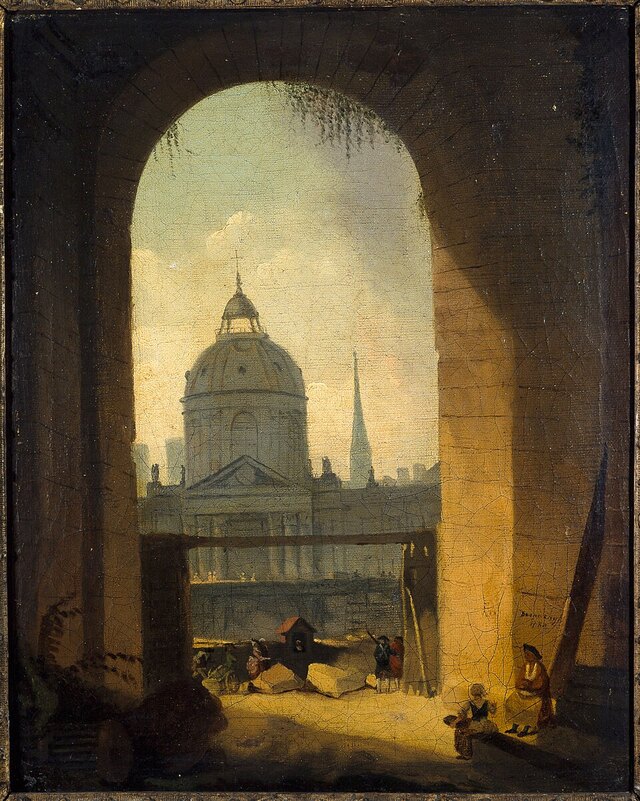
In 1770, at eighteen, he defended a thesis there in mathematics and physics. It was more a programme than a finished work: a list of the books he meant to study and of the results he hoped to prove. As he had money, he did not need a job to live on, and could devote himself to research.
The Berlin prize
Even so, between 1775 and 1780 he taught mathematics at the École Militaire in Paris, on d’Alembert’s recommendation. His colleague at the school was another young teacher with a great future, Pierre-Simon Laplace, three years his senior.
In 1782 the Berlin Academy set a prize question on the path of cannonballs and shells, taking air resistance into account. Legendre won with a study that showed how to compute the range of a projectile in a medium that slows it down. The essay caught the attention of Lagrange, then director of mathematics at the Berlin Academy, who wrote to Laplace asking who this young man was.
The following year Legendre presented to the Paris Academy of Sciences a paper on the attraction of ellipsoids, which Laplace praised, and on 30 March 1783 he was elected an associate member. When Lagrange moved to Paris in 1787, bringing the finished manuscript of the Analytical Mechanics, it was Legendre who persuaded a bookseller to publish it and who corrected the proofs.
Greenwich
In 1787 Legendre was chosen, with Jean-Dominique Cassini and Pierre Méchain, for the French part of a great scientific operation: to link the observatories of Paris and Greenwich by a chain of triangles across the Channel, so as to know exactly the difference in longitude between them. The three went to Dover and to London, where they saw the great theodolite built by Jesse Ramsden for the English side. Legendre came back with a theorem on spherical triangles that greatly simplified the calculations, and with the title of Fellow of the Royal Society of London.
The Revolution
The French Revolution began in 1789 and, at first, it gave scientists work. On 13 May 1791 Legendre joined the Academy’s committee charged with unifying weights and measures, which would create the metric system. But in 1793 the government of the Terror closed the Academy, and Legendre lost the capital he lived on. Years later he wrote to Jacobi:
I married after a bloody revolution that had destroyed my small fortune.
— Legendre, letter to Carl Jacobi
His wife, he said in the same letter, helped him to put his affairs in order and gave him the peace of mind he needed to work.
The Institute
In 1795 the Academy was reborn as the National Institute of Sciences and Arts, and Legendre was one of the six members of its mathematics section. These were the years of his books: the Elements of Geometry, of 1794; the Essay on the Theory of Numbers, of 1798; the small book on the orbits of comets, of 1805, with its appendix on least squares; and the Exercises in Integral Calculus, from 1811 to 1817.
He also held public posts. He was an examiner at the École Polytechnique, received the Legion of Honour and, in 1813, succeeded Lagrange at the Bureau des Longitudes, the body responsible for astronomical tables and navigation. In 1806 the Institute moved into the old building of the Collège Mazarin: Legendre now went as an academician to the school where he had been a pupil.
The pension
Legendre was a man of firm opinions and little diplomacy. In 1824, in an election at the Institute, he refused to vote for the candidate backed by the government. As a punishment his pension was stopped, and he spent his last years with little money to spare. Even so he went on working: between 1825 and 1828 he published the three volumes of the Treatise on Elliptic Functions and, at over seventy, completed with Dirichlet the proof of the case $n=5$ of Fermat’s last theorem.
In 1826 the young Norwegian Niels Henrik Abel, visiting Paris, was introduced to him and wrote home that Legendre was an extremely kind man, “but unfortunately as old as the stones”.
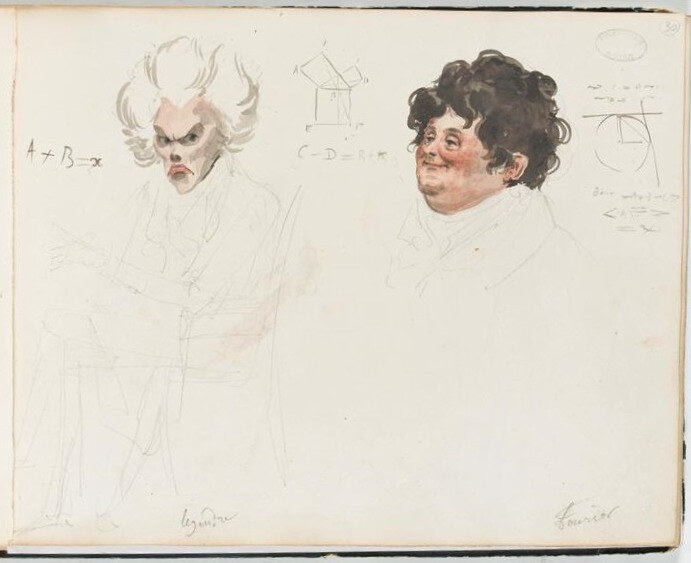
Legendre died in Paris on 10 January 1833, aged eighty, after a long illness. Poisson, who spoke at the funeral, said that his works were, in truth, his whole life.
Exercise: Legendre's ages
Legendre was born on 18 September 1752. How old was he when the Academy was closed, on 8 August 1793, and when he died, on 10 January 1833? How long did he outlive Lagrange, who died on 10 April 1813?
Both dates fall before his September birthday. In August 1793: $1793 - 1752 - 1 = 40$ years. In January 1833: $1833 - 1752 - 1 = 80$ years. From 10 April 1813 to 10 April 1832 is $19$ years, and from there to 10 January 1833 another nine months: Legendre lived almost twenty years after Lagrange.
Exercise: the year VI
The title page of the Essay on the Theory of Numbers is dated “An VI”, year VI of the French Republican calendar, whose year I began on 22 September 1792. Between which dates of our calendar did the book come out?
Year I ran from 22 September 1792 to 21 September 1793, and each following year begins one year later. Year VI began five years later, on 22 September 1797, and ended on 21 September 1798. That is why the book is usually dated 1798, though it may have come out at the end of 1797.
Sources: Legendre biography, MacTutor · Jean Itard, “Legendre, Adrien-Marie”, Dictionary of Scientific Biography · Siméon Denis Poisson, funeral oration for Legendre (1833) · Ivor Grattan-Guinness, “Work for the hairdressers: the production of de Prony’s logarithmic and trigonometric tables”, Annals of the History of Computing 12 (1990).
All topics on Adrien-Marie Legendre · The attraction of spheroids →