
Euler's Eyes
2026-11-02
MEXT 2017 – Mathematics (A) solved
Source: MEXT / Study in Japan – Mathematics (A) paper. Files on the past exams page. The official 2017 answers were not published: the answers below are ours and were checked by computer.
Mathematics (A) is the paper for undergraduate applicants in the humanities. It lasts 60 minutes and has three fill-in questions: each box $\boxed{\text{1-1}}$, $\boxed{\text{1-2}}$, … takes a number or an expression. The statements below follow the original English.
Answer key
| Question | Topic | Answers |
|---|---|---|
| 1 | Ten short items | see the table in the question |
| 2 | Scores in two subjects | $\frac{a + b}{2};\ c;\ \frac34,\ <$ |
| 3 | Two functions from their derivatives | $2x;\ x^2 - 1;\ x + 1,\ x - 1$ |
Question 1: ten short items
| Item | Boxes | Answer |
|---|---|---|
| (1) | 1-1 to 1-3 | $1$, $-2$, $2$ |
| (2) | 1-4, 1-5 | $10\sqrt3$, $\sqrt3$ |
| (3) | 1-6, 1-7 | $47$th of the $73$rd group |
| (4) | 1-8, 1-9 | $n$, $6n + 4$ |
| (5) | 1-10, 1-11 | $576$, $12$ |
| (6) | 1-12 to 1-15 | $3$, $13$; $3$, $-1$ |
| (7) | 1-16 to 1-22 | $4$, $2$, $-2$; $\frac\pi6$, $\frac{2\pi}{3}$, $\frac{5\pi}{6}$, $\frac{4\pi}{3}$ |
| (8) | 1-23 to 1-26 | $-3$, $1$; $7$, $1$ |
| (9) | 1-27 to 1-30 | $-6$, $-1$; $6$, $3$ |
| (10) | 1-31 to 1-33 | $-\frac12$, $\sqrt3$, $90$ |
Item (1)
Statement. The graph of the quadratic function $y = f(x)$ is symmetric about the line $x = 1$ and passes through the points $(0, 2)$ and $(3, 5)$. Then $f(x) = \boxed{\text{1-1}}\,x^2 + \boxed{\text{1-2}}\,x + \boxed{\text{1-3}}$.
Solution. The axis of symmetry is $x = 1$, so $f(x) = p(x - 1)^2 + q$. From the points: $p + q = 2$ and $4p + q = 5$, hence $p = 1$, $q = 1$ and $f(x) = x^2 - 2x + 2$.
Answer: $1$, $-2$, $2$.
Item (2)
Statement. A triangle has sides $5, 7, 8$. Its area is $\boxed{\text{1-4}}$ and the radius of its inscribed circle is $\boxed{\text{1-5}}$.
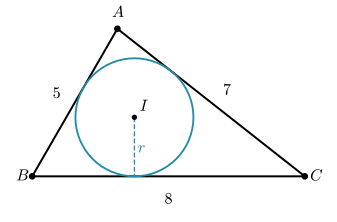
Solution. The semiperimeter is $s = 10$. By Heron’s formula,
$$S = \sqrt{10\cdot 5\cdot 3\cdot 2} = \sqrt{300} = 10\sqrt3.$$Since $S = rs$, the inradius is $r = \frac{10\sqrt3}{10} = \sqrt3$. (The angle opposite the side 7 measures $60^\circ$: $49 = 25 + 64 - 80\cos\theta$ gives $\cos\theta = \frac12$.)
Answer: $10\sqrt3$ and $\sqrt3$.
Item (3)
Statement. The natural numbers are divided into groups, with $n$ elements in the $n$-th group:
$$1 \mid 2, 3 \mid 4, 5, 6 \mid 7, 8, 9, 10 \mid 11, 12, \dots$$The number 2675 is the $\boxed{\text{1-6}}$-th element of the $\boxed{\text{1-7}}$-th group.
Solution. The $n$-th group ends at $1 + 2 + \dots + n = \frac{n(n + 1)}{2}$. Since $\frac{72\cdot 73}{2} = 2628 < 2675 \le 2701 = \frac{73\cdot 74}{2}$, the number is in group $73$, at position $2675 - 2628 = 47$.
Answer: the $47$th element of the $73$rd group.
Item (4)
Statement. For a natural number $n$,
$$\frac{1}{2\cdot5} + \frac{1}{5\cdot8} + \frac{1}{8\cdot11} + \dots + \frac{1}{(3n - 1)(3n + 2)} = \frac{\boxed{\text{1-8}}}{\boxed{\text{1-9}}}.$$Solution. Partial fractions: $\frac{1}{(3k - 1)(3k + 2)} = \frac13\left(\frac{1}{3k - 1} - \frac{1}{3k + 2}\right)$. The sum telescopes:
$$\frac13\left(\frac12 - \frac{1}{3n + 2}\right) = \frac13\cdot\frac{3n}{2(3n + 2)} = \frac{n}{6n + 4}.$$Answer: $\frac{n}{6n + 4}$.
Item (5)
Statement. There are three red balls of different sizes and three white balls of different sizes. Placing all six in a row, the number of arrangements in which at least one end is red is $\boxed{\text{1-10}}$. Placing them in a circle, alternating colors, the number of arrangements is $\boxed{\text{1-11}}$.
Solution.
1. In a row. There are $6! = 720$ rows. Both ends are white in $3\cdot2\cdot4! = 144$ of them. So $720 - 144 = 576$ have at least one red end.
2. In a circle. Rotations of the same circle count as one arrangement. Fix one red ball; the other two red balls fill the remaining red positions in $2!$ ways, and the white balls fill the three white positions in $3!$ ways: $2\cdot6 = 12$.
Answer: $576$ and $12$.
Item (6)
Statement. The solutions of $x^2 - 3x - 1 = 0$ are
$$x_1 = \frac{\boxed{\text{1-12}} + \sqrt{\boxed{\text{1-13}}}}{2}, \qquad x_2 = \frac{\boxed{\text{1-12}} - \sqrt{\boxed{\text{1-13}}}}{2}.$$The integers with $m < x_1 < m + 1$ and $n < x_2 < n + 1$ are $m = \boxed{\text{1-14}}$ and $n = \boxed{\text{1-15}}$.
Solution. By the quadratic formula, $x = \frac{3 \pm \sqrt{13}}{2}$. Since $3 < \sqrt{13} < 4$: $3 < x_1 < 3.5$ and $-0.5 < x_2 < 0$. So $m = 3$ and $n = -1$.
Answer: $3$, $13$; $m = 3$, $n = -1$.
Item (7)
Statement. To solve $\sin2x > \sqrt2\cos\left(x + \frac\pi4\right) + \frac12$ on $0 \le x < 2\pi$, we set $a = \sin x$ and $b = \cos x$ and rewrite the inequality as
$$\boxed{\text{1-16}}\,ab + \boxed{\text{1-17}}\,a + \boxed{\text{1-18}}\,b - 1 > 0.$$Factoring, the solutions are $\boxed{\text{1-19}} < x < \boxed{\text{1-20}}$ or $\boxed{\text{1-21}} < x < \boxed{\text{1-22}}$, with $\boxed{\text{1-19}} < \boxed{\text{1-21}}$.
Solution.
1. Rewriting. $\sin 2x = 2ab$ and $\sqrt2\cos\left(x + \frac\pi4\right) = \cos x - \sin x = b - a$. The inequality becomes $2ab > b - a + \frac12$, or, multiplying by 2, $4ab + 2a - 2b - 1 > 0$.
2. Factoring. $4ab + 2a - 2b - 1 = (2a - 1)(2b + 1)$. So we want $(2\sin x - 1)(2\cos x + 1) > 0$.
3. The two cases.
- Both factors positive: $\sin x > \frac12$ ($\frac\pi6 < x < \frac{5\pi}{6}$) and $\cos x > -\frac12$ ($x < \frac{2\pi}{3}$ or $x > \frac{4\pi}{3}$). Intersection: $\frac\pi6 < x < \frac{2\pi}{3}$.
- Both negative: $\sin x < \frac12$ and $\cos x < -\frac12$ ($\frac{2\pi}{3} < x < \frac{4\pi}{3}$). Intersection: $\frac{5\pi}{6} < x < \frac{4\pi}{3}$.
Answer: $4$, $2$, $-2$; $\frac\pi6 < x < \frac{2\pi}{3}$ or $\frac{5\pi}{6} < x < \frac{4\pi}{3}$.
Item (8)
Statement. Dividing $x^4 - 8x^3 + 14x^2 + 8x - 1$ by $x^2 - 5x - 2$, the quotient is $x^2 + \boxed{\text{1-23}}\,x + \boxed{\text{1-24}}$ and the remainder is $\boxed{\text{1-25}}\,x + \boxed{\text{1-26}}$.
Solution. By long division:
- $x^2\cdot(x^2 - 5x - 2) = x^4 - 5x^3 - 2x^2$; leaves $-3x^3 + 16x^2 + 8x - 1$.
- $-3x\cdot(x^2 - 5x - 2) = -3x^3 + 15x^2 + 6x$; leaves $x^2 + 2x - 1$.
- $1\cdot(x^2 - 5x - 2)$; leaves $7x + 1$.
Quotient $x^2 - 3x + 1$, remainder $7x + 1$.
Answer: $-3$, $1$; $7$, $1$.
Item (9)
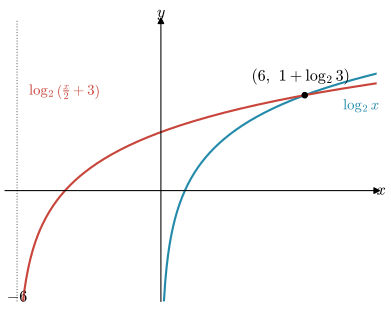
Statement. The graph of $y = \log_2 x$ is translated by $\boxed{\text{1-27}}$ units in $x$ and $\boxed{\text{1-28}}$ units in $y$, and the result is $y = \log_2\left(\frac x2 + 3\right)$. The two graphs meet at $\left(\boxed{\text{1-29}},\ 1 + \log_2\boxed{\text{1-30}}\right)$.
Solution.
1. The translation. $\log_2\left(\frac x2 + 3\right) = \log_2\frac{x + 6}{2} = \log_2(x + 6) - 1$. It is the original graph shifted by $-6$ in $x$ and $-1$ in $y$.
2. The intersection. $\log_2 x = \log_2\left(\frac x2 + 3\right)$ requires $x = \frac x2 + 3$, that is, $x = 6$, and $y = \log_2 6 = 1 + \log_2 3$.
Answer: $-6$, $-1$; $6$, $3$.
Item (10)
Statement. The vectors $\vec a$ and $\vec b$ satisfy $|\vec a| = |\vec b| = |\vec a + \vec b| = 1$. Then $\vec a\cdot\vec b = \boxed{\text{1-31}}$, $|2\vec a + \vec b| = \boxed{\text{1-32}}$, and the angle between $2\vec a + \vec b$ and $\vec b$ measures $\boxed{\text{1-33}}$ degrees.
Solution.
1. $|\vec a + \vec b|^2 = 1 + 1 + 2\vec a\cdot\vec b = 1$, so $\vec a\cdot\vec b = -\frac12$.
2. $|2\vec a + \vec b|^2 = 4 + 1 + 4\left(-\frac12\right) = 3$, so $|2\vec a + \vec b| = \sqrt3$.
3. $(2\vec a + \vec b)\cdot\vec b = 2\left(-\frac12\right) + 1 = 0$: the vectors are perpendicular, and the angle is $90^\circ$.
Answer: $-\frac12$, $\sqrt3$, $90$.
Question 2: scores in two subjects
Statement
The table shows the scores of eight students in subjects A and B.
| $x_1$ | $x_2$ | $x_3$ | $x_4$ | $x_5$ | $x_6$ | $x_7$ | $x_8$ | |
|---|---|---|---|---|---|---|---|---|
| Subject A | $c$ | $a$ | $b$ | $a$ | $b$ | $a$ | $b$ | $c$ |
| Subject B | $b$ | $b$ | $a$ | $a$ | $b$ | $a$ | $b$ | $a$ |
The scores $a$, $b$, $c$ are distinct positive integers, and the means of the two subjects are equal.
- In terms of $a$ and $b$, $c = \boxed{\text{2-1}}$.
- The mean of subject A, in terms of $c$, is $\boxed{\text{2-2}}$.
- Let $s_A^2$ and $s_B^2$ be the variances of subjects A and B. The ratio $s_A^2/s_B^2$ is $\boxed{\text{2-3}}$, so $s_A^2\ \boxed{\text{2-4}}\ s_B^2$.
Solution
1. The sums. In subject A there are two scores $c$, three $a$ and three $b$: sum $2c + 3a + 3b$. In subject B there are four $a$ and four $b$: sum $4a + 4b$. Equal means give $2c + 3a + 3b = 4a + 4b$, that is, $c = \frac{a + b}{2}$.
2. The mean. The mean of B is $\frac{4a + 4b}{8} = \frac{a + b}{2} = c$, and that of A is the same: $c$.
3. The variances. Let $d = \frac{|a - b|}{2} > 0$. Relative to the mean $c$, the scores $a$ and $b$ deviate by $d$, and the score $c$ does not deviate at all.
- Subject A: six scores at distance $d$ and two at distance $0$: $s_A^2 = \frac{6d^2}{8} = \frac34d^2$.
- Subject B: all eight scores at distance $d$: $s_B^2 = d^2$.
The ratio is $\frac34$ (the same if the sample variance divides by $n - 1$), and $s_A^2 < s_B^2$.
Answer
$c = \frac{a + b}{2}$; mean $c$; $\frac34$, and $s_A^2 < s_B^2$.
Question 3: two functions from their derivatives
Statement
The functions $f(x)$ and $g(x)$ are differentiable on $\mathbb R$ and satisfy
$$\frac{d}{dx}\{f(x) + g(x)\} = 2, \qquad \frac{d}{dx}\{f(x)^2 + g(x)^2\} = 4x,$$with $f(1) = 2$ and $g(1) = 0$.
- $f(x) + g(x) = \boxed{\text{3-1}}$.
- $f(x)\,g(x) = \boxed{\text{3-2}}$.
- $f(x) = \boxed{\text{3-3}}$ and $g(x) = \boxed{\text{3-4}}$.
Solution
1. The sum. Integrating, $f + g = 2x + C$; at $x = 1$, $2 = 2 + C$, so $f(x) + g(x) = 2x$.
2. The sum of squares. $f^2 + g^2 = 2x^2 + D$; at $x = 1$, $4 = 2 + D$, so $f^2 + g^2 = 2x^2 + 2$.
3. The product.
$$f\,g = \frac{(f + g)^2 - (f^2 + g^2)}{2} = \frac{4x^2 - 2x^2 - 2}{2} = x^2 - 1.$$4. The functions. $f(x)$ and $g(x)$ are the roots of $T^2 - 2xT + (x^2 - 1) = 0$, that is, $x + 1$ and $x - 1$. To know which is which at each $x$: $(f - g)^2 = (f + g)^2 - 4fg = 4$, so $f - g = \pm2$. Since $f - g$ is continuous and equals $2$ at $x = 1$, it equals $2$ everywhere. Hence $f(x) = x + 1$ and $g(x) = x - 1$.
Answer
$2x$; $x^2 - 1$; $f(x) = x + 1$, $g(x) = x - 1$.