
Euler's Eyes
2026-10-23
The life of Henri Poincaré
Timeline
- 1854Born on 29 April in Nancy, son of a professor of medicine.
- 1870During the Franco-Prussian War, Nancy is occupied by the German army.
- 1873Enters the École Polytechnique in first place.
- 1879As a mining engineer, investigates a coal-mine explosion. Doctorate under Hermite.
- 1880Discovers Fuchsian functions and their link with non-Euclidean geometry.
- 1881Professor at the Sorbonne. Marries Louise Poulain d’Andecy.
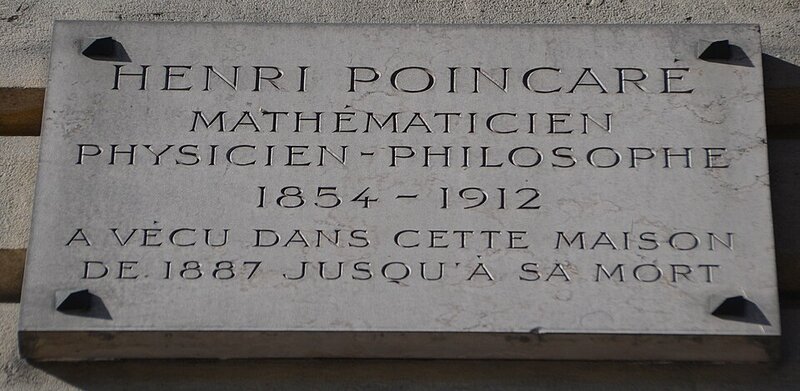
- 1887Elected to the Academy of Sciences, aged 32.
- 1889Wins King Oscar II of Sweden’s prize with a work on the three-body problem.
- 1895Publishes Analysis situs, which founds topology.
- 1905Publishes the work on the dynamics of the electron, with the Lorentz group.
- 1908Elected to the Académie française.
- 1912Dies on 17 July in Paris, aged 58.
The boy from Nancy
Jules Henri Poincaré was born on 29 April 1854 in Nancy, in Lorraine, into a distinguished family. His father, Léon Poincaré, was a professor of medicine at the local university; a cousin, Raymond Poincaré, would be President of France during the First World War. Henri had a younger sister, Aline, who would later marry the philosopher Émile Boutroux.
At five, diphtheria left his legs and throat paralysed for months. During that time he could not speak and communicated by gestures. He recovered, but remained a frail child who did not join in running games and spent his time reading. He had an extraordinary visual and auditory memory: it is said that he read a book once and remembered on which page and which line each thing appeared.
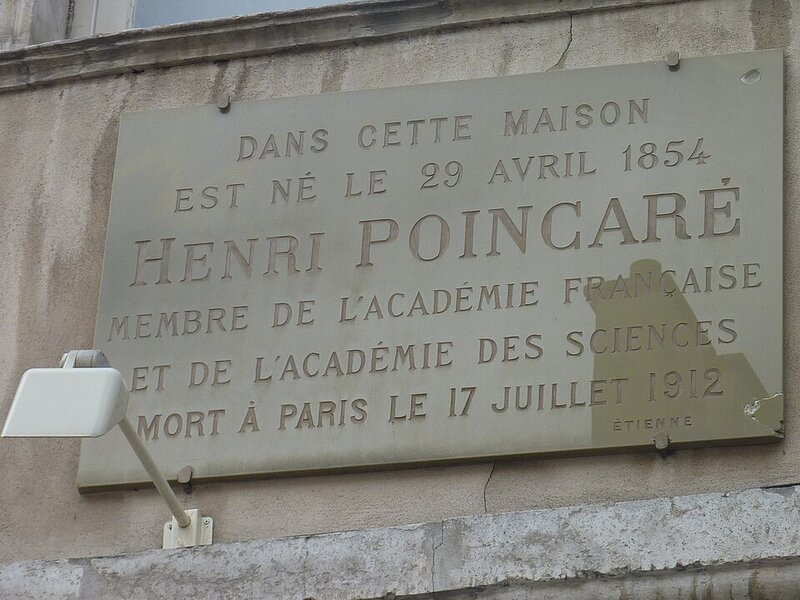
At the lycée in Nancy, which now bears his name, he was the best pupil in almost everything except drawing and physical education. When the war of 1870 broke out, Nancy was occupied by the Prussians; Henri, aged sixteen, taught himself German to read the newspapers and follow the war. He won first prize in mathematics in the Concours général, the national competition of the French lycées.
The student who took no notes
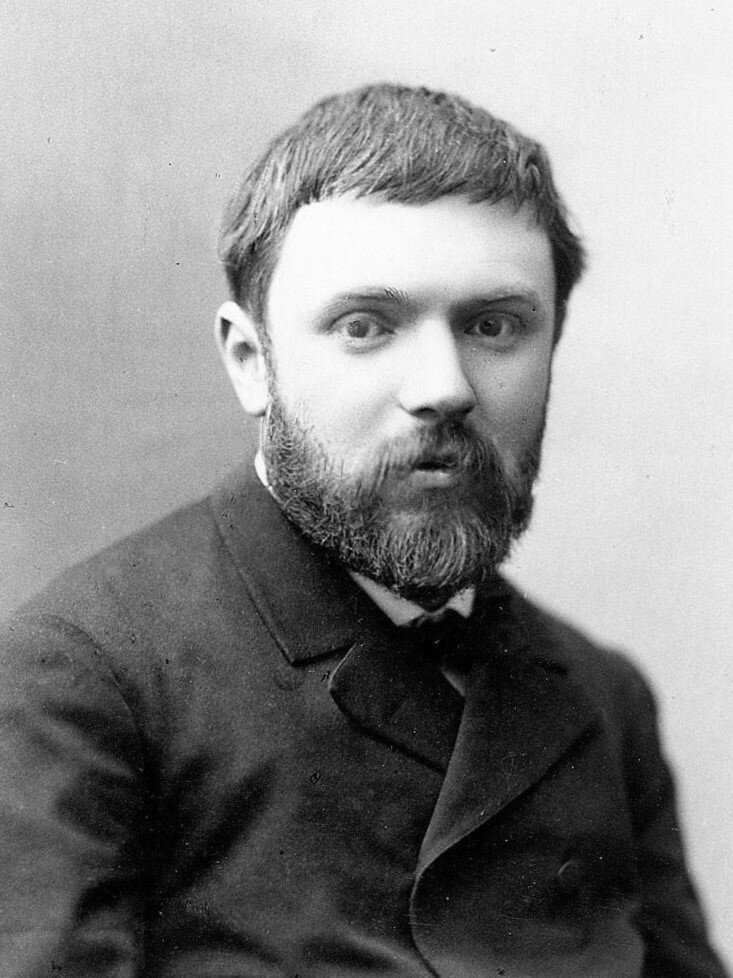
In 1873 he entered the École Polytechnique in first place. His classmates were astonished: he attended lectures with his arms folded, writing nothing, and then solved the problems in his head, pacing up and down. He left the school in second place, held back above all by his marks in drawing.
He then moved on to the École des Mines and, in 1879, became an engineer in the mining service at Vesoul. That year there was a firedamp explosion at the Magny mine that killed sixteen miners, and Poincaré went down the mine to investigate the causes. The report he wrote is meticulous and technical. He remained attached to the Corps des Mines all his life, becoming chief engineer in 1893.
The mathematician
In the same year, 1879, he defended his doctoral thesis on differential equations, supervised by Charles Hermite, and went to teach analysis at the University of Caen. There, in 1880, he made his first great discovery, the Fuchsian functions, and with it entered a friendly contest with the German Felix Klein, who was working on the same ideas. In 1881 he moved to Paris, where he would teach at the Sorbonne for the rest of his life, holding several chairs: mechanics, mathematical physics, probability, astronomy. The same year he married Louise Poulain d’Andecy; they had three daughters and a son.
In 1887, at 32, he was elected to the Academy of Sciences. Two years later he won the prize offered by King Oscar II of Sweden with a memoir on the three-body problem, and an error discovered in that memoir led him to discover chaos.
How he worked
In 1897 the psychologist Édouard Toulouse studied Poincaré for months, with interviews and tests, and published a book about him in 1910. He described a methodical man: he worked from ten to noon and from five to seven in the evening, never at night, and rarely went back to a paper once it was written. He made no detailed plans; he began writing without knowing exactly where he would end up.
Poincaré himself, in a lecture of 1908, described how ideas came to him. After days of conscious effort without result he would set the problem aside; the solution would appear suddenly, on a walk or while stepping onto a bus, with a feeling of absolute certainty. Conscious work served to prepare the ground and, afterwards, to verify what the unconscious had found.
The last years
In the 1900s Poincaré was a public figure. He wrote books of popular philosophy, such as Science and Hypothesis (1902), The Value of Science (1905) and Science and Method (1908), which were translated into many languages and sold in the tens of thousands. He served as an expert in the Dreyfus affair, presided over the Astronomical Society of France and the Bureau des Longitudes, and in 1908 was elected to the Académie française, the academy of letters.
In 1911 he took part in the first Solvay Conference in Brussels, alongside Einstein, Marie Curie and Planck, where the new physics of quanta was discussed. In 1912, already ill, he published a paper on a theorem of geometry he could not prove, explaining that at his age he might not have time to finish it; the American George Birkhoff proved it the following year. In July 1912 he had a prostate operation; it seemed to have gone well, but an embolism killed him on 17 July, aged 58. He is buried in the Montparnasse cemetery, in the Boutroux family tomb.
Exercise: Poincaré's ages
Poincaré was born on 29 April 1854. How old was he when he entered the École Polytechnique at the end of 1873, when he was elected to the Academy of Sciences in January 1887, and when he died on 17 July 1912?
At the end of 1873, after his April birthday: $1873 - 1854 = 19$ years. In January 1887, before his birthday: $1887 - 1854 - 1 = 32$ years. In July 1912, after his birthday: $1912 - 1854 = 58$ years.
Exercise: the cost of the prize
The prize was 2,500 crowns and the reprint cost 3,585. What was Poincaré’s loss? How many times the prize did the reprint cost?
The loss was $3\,585 - 2\,500 = 1\,085$ crowns, and the reprint cost $\frac{3\,585}{2\,500} \approx 1.43$ times the prize. Few mathematicians have paid so dearly for a mistake, and few mistakes have yielded so much.
Sources: Jeremy Gray, Henri Poincaré: A Scientific Biography (2013) · Ferdinand Verhulst, Henri Poincaré: Impatient Genius (2012) · Édouard Toulouse, Henri Poincaré (1910) · Poincaré biography, MacTutor · June Barrow-Green, Poincaré and the Three Body Problem (1997).
All topics on Henri Poincaré · Fuchsian functions and hyperbolic geometry →