Euler's Eyes
2026-10-29
A woman at the university: the speech of 1727 and the chair at Bologna
Oratio qua ostenditur artium liberalium studia a femineo sexu neutiquam abhorrere.
— Title of Agnesi's speech, 1727
The Latin sentence means: “A speech in which it is shown that the study of the liberal arts is by no means unsuited to the female sex”. Agnesi was nine when she recited it before her father’s guests, in 1727. The text had been written in Italian by one of her teachers; she translated it into Latin and learned it by heart.
The liberal arts
The “liberal arts” were the subjects that, since the Middle Ages, had formed the basis of higher education: grammar, rhetoric and logic on one side; arithmetic, geometry, astronomy and music on the other. They were the subjects of the universities, and the universities were for men. The speech of 1727 argued that nothing in women’s nature prevented a woman from learning them, and recalled the learned women of antiquity and of recent history.
A few exceptions
In eighteenth-century Italy, a few women had managed to break through. In 1678, Elena Cornaro Piscopia received a doctorate in philosophy at Padua, the first ever awarded to a woman. In 1732, the University of Bologna gave a doctorate to the twenty-year-old Laura Bassi, and soon after a chair of natural philosophy; she would become one of the great popularizers of Newton’s physics in Italy.
Outside Italy, the Frenchwoman Émilie du Châtelet published the Institutions de physique in 1740 (the title is similar to that of Agnesi’s Instituzioni, and not by chance: both books aimed to be textbooks) and spent her last years translating Newton’s Principia into French, in a translation still in use today.
The pope and the chair
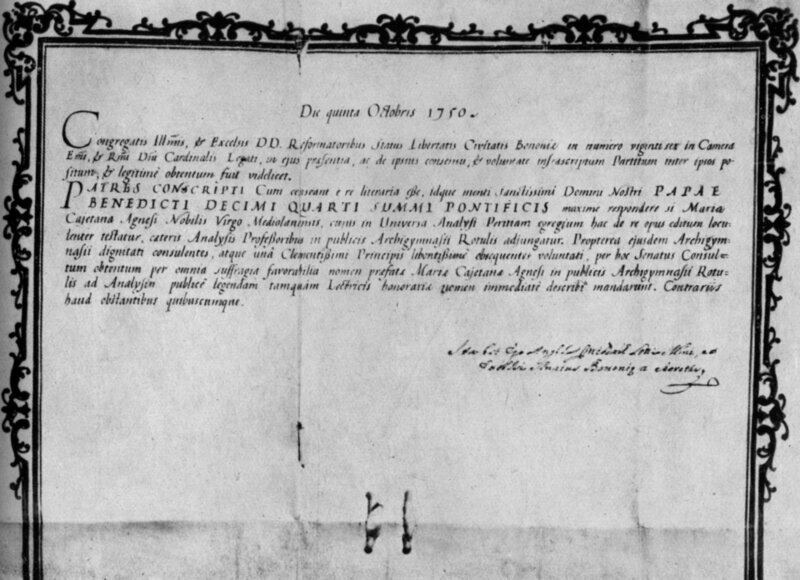
Bologna had a powerful ally. Prospero Lambertini, archbishop of the city, was elected pope in 1740 under the name Benedict XIV and went on protecting the university and its Institute of Sciences. It was he who supported Laura Bassi and, in 1750, after reading the Instituzioni, appointed Agnesi to the chair of mathematics.
Agnesi gave thanks and accepted the title, but she never left Milan to teach. The appointment stayed in the university’s records for about 45 years, as an honour. For many historians, the episode shows at once the recognition and its limits: a woman could be honoured with a chair, but nobody really expected her to stand in a lecture room full of young men.
Exercise: the date in Roman numerals
The title page of the Instituzioni carries the date MDCCXLVIII. What year is it? And how would the year of Agnesi’s death, 1799, be written?
M = 1000, D = 500, CC = 200, XL = 40 (10 before 50), VIII = 8. Total: $1000 + 500 + 200 + 40 + 8 = 1748$. For 1799: M (1000) + DCC (700) + XC (90) + IX (9) = MDCCXCIX.
Exercise: three dates
Elena Cornaro Piscopia received her doctorate in 1678, Laura Bassi in 1732, and Agnesi was appointed at Bologna in 1750. How many years separate each pair of dates? And how many years passed from 1750 to the first woman elected to the Paris Academy of Sciences, in 1979?
From 1678 to 1732: 54 years. From 1732 to 1750: 18 years. From 1678 to 1750: 72 years. From 1750 to 1979: 229 years.
Sources: Maria Gaetana Agnesi, Oratio qua ostenditur artium liberalium studia a femineo sexu neutiquam abhorrere (1727) · Paula Findlen, “Science as a Career in Enlightenment Italy: The Strategies of Laura Bassi”, Isis 84 (1993) · Massimo Mazzotti, The World of Maria Gaetana Agnesi, Mathematician of God (2007) · Judith P. Zinsser, La Dame d’Esprit: A Biography of the Marquise du Châtelet (2006).
All topics on Maria Gaetana Agnesi · ← The witch in statistics · The legacy of Maria Gaetana Agnesi →