
Euler's Eyes
2022-07-10
Even and odd numbers
The doubles dance


To define who starts in a football match, hide and seek, among others, children use the odd and even game. Who has never used odd and even for hand games. The first use of this concept was in ancient Greece, with the Pythagorean school.
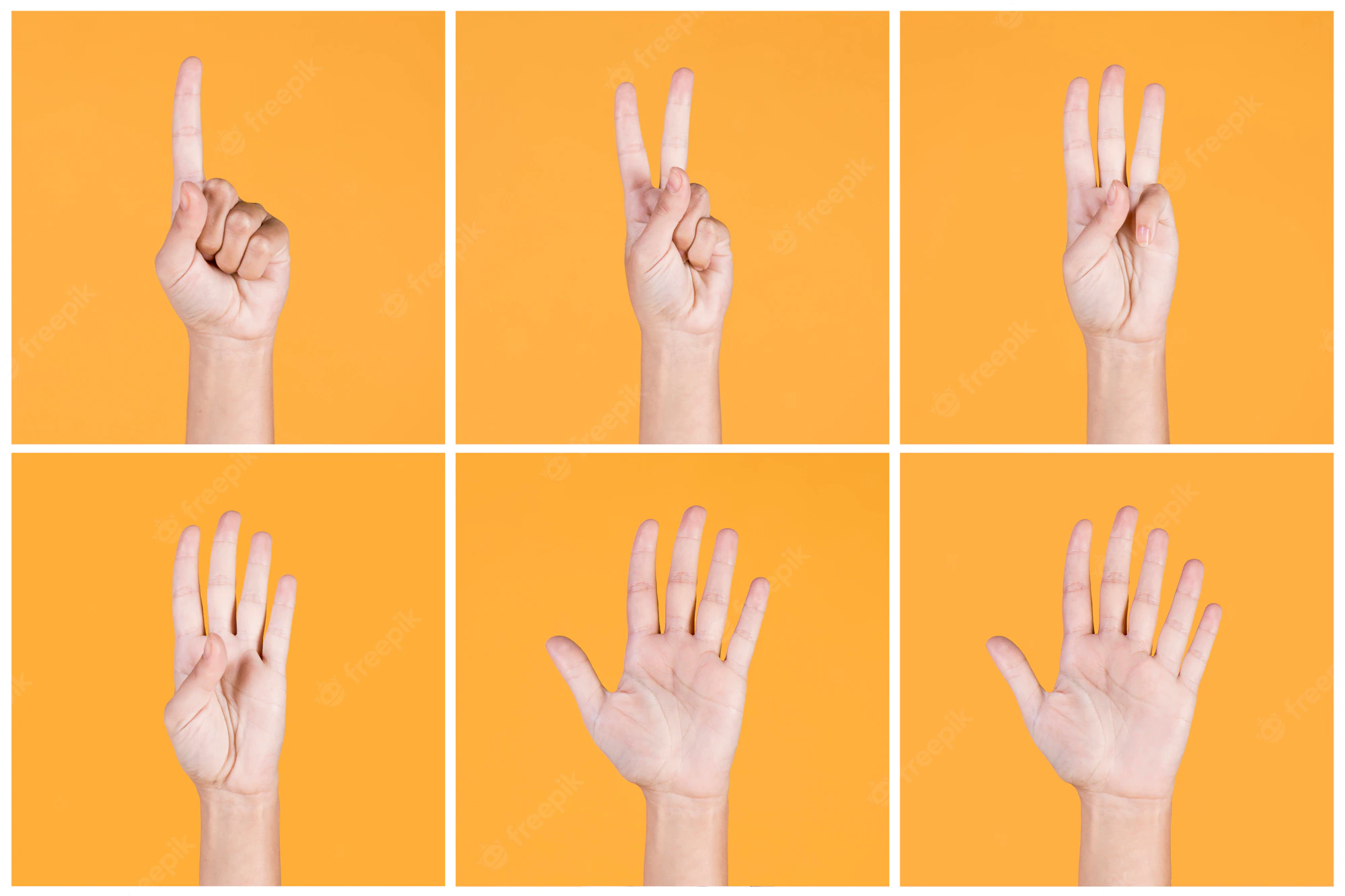
The idea was used to define:
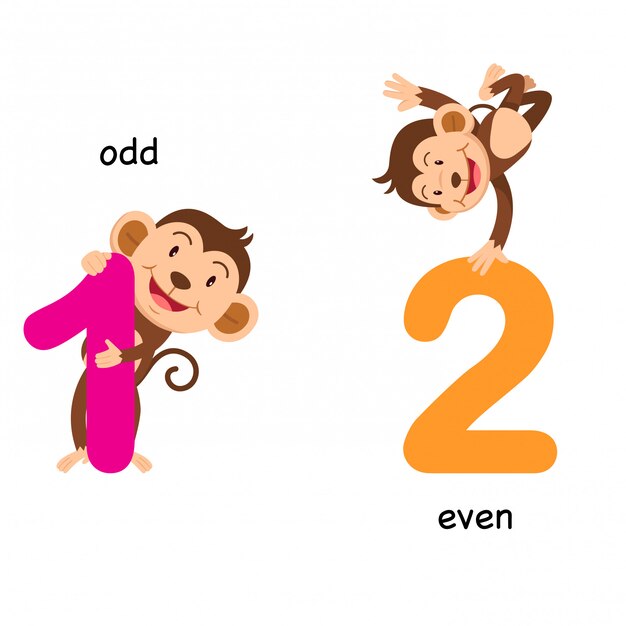
- par: as something that can be shared in equal parts.
- odd: as something that cannot be shared in equal parts.
Help us build the math website. Donate as much as you can.

Definition of odd and even numbers
An important observation is that:
Every even number is divisible by 2.
In this way, we can observe that the numbers are grouped two by two. In effect:
Pair
$$6 = (1+1) + (1+1) + (1+1) = 3 \times (1+1) = 2\times 3 $$Odd
$$7 = (1+1) + (1+1) + (1+1) + 1 = 3 \times (1+1) + 1 = 2\times 3 + 1$$
General way of defining odd and even numbers
In general, even and odd numbers can be represented as:
Pair
$$n= 2q $$Odd
$$n = 2q + 1$$for all \(q\) a natural number
.
For the particular case for n equal to 3 we have:
$$7 = 2\times 3 + 1 = 2 q + 1 $$$$6 = 2\times 3 = 2 q $$
Set of odd and even numbers
The set of natural numbers can be represented as two disjoint sets consisting of evens and odds:
$$\mathbb{N} = \{0, 1, 2 , 3, 4, \dots\}$$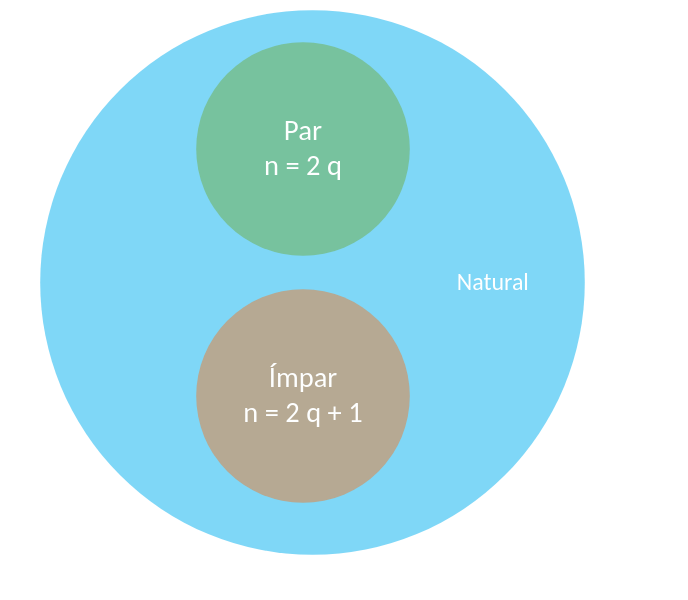
| Natural $$\mathbb{N}$$ | Pair $$n = 2q$$ | Odd $$n = 2q+1$$ |
|---|---|---|
| 0 | 0 | 1 |
| 1 | 2 | 3 |
| 2 | 4 | 5 |
| 3 | 6 | 7 |
| 4 | 8 | 9 |
| 5 | 10 | 11 |
| $$\vdots$$ | $$\vdots$$ | $$\vdots$$ |
The games use odd and even numbers and are widely used in everyday life.

Peer ownership
An important property to keep in mind is that the sum or difference between pairs is even. For example:
- 12 + 6 = 18
- 4 + 2 = 6
- 12 - 6 = 6
- 4 - 2 = 2
The sum or difference of two odd numbers is even. For example:
- 3 + 1 = 4
- 9 + 3 = 12
- 3 - 1 = 2
- 9 - 3 = 6
As a mathematician is the same as Saint Thomas, we have to see it to believe it. So let’s prove if it’s true.
Proposition: The sum or difference between two even numbers is even. Just like the sum or difference between two odd numbers is even.
Demo:
Let a and b be two natural numbers of the same type (even, even) or (odd, odd).
- Case 1:
Let us suppose the two pairs (pair, pair). Then there are two natural numbers n and m, such that:
With this, we have the sum:
$$a + b = 2n + 2m = 2(n+m)= 2q \quad \text{com q natural}$$As q is natural, we have:
$$a+b \quad \text{é par}$$The difference is obtained in an analogous way.
- Case 2:
Now, let’s suppose the two pairs (odd, odd). Then there are two natural numbers n and m, such that:
With this, we have the sum:
$$a + b = 2n + 1 + 2m + 1 = 2(n+m+1)= 2p \quad \text{com p natural}$$As q is natural, we have:
$$a+b \quad \text{é par}$$In the same way as in the 1 case, the difference is obtained in a similar way. \(\square\)
Another important result is the sum or difference of even and odd numbers is odd. For example:
- 3 + 2 = 5
- 9 + 4 = 13
- 3 - 2 = 1
- 9 - 4 = 5
The general result is the following:
Proposition: The sum or difference between a pair (even, odd) is odd.
Demo:
Exercise. \(\square\)
These are the main concepts of even and odd numbers. Wait for the next posts.