
Euler's Eyes
2026-10-20
Sine function: definition, signs and graph
The height of the point
If the image of the real $x$ in the cycle is $P=(u,v)$, we define $\sin x=v$. The sine is the vertical, signed coordinate, not the unsigned distance to the horizontal axis.
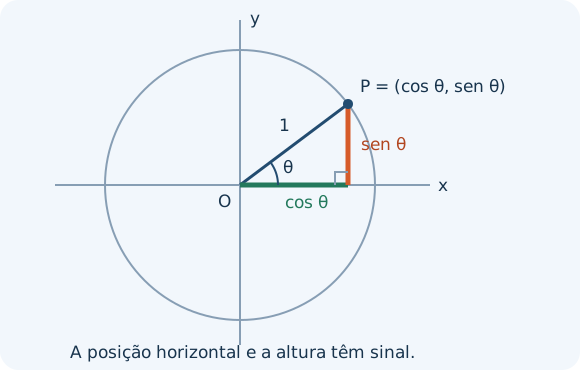
Any real has an image in the cycle. The height varies from $-1$ to 1, including the extremes. Therefore:
$$\operatorname{Dom}(\sin)=\mathbb R,\qquad\operatorname{Im}(\sin)=[-1,1].$$In each turn, the sine is positive in the upper semicircle and negative in the lower one. Its zeros are $x=k\pi$, to $k\in\mathbb Z$.
A turn of the graph
| $x$ | $0$ | $\pi/2$ | $\pi$ | $3\pi/2$ | $2\pi$ |
|---|---|---|---|---|---|
| $\sin x$ | $0$ | $1$ | $0$ | $-1$ | $0$ |
The sine increases from $-1$ to 1 in each interval $[-\pi/2+2k\pi,\pi/2+2k\pi]$ and decreases from 1 to $-1$ in $[\pi/2+2k\pi,3\pi/2+2k\pi]$. These sections, repeated, form the sinusoid.
Demonstration of two properties
Reflection on the horizontal axis transforms the image of $x$ into that of $-x$, maintaining the horizontal coordinate and inverting the vertical. Like this:
$$\sin(-x)=-\sin x.$$Therefore, the sine is an odd function. A complete turn preserves the point, therefore $\sin(x+2\pi)=\sin x$. The smallest positive period is $2\pi$, as the maximum height 1 only reappears after a complete revolution.
Maximums occur at $x=\pi/2+2k\pi$; the minimum ones, in $x=3\pi/2+2k\pi$.
Read a transformation
At $h(x)=4+3\sin x$, the midline is 4 and the amplitude is 3. The image is $[1,7]$. The period remains $2\pi$, as adding a constant or multiplying the output does not change the time required to complete the pattern.
In everyday life
- Music. The A note on the tuning fork is a sinusoid of 440 cycles per second; Higher notes have a shorter period.
- Sea waves. The profile of a regular wave, far from the beach, approaches a sinusoid; the amplitude is half the distance between the crest and the valley.
- Vibration of the cell phone. The little motor that makes the cell phone vibrate produces a back and forth movement described by a sine.
Exercises with resolution
1. Calculate $\sin(7\pi/2)$.
Check resolution 1
Remove one turn: $7\pi/2-2\pi=3\pi/2$. The sine is $-1$.
2. What is the image of $f(x)=2-5\sin x$?
Check resolution 2
Like $-1\le\sin x\le1$, we have $-5\le-5\sin x\le5$ and $-3\le f(x)\le7$. The image is $[-3,7]$.
In the interactive book
The same subjects, with all the demonstrations and the complete list of exercises, are in the interactive Trigonometry book:
This class is a shorter introduction to the topic; In the book, the theory is accompanied by solved and proposed exercises from the chapter.