
Euler's Eyes
2026-10-10
Ceres and the least squares method
On January 1, 1801, astronomer Giuseppe Piazzi, in Palermo, discovered a tiny dot that moved among the stars: it was Ceres, today classified as a dwarf planet. Piazzi accompanied him for 41 days, until it disappeared in the Sun’s glare. With so few observations, no one knew how to calculate the orbit, and Ceres seemed lost forever.
Gauss, at 24 years old, created a new method and calculated the orbit in a few weeks. On the night of 31 December 1801, astronomer Franz von Zach pointed the telescope where Gauss indicated, and there it was Ceres.
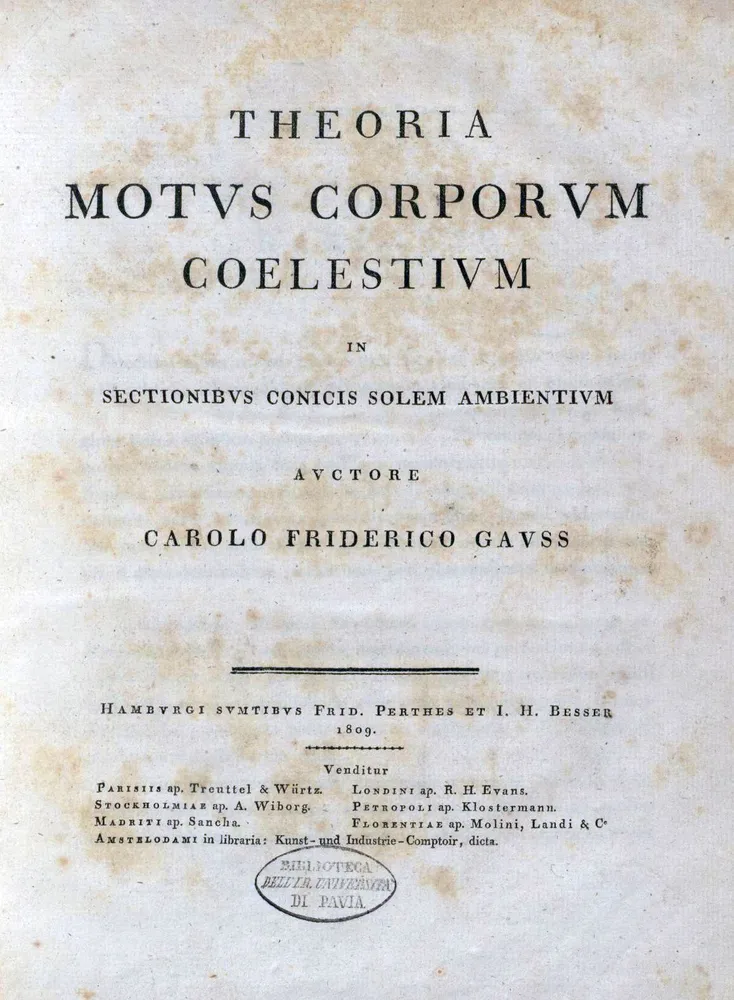
Part of the secret was dealing with measurement errors. Every observation has a small error. If you measure the same thing several times and finds different values, which number to choose?
Gauss’s answer: the number $c$ that makes the sum of the squares of the errors minimum. With measurements $x_1, x_2, \ldots, x_n$, the sum is
Opening the squares, a 2nd degree function appears in $c$:
The graph is a parabola with the mouth facing upwards, and the lowest point is the vertex, in $c = -\frac{b}{2a}$:
It’s the average! The least squares method explains why the mean is the best estimate. And he will beyond: used to find the straight line (or orbit) that passes closest to many points at the same time.
All topics by Carl Friedrich Gauss · ← Counting prime numbers · The normal curve, the Gaussian bell →