
Euler's Eyes
2026-09-26
ENEM 2021 – Solved mathematics: questions 136 to 150
Source: INEP – proof and template of the 2nd day, Notebook 5 – Yellow (1st application).
The ENEM Mathematics and Technologies test 2021 was administered on the 2nd day and will from question 136 to 180. This post addresses questions 136 to 150. The numbering used here is that of the Notebook 5 – Yellow; us In other notebooks the same questions appear in a different order.
Template
| Question | Subject | Template |
|---|---|---|
| 136 | Roman numeral system | D |
| 137 | Addition in binary base | D |
| 138 | Area and subdivision units | C |
| 139 | Combinatorial analysis: combinations | A |
| 140 | Cost per user (comparison) | B |
| 141 | Percentage: heart rate | D |
| 142 | Fewer number of washes (inequality) | C |
| 143 | Discounts: lower expense | C |
| 144 | Spatial geometry: faces of the structure | A |
| 145 | Octahedron flattening | E |
| 146 | Perimeter of equilateral triangle | D |
| 147 | Volume of the cone frustum | C |
| 148 | Areas of flat figures and cost | E |
| 149 | Dimensional analysis | B |
| 150 | Linear system: baggage mass | B |
Question 136: Year of foundation in Roman numerals
Statement
The Roman numeral system is still used to indicate chapters and volumes of books, in the designation of centuries and, in chronological order, of popes and kings of the same name. Seven letters of the alphabet are used:
Four fundamentals: I (worth 1); X (value 10); C (worth 100) and M (worth 1 000).
Three secondaries: V (worth 5); L (worth 50) and D (worth 500).
The rules for writing Roman numerals are:
- There is no symbol corresponding to zero;
- Fundamental symbols can be repeated up to three times and their values are added. Example: XXX = 30;
- A letter placed to the left of another with a higher value indicates subtraction of the respective values. Example: IX = 10 − 1 = 9;
- A letter placed to the right of another with a higher value indicates addition of the respective values. Example: XI = 10 + 1 = 11.
In a European city there is a sign indicating the year of its foundation: MCDLXIX.
How many years since the founding of this city will this city celebrate in 2050?
- A) 379
- B) 381
- C) 579
- D) 581
- E) 601
Resolution
1. Separate the number into blocks. We read from left to right, joining the pairs in which a smaller letter comes before a larger one (rule 3):
$$\text{M} \mid \text{CD} \mid \text{L} \mid \text{X} \mid \text{IX}$$2. Value of each block:
- M = 1 000;
- CD = 500 − 100 = 400 (C before D indicates subtraction);
- L = 50;
- X = 10;
- IX = 10 − 1 = 9.
3. Add:
$$1000 + 400 + 50 + 10 + 9 = 1469$$The city was founded in 1469.
4. Years founded in 2050:
$$2050 - 1469 = 581$$Answer: alternative D (581).
Be careful with the catch: whoever reads CDs like $100 + 500 = 600$ finds the year 1669 and the answer 381 (alternative B). And whoever forgets the isolated X and reads only “L” and “IX” reach 1459 and 591, which are not in the alternatives.
Question 137: Sum in binary base
Statement
One of the most used bases to represent a number is the decimal base. However, computers work with numbers in binary base. On that basis, any natural number is represented using only the digits 0 and 1. By For example, the representations of the numbers 9 and 12, in binary base, are 1001 and 1100, respectively. The addition operation, in binary base, follows an algorithm similar to that used in the decimal base, as detailed in the table:
| a | b | a + b |
|---|---|---|
| 0 | 0 | 0 |
| 0 | 1 | 1 |
| 1 | 0 | 1 |
| 1 | 1 | 10 |
For example, in binary base, the sum of the numbers 10 and 10 is 100, as shown:
Considering the text information, the result of adding 9 + 12 will be represented, in binary base, by
- A) 101.
- B) 1101.
- C) 1111.
- D) 10101.
- E) 11001.
Resolution
Path 1: add to decimal and convert. $9 + 12 = 21$. To write 21 in binary, we decompose it into powers of 2:
$$21 = 16 + 4 + 1 = 1 \cdot 2^4 + 0 \cdot 2^3 + 1 \cdot 2^2 + 0 \cdot 2^1 + 1 \cdot 2^0$$The coefficients, from highest exponent to lowest, form the binary number $10101$.
Path 2: add directly in binary. We add $1001 + 1100$ column by column, from right to left, using the frame ($1 + 1 = 10$, “go 1”):
- 1st column: $1 + 0 = 1$;
- 2nd column: $0 + 0 = 0$;
- 3rd column: $0 + 1 = 1$;
- 4th column: $1 + 1 = 10$: write 0 and “vai 1”, which becomes the front digit.
Both paths give the same result.
Answer: alternative D (10101).
Be careful with the trick: whoever adds column to column and forgets the “go 1” in the last column write 0101 = 101 (alternative A).
Question 138: Sale of land in hectares
Statement
A common unit of measurement used to express land areas of large dimensions is the hectare, which is equivalent to 10 000 m². A farmer decides to make a subdivision using 3 hectares of your farm, of which 0,9 hectare will be used for the construction of streets and sidewalks and the remainder will be divided into land with an area of 300 m² each. The 20 first plots of land sold will have promotional prices of R$ 20 000,00 each, and the others, R$ 30 000,00 each.
Under the established conditions, the total value, in reais, obtained by the farmer with the sale of all land will be equal to
- A) 700 000.
- B) 1 600 000.
- C) 1 900 000.
- D) 2 200 000.
- E) 2 800 000.
Resolution
1. Area left over for land. Excluding streets and sidewalks:
$$3 - 0{,}9 = 2{,}1 \text{ hectares} = 2{,}1 \cdot 10\thinspace 000 = 21\thinspace 000 \text{ m}^2$$2. Number of plots. Each plot has 300 m²:
$$\frac{21\thinspace 000}{300} = 70 \text{ terrenos}$$3. Sale value. The first 20 cost R$ 20 000,00 and the others $70 - 20 = 50$ come out at R$ 30 000,00:
$$20 \cdot 20\thinspace 000 + 50 \cdot 30\thinspace 000 = 400\thinspace 000 + 1\thinspace 500\thinspace 000 = 1\thinspace 900\thinspace 000$$Answer: alternative C (R$ 1 900 000).
Be careful with the trick: whoever forgets to discount the streets uses the 30 000 whole m², finds 100 land and arrives at $400\thinspace 000 + 80 \cdot 30\thinspace 000 = 2\thinspace 800\thinspace 000$ (alternative E).
Question 139: Costumes with fabrics and stones (combinations)
Statement
A person will produce a costume using the following materials: 2 types of fabrics different and 5 distinct types of ornamental stones. This person has arrangement 6 different fabrics and 15 different ornamental stones.
The number of costumes with different materials that can be produced is represented by the expression
A)
$$\frac{6!}{4!\thinspace 2!} \cdot \frac{15!}{10!\thinspace 5!}$$B)
$$\frac{6!}{4!\thinspace 2!} + \frac{15!}{10!\thinspace 5!}$$C)
$$\frac{6!}{2!} + \frac{15!}{5!}$$D)
$$\frac{6!}{2!} \cdot \frac{15!}{5!}$$E)
$$\frac{21!}{7!\thinspace 14!}$$Resolution
The order in which the fabrics (or stones) are chosen does not change the costume, then we use combinations:
$$C_{n,p} = \frac{n!}{p!\thinspace (n-p)!}$$1. Choice of fabrics: 2 between 6.
$$C_{6,2} = \frac{6!}{2!\thinspace 4!}$$2. Choice of stones: 5 between 15.
$$C_{15,5} = \frac{15!}{5!\thinspace 10!}$$3. Put it together. The costume uses the fabrics and the stones: the choices are made together, then we multiply:
$$\frac{6!}{4!\thinspace 2!} \cdot \frac{15!}{10!\thinspace 5!} = 15 \cdot 3003 = 45\thinspace 045$$Answer: alternative A.
Why the others are wrong:
- B adds the choices, as if the costume had fabrics or stones.
- D (and C) does not divide by $4!$ and $10!$: this counts choices where the order matters, which is not the case.
- E mixes fabrics and stones into a single group of 21 materials, and then a costume could have, for example, 7 stones and no fabric.
Question 140: Laboratory A or B: savings per user
Statement
School principals need to build a laboratory for students to use. students. There are two possibilities:
(i) a type A laboratory, with capacity for 100 users, at a cost of 180 thousand reais and expenses of 60 thousand reais per year for maintenance;
(ii) a type B laboratory, with capacity for 80 users, at a cost of 120 thousand reais and maintenance expenses of 16 thousand reais per year.
It is considered that, in any case, the implemented laboratory will be used in the full capacity.
The school’s savings in using a type B laboratory, instead of a type A laboratory, over a period of 4 years, per user, will be
- A) 1,31 thousand reais.
- B) 1,90 thousand reais.
- C) 2,30 thousand reais.
- D) 2,36 thousand reais.
- E) 2,95 thousand reais.
Resolution
1. Total cost of each laboratory in 4 years (in thousand reais):
- type A: $180 + 4 \cdot 60 = 180 + 240 = 420$;
- type B: $120 + 4 \cdot 16 = 120 + 64 = 184$.
2. Cost per user. Each lab is used at full capacity:
- type A: $\dfrac{420}{100} = 4{,}20$ thousand reais per user;
- type B: $\dfrac{184}{80} = 2{,}30$ thousand reais per user.
3. Savings per user:
$$4{,}20 - 2{,}30 = 1{,}90 \text{ mil reais}$$Answer: alternative B (1,90 thousand reais).
Be careful with the catch: 2,30 thousand reais (alternative C) is the cost per user of laboratory B, not the economy. It is also not possible to calculate the total economy ($420 - 184 = 236$) and divide by a single number of users: two laboratories serve different numbers of people (236/100 = 2,36 is alternative D).
Question 141: Ideal aerobic range (percentage)
Statement
An 61 year-old amateur cyclist used a heart monitor to measure your heart rates on four different types of sections of the route. The results of the maximum heart rates achieved in these stretches were:
| Excerpts of the route | Maximum heart rates (bpm) |
|---|---|
| Take it on plan | 90 |
| Strong on the plane | 120 |
| Moderate climb | 130 |
| Strong climb | 140 |
It is known that the ideal aerobic range for gaining physical fitness is between 65% and 85% of maximum heart rate (Fcmax), which in turn is determined by the formula:
$$\text{Fc máx.} = 220 - \text{idade},$$where age is given in years and Fc max. is given in bpm (beats per minute).
The sections of the route in which this cyclist stays within his lane ideal aerobics, for gaining physical conditioning, are
- A) light on the flat, strong on the flat, moderate climb and strong climb.
- B) light on the flat, strong on the flat and moderate climb.
- C) strong on the flat, moderate climb and strong climb.
- D) strong on the flat and moderate climb.
- E) light on the flat and strong climb.
Resolution
1. Cyclist’s maximum heart rate:
$$\text{Fc máx.} = 220 - 61 = 159 \text{ bpm}$$2. Aerobic range limits:
- 65% of 159: $0{,}65 \cdot 159 = 103{,}35$ bpm;
- 85% of 159: $0{,}85 \cdot 159 = 135{,}15$ bpm.
3. Which sections are between 103,35 and 135,15 bpm?
| Excerpt | bpm | Within range? |
|---|---|---|
| Take it on plan | 90 | no (below) |
| Strong on the plane | 120 | Yes |
| Moderate climb | 130 | Yes |
| Strong climb | 140 | no (above) |
Answer: alternative D (strong on the flat and moderate climb).
Be careful with the catch: the percentages are calculated on the HR max. of the cyclist (159), not about 220. With 220, the range would go from 143 to 187 bpm and no excerpt would do.
To review, see Percentage Basics.
Question 142: Fewer number of washes
Statement
A car wash offers two types of vehicle washing: simple washing, price of R$ 20,00, and complete washing, at the price of R$ 35,00. To cover the expenses with products and employees, and not incur losses, the car wash must have a daily income of at least R$ 300,00.
To avoid losses, the fewer number of daily washes than the car wash must do is
- A) 6.
- B) 8.
- C) 9.
- D) 15.
- E) 20.
Resolution
1. The idea. To reach R$ 300,00 with the smallest number of washes, each wash should yield as much as possible. So the best case is to just do complete washes, R$ 35,00.
2. How many full washes are needed? We want the smallest integer $n$ with
$$35n \ge 300 \quad\Rightarrow\quad n \ge \frac{300}{35} \approx 8{,}57$$As $n$ is an integer, $n = 9$ ($9 \cdot 35 = 315 \ge 300$).
3. You can’t do less. With 8 washes, even all complete ones, the maximum revenue is $8 \cdot 35 = 280 < 300$.
Answer: alternative C (9 washes).
Be careful with the catch: rounding $8{,}57$ down gives 8 (alternative B), which does not cover expenses. And 15 (alternative D) is the number minimum using only simple washes ($300 / 20$), which is not the smallest possible.
To review, see Inequalities of real numbers.
Question 143: Buying medicines at a discount
Statement
After medical consultation, a patient must follow a treatment consisting of three medications: X, Y and Z. The patient, to acquire the three medications, makes a budget in three different pharmacies, as shown in the table.
| X | Y | Z | |
|---|---|---|---|
| Pharmacy 1 | R$ 45,00 | R$ 40,00 | R$ 50,00 |
| Pharmacy 2 | R$ 50,00 | R$ 50,00 | R$ 40,00 |
| Pharmacy 3 | R$ 65,00 | R$ 45,00 | R$ 35,00 |
Of these pharmacies, some offer discounts:
- when purchasing medicines X and Y at Pharmacy 2, you receive a discount of 20% in both products, regardless of the purchase of drug Z, and there is no discount for drug Z;
- when purchasing 3 medicines at Pharmacy 3, you receive 20% discount on total purchase value.
The patient wishes to make the purchase in order to minimize their expenditure on medications.
According to the information provided, the patient must purchase the medicines as follows:
- A) X, Y and Z in the Pharmacy 1.
- B) X and Y in the Pharmacy 1, and Z in the Pharmacy 3.
- C) X and Y in Pharmacy 2, and Z in Pharmacy 3.
- D) X in the Pharmacy 2, and Y and Z in the Pharmacy 3.
- E) X, Y and Z in the Pharmacy 3.
Resolution
Let’s calculate the cost of each alternative.
A) Everything at the Pharmacy 1 (no discount):
$$45 + 40 + 50 = 135$$B) X and Y at the Pharmacy 1, Z at the Pharmacy 3 (no discount):
$$45 + 40 + 35 = 120$$C) X and Y at the Pharmacy 2 (with 20% discount), Z at the Pharmacy 3:
$$0{,}8 \cdot (50 + 50) + 35 = 80 + 35 = 115$$D) X in Pharmacy 2, Y and Z in Pharmacy 3. Buying only X at Pharmacy 2 there is no discount, and neither does Pharmacy 3 (not the 3 medicines):
$$50 + 45 + 35 = 130$$E) Everything at the Pharmacy 3 (with 20% discount on total):
$$0{,}8 \cdot (65 + 45 + 35) = 0{,}8 \cdot 145 = 116$$The lowest expense is R$ 115,00.
Answer: alternative C.
Be careful with the catch: alternative E (R$ 116,00) is very close. The 20% discount on everything at Pharmacy 3 seems advantageous, but the X is there expensive (R$ 65,00) and this makes the purchase R$ 1,00 more expensive.
To review, see Increases and Discounts.
Question 144: Flat figures formed by rods
Statement
Many toys that are often found in squares and parks audiences present formats of two-dimensional geometric figures and three-dimensional. A company was hired to develop a new way of toy. The proposal presented by the company was a structure formed only by metal rods, connected to each other, as shown in figure. Stems of the same tone and thickness are congruent.
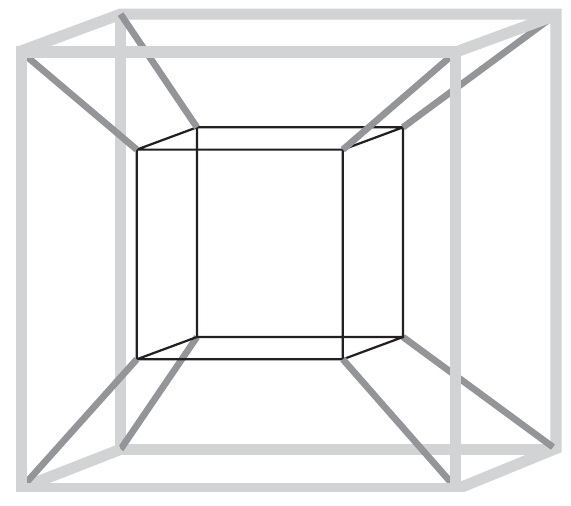
Based on the proposal presented, how many flat geometric figures of each type are formed by the union of the rods?
- A) 12 isosceles trapezoids and 12 squares.
- B) 24 isosceles trapezoids and 12 squares.
- C) 12 parallelograms and 12 squares.
- D) 8 isosceles trapezoids and 12 squares.
- E) 12 scalene trapezoids and 12 rectangles.
Resolution
The structure is a large cube (light gray rods) with a smaller cube inside (black rods), and each vertex of the small cube is connected to the vertex corresponding to the large cube by a dark gray rod. The 8 connecting rods are congruent.
1. Squares. Each cube has 6 square faces:
$$6 + 6 = 12 \text{ quadrados}$$2. Figures between the two cubes. Each edge of the small cube, along with the parallel edge of the large hub and the two end connecting rods, forms a quadrilateral:
- the two edges are parallel and of different sizes, so it is a trapezoid;
- the other two sides are connecting rods, which are congruent, so the trapezoid is isosceles.
A cube has 12 edges, so they are 12 isosceles trapezoids.
Answer: alternative A (12 isosceles trapezoids and 12 squares).
Be careful with the catch: they are not parallelograms (alternative C), because the bases have different sizes; and are not scalenes (alternative E), because the connecting rods are the same.
For review, see Trapezoid.
Question 145: Opposite face in the planation of the octahedron
Statement
In a regular octahedron, two faces are considered opposite when they have neither edges or vertices in common. In the figure, a regular octahedron and a of its plans, in which there is a side colored in dark gray and others four numbered sides.
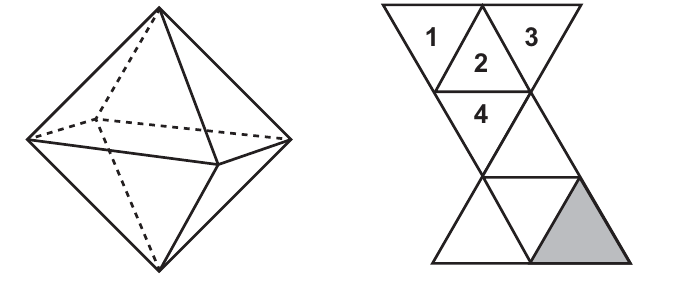
Which face(s) will be opposite the dark gray face, when the octahedron is reconstructed from the given plan?
- A) 1, 2, 3 e 4
- B) 1 e 3
- C) 1
- D) 2
- E) 4
Resolution
By the definition of the statement, each face has exactly one opposite face (the only one that does not touch it even by a vertex). So alternatives A and B already are discarded.
1. Name the vertices of the octahedron. The octahedron has 6 vertices, which form 3 opposite pairs: let’s call them N and S (top and bottom), L and O (east and west), F and T (front and back). Each face is a triangle with one vertex from each pair, and the opposite face uses the other three.
2. Reassemble the pattern. Calling the triangle to the right of 4 5, and 6, 7 the triangles at the bottom (6 is the one on the left, 7 is the one in the middle), the flat pattern is a chain of faces glued together at the edges:
- face 2 = {N, L, F};
- face 1 is glued to 2 by the N–L edge, so use the third vertex other than F: {N, L, T};
- face 3 is glued to 2 by the N–F edge: {N, F, O};
- face 4 is glued to 2 by the L–F edge: {L, F, S};
- face 5 is glued to 4 by the edge F–S: {F, S, O};
- face 7 (middle, bottom) is glued to 5 by the S–O edge: {S, O, T};
- face gray is glued to 7 by the edge O–T: {O, T, N}.
(The 6 face becomes {S, T, L}, completing the 8 faces, without repetition.)
3. Opposite face to the gray. The gray has the vertices {N, O, T}. The opposite has three others: {S, L, F}, which is the face 4.
Checking: the face 4 has no vertex in common with the gray one, and all other numbered faces (1, 2 and 3) contain vertex N, which is also in gray.
Answer: alternative E (face 4).
Tip: if you have paper on hand, cut out the pattern and assemble the octahedron. It is the safest way to check planning issues.
Question 146: Length of the bar of the musical triangle
Statement
The percussion instrument known as a triangle is made up of a bar thin piece of steel, folded into a shape that resembles a triangle, with a opening and a rod, as shown in Figure 1.
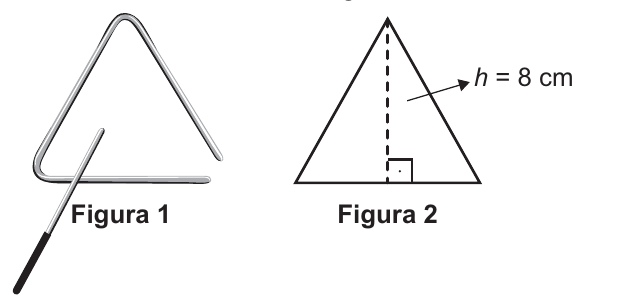
A promotional gifts company hires a foundry to produce miniatures of instruments of this type. The foundry initially produces parts with the shape of a equilateral triangle of height $h$, as shown in Figure 2. After this process, each piece is heated, deforming the corners, and cut at one of the vertices, giving rise to the miniature. Assume that they do not occur material losses in the production process, so that the length of the bar used is equal to the perimeter of equilateral triangle represented in Figure 2.
Consider 1,7 as an approximate value for $\sqrt{3}$.
Under these conditions, the value that comes closest to measuring the length of the bar, in centimeters, is
- A) 9,07.
- B) 13,60.
- C) 20,40.
- D) 27,18.
- E) 36,24.
Resolution
1. Height of equilateral triangle. Height divides equilateral triangle by side $\ell$ in two right-angled triangles, with hypotenuse $\ell$ and side $\frac{\ell}{2}$. By Pythagoras:
$$h^2 + \left(\frac{\ell}{2}\right)^2 = \ell^2 \quad\Rightarrow\quad h = \frac{\ell\sqrt{3}}{2}$$2. Side. With $h = 8$:
$$\frac{\ell\sqrt{3}}{2} = 8 \quad\Rightarrow\quad \ell = \frac{16}{\sqrt{3}} = \frac{16\sqrt{3}}{3}$$3. Perimeter (bar length):
$$3\ell = 3 \cdot \frac{16\sqrt{3}}{3} = 16\sqrt{3} \approx 16 \cdot 1{,}7 = 27{,}2 \text{ cm}$$The closest value to 27,2 among the alternatives is 27,18.
Answer: alternative D (27,18 cm).
Beware of the catch: $\frac{16\sqrt{3}}{3} \approx 9{,}07$ is the side of the triangle (alternative A). The bar is the perimeter, three sides.
For review, see Pythagorean Theorem.
Question 147: Capacity of the mug (cone trunk)
Statement
A person bought a mug to drink soup, as shown in the illustration.
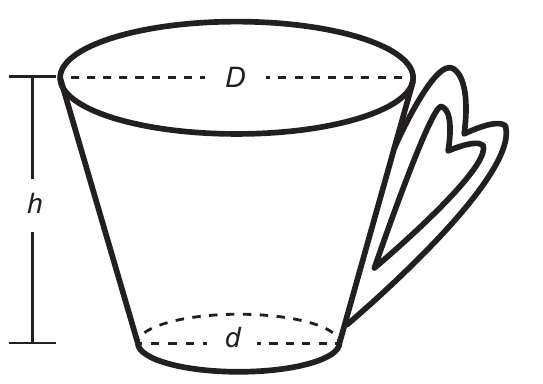
It is known that 1 cm³ = 1 mL and that the top of the mug is a circumference of diameter ($D$) measuring 10 cm, and the base is a circle of diameter ($d$) measuring 8 cm. Furthermore, it is known that the height ($h$) of this mug measures 12 cm (distance between the center of the top and bottom circumferences).
Use 3 as an approximation for $\pi$.
What is the volumetric capacity, in milliliters, of this mug?
- A) 216
- B) 408
- C) 732
- D) 2 196
- E) 2 928
Resolution
The mug has the shape of a frustum cone, with a larger radius $R$ (top), radius smallest $r$ (base) and height $h$. Its volume is
$$V = \frac{\pi h}{3}\left(R^2 + R r + r^2\right)$$1. Radii. The statement gives the diameters: $R = \frac{10}{2} = 5$ cm and $r = \frac{8}{2} = 4$ cm.
2. Volume, with $\pi = 3$ and $h = 12$:
$$V = \frac{3 \cdot 12}{3}\left(5^2 + 5 \cdot 4 + 4^2\right) = 12 \cdot (25 + 20 + 16) = 12 \cdot 61 = 732 \text{ cm}^3$$3. In milliliters: 732 cm³ = 732 mL.
Answer: alternative C (732 mL).
Be careful with the catch: using diameters instead of radii gives $12 \cdot (100 + 80 + 64) = 2\thinspace 928$ (alternative E), four times the correct value.
Question 148: Larger area magnet card
Statement
The owner of a store intends to use magnet cards to publicize his store. The company that will provide the service informs you that the cost of manufacturing the card is R$ 0,01 per square centimeter and offers models having as useful faces for printing:
- one equilateral triangle side 12 cm;
- a square of side 8 cm;
- a rectangle with sides 11 cm and 8 cm;
- a regular hexagon with side 6 cm;
- a circle of diameter 10 cm.
The store owner is willing to pay a maximum of R$ 0,80 per card. He will choose, within this price limit, the model that has the largest area of printing.
Use 3 as an approximation for $\pi$ and use 1,7 as an approximation for $\sqrt{3}$.
Under these conditions, the model that should be chosen is useful for print one
- A) triangle.
- B) square.
- C) rectangle.
- D) hexagon.
- E) circle.
Resolution
1. Maximum area allowed. With R$ 0,01 per cm² and a limit of R$ 0,80, the area can be at most
$$\frac{0{,}80}{0{,}01} = 80 \text{ cm}^2$$2. Area of each model:
- equilateral triangle side 12: $\dfrac{12^2\sqrt{3}}{4} = 36\sqrt{3} \approx 36 \cdot 1{,}7 = 61{,}2$ cm²;
- side square 8: $8^2 = 64$ cm²;
- rectangle 11 × 8: $88$ cm²;
- regular hexagon on one side 6 (six equilateral triangles on one side 6): $6 \cdot \dfrac{6^2\sqrt{3}}{4} = 54\sqrt{3} \approx 91{,}8$ cm²;
- diameter circle 10 (radius 5): $\pi \cdot 5^2 \approx 3 \cdot 25 = 75$ cm².
3. Choose. Rectangle (88) and hexagon (91,8) exceed 80 cm², that is, cost more than R$ 0,80. Among those that fit the budget (61,2; 64; 75), the The largest area is the circle, which costs R$ 0,75.
Answer: alternative E (circle).
Be careful with the catch: the hexagon has the largest area of all, but exceeds the price limit. And in the circle the data is the diameter: with radius 10 a area would give 300 cm², and the circle would be discarded by mistake.
To review, see Circle Area and Regular Polygons.
Question 149: Volumetric module unit (dimensional analysis)
Statement
The Newton-Laplace relationship establishes that the volumetric modulus of a fluid is directly proportional to the square of the speed of sound (in meters per second) in the fluid and its density (in kilograms per cubic meter), with a constant of dimensionless proportionality.
In this relationship, the appropriate unit of measurement for the volumetric modulus is
- A) kg·m−2·s−1
- B) kg·m−1·s−2
- C) kg·m−5·s2
- D) kg−1·m1·s2
- E) kg−1·m5·s−2
Resolution
1. Write the relationship. Calling the volumetric modulus $K$, the speed of the sound of $v$ and the density of $\rho$:
$$K = c \cdot v^2 \cdot \rho$$where $c$ is the constant, unitless (dimensionless).
2. Units for each factor:
- $v$ in m/s, then $v^2$ in $\dfrac{\text{m}^2}{\text{s}^2}$;
- $\rho$ to $\dfrac{\text{kg}}{\text{m}^3}$.
3. Multiply the units:
$$\frac{\text{m}^2}{\text{s}^2} \cdot \frac{\text{kg}}{\text{m}^3} = \frac{\text{kg}}{\text{m} \cdot \text{s}^2} = \text{kg} \cdot \text{m}^{-1} \cdot \text{s}^{-2}$$Answer: alternative B (kg·m−1·s−2).
Be careful with the catch: “directly proportional to the square of speed”: whoever forgets the square finds kg·m−2·s−1 (alternative A).
To review, see Quantity Analysis.
Question 150: How many t-shirts can fit in the suitcase
Statement
A person intends to travel with an airline that ships for free a suitcase weighing up to 10 kg.
On two trips he made, this person used the same suitcase and managed to 10 kg with the following item combinations:
| Trip | T-shirts | Pants | Shoes |
|---|---|---|---|
| I | 12 | 4 | 3 |
| II | 18 | 3 | 2 |
To make sure that her luggage has a mass of 10 kg, she decides to take this suitcase with two pants, one shoe and as many t-shirts as possible, assuming that items from the same type have the same mass.
What is the maximum number of t-shirts this person can take?
- A) 22
- B) 24
- C) 26
- D) 33
- E) 39
Resolution
Let $c$, $p$ and $s$ be the masses of a t-shirt, a pair of pants and a shoe (suitcase included in both trips in the same way). Trips give:
There are 3 unknowns and only 2 equations, so it is not possible to find each mass. But no we need: just assemble the combination “2 pants + 1 shoes” from the two travel.
1. Search for numbers $x$ and $y$ such that $x \cdot \text{(I)} + y \cdot \text{(II)}$ have 2 pants and 1 shoes:
Multiplying the first by 2 and the second by 3 and subtracting: $8x - 9x = 4 - 3$, i.e. $x = -1$. Hence $3y = 2 + 4 = 6$ and $y = 2$.
2. Do $2 \cdot \text{(II)} - \text{(I)}$:
$$(36c + 6p + 4s) - (12c + 4p + 3s) = 20 - 10$$$$24c + 2p + s = 10$$In other words, 24 t-shirts, 2 pants and 1 shoes weigh exactly 10 kg.
Answer: alternative B (24 t-shirts).
Tip: in systems with more unknowns than equations, sometimes the question only asks for a combination of the unknowns, and it comes out combining the equations, without needing each value.