
Euler's Eyes
2026-11-01
MEXT 2025 – Mathematics (B) solved
Source: MEXT / Study in Japan – Mathematics (B) exam and official answer key. Files on the past-exam page.
Mathematics (B) is the exam for undergraduate applicants in science and engineering. It has three fill-in-the-blank questions; each box is worth 5 points. The statements below follow the original English.
Answer key
| Item | Topic | Answer |
|---|---|---|
| 1 (1) | Smallest and largest of four numbers | $\log_8(4\sqrt2)$; $\frac{\sqrt[4]{10}}{2}$ |
| 1 (2) | Mean value theorem | $\sqrt3$ |
| 1 (3) | Focus of a translated parabola | $(-1, 2)$ |
| 1 (4) | Isosceles triangle and tangent | $\frac{40}{9}$ |
| 1 (5) | Recurrence | $\frac58$; $n + 7$ |
| 1 (6) | Integer solutions | $-7$; $5$ |
| 2 (1) | Tangent to the logarithm and area | $2$; $\frac32$; $\frac83$ |
| 2 (2) | Common tangent | $\sqrt e$; $2$ |
| 3 (1) | Intersection of progressions | $46$ |
| 3 (2) | Counting the intersection and the union | $22$; $99$ |
| 3 (3) | Sum equal to 252 | $26 \le n \le 28$; $52$ |
Question 1: six short items
Item (1)
Statement. Among the four values $\frac78$, $\frac{\sqrt[4]{10}}{2}$, $\sin\frac\pi3$ and $\log_8(4\sqrt2)$, the smallest is (i) and the largest is (ii).
Solution. We rewrite two of them:
- $\log_8(4\sqrt2) = \log_8 2^{5/2} = \frac{5/2}{3} = \frac56$;
- $\sin\frac\pi3 = \frac{\sqrt3}{2}$.
We compare the four positive numbers, squaring or raising to the fourth power when needed:
- $\frac56 < \frac{\sqrt3}{2}$, because $\frac{25}{36} < \frac{27}{36} = \frac34$;
- $\frac{\sqrt3}{2} < \frac78$, because $\frac34 = \frac{48}{64} < \frac{49}{64}$;
- $\frac78 < \frac{\sqrt[4]{10}}{2}$, because $\left(\frac74\right)^4 = \frac{2401}{256} < 10$.
In decimals: $0.833 < 0.866 < 0.875 < 0.889$.
Answer: (i) $\log_8(4\sqrt2)$; (ii) $\frac{\sqrt[4]{10}}{2}$.
Item (2)
Statement. Let $f(x) = x^3 - \frac x2 + 2$. The positive value of $c$ satisfying the mean value theorem
$$\frac{f(b) - f(a)}{b - a} = f'(c)$$on the interval $[a, b] = [-1, 1]$ is $\dfrac{1}{\boxed{\phantom{0}}}$.
Solution. $f(1) = \frac52$ and $f(-1) = \frac32$, so the slope of the secant is $\frac{1}{2}$. Since $f'(c) = 3c^2 - \frac12$,
$$3c^2 - \frac12 = \frac12 \iff c^2 = \frac13 \iff c = \frac{1}{\sqrt3}\ (c > 0).$$Answer: $\sqrt3$.
Item (3)
Statement. The focus of the parabola $4y = x^2$ after a translation by $-1$ unit along the $x$-axis and by $1$ unit along the $y$-axis is $\boxed{\phantom{0}}$.
Solution. $x^2 = 4py$ with $p = 1$ has focus $(0, 1)$. The translation takes the focus to $(0 - 1,\ 1 + 1) = (-1, 2)$.
Answer: $(-1, 2)$.
Item (4)
Statement. A triangle $ABC$ has $AB = AC$. Let $\angle A = \alpha$ and $\angle B = \beta$. If $\tan(\alpha + \beta) = -\frac54$, then $\tan\alpha = \boxed{\phantom{0}}$.
Solution. The triangle is isosceles, so $\angle C = \beta$ and $\alpha + 2\beta = \pi$. Then $\alpha + \beta = \pi - \beta$ and
$$\tan(\alpha + \beta) = -\tan\beta = -\frac54 \implies \tan\beta = \frac54.$$Since $\alpha = \pi - 2\beta$,
$$\tan\alpha = -\tan 2\beta = -\frac{2\cdot\frac54}{1 - \frac{25}{16}} = -\frac{\frac52}{-\frac{9}{16}} = \frac{40}{9}.$$Answer: $\frac{40}{9}$.
Item (5)
Statement. The sequence $(a_k)$ is given by $a_1 = 2$ and $2a_k - a_{k-1} = \frac{1}{2^k}$ for $k \ge 2$. Then $a_3 =$ (i) and the general term is $a_n = \dfrac{\text{(ii)}}{2^{n+1}}$.
Solution. Multiplying the recurrence by $2^k$:
$$2^{k+1}a_k - 2^k a_{k-1} = 1.$$With $b_k = 2^{k+1}a_k$, this says $b_k - b_{k-1} = 1$: $(b_k)$ is an arithmetic progression with common difference 1 and $b_1 = 4\cdot 2 = 8$. So $b_n = n + 7$ and
$$a_n = \frac{n + 7}{2^{n+1}}, \qquad a_3 = \frac{10}{16} = \frac58.$$Answer: (i) $\frac58$; (ii) $n + 7$.
Item (6)
Statement. Consider the integer solutions $a$, $b$ of $a(b + 1) = 2(b + 4)$. The smallest integer $b$ satisfying the equation is (i), and the largest is (ii).
Solution. $b = -1$ does not work (it would give $0 = 6$). For $b \ne -1$,
$$a = \frac{2(b + 4)}{b + 1} = 2 + \frac{6}{b + 1}.$$$a$ is an integer exactly when $b + 1$ divides $6$: $b + 1 \in \{\pm1, \pm2, \pm3, \pm6\}$, that is, $b \in \{-7, -4, -3, -2, 0, 1, 2, 5\}$.
Answer: (i) $-7$; (ii) $5$.
Question 2: tangents to a logarithm and a parabola
Statement
Let $\log$ denote the natural logarithm, with base $e$. Consider the curves
$$C_1: y = \log(2x) + \frac52, \qquad C_2: y = -2x^2 + a,$$where $a$ is a real number.
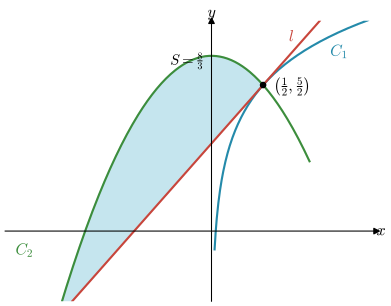
- The tangent $l$ to $C_1$ at $x = \frac12$ is $y = \text{(i)}\,x + \text{(ii)}$. If $a = 3$, the area of the region bounded by $C_2$ and $l$ is (iii).
- If $a = 2 - \frac{1}{2e}$, then $C_1$ and $C_2$ have a unique common tangent line, $y = \dfrac{2}{\text{(i)}}\,x + \text{(ii)}$.
Solution
1. The tangent at $x = \frac12$. $y' = \frac1x$, which equals $2$ at $x = \frac12$, and $y(\tfrac12) = \log 1 + \frac52 = \frac52$. So
$$l: y = 2\left(x - \tfrac12\right) + \tfrac52 = 2x + \tfrac32.$$2. The area with $a = 3$. The line and the parabola $y = -2x^2 + 3$ meet where $-2x^2 + 3 = 2x + \frac32$, that is, $4x^2 + 4x - 3 = 0$, with roots $x = -\frac32$ and $x = \frac12$. For a parabola with leading coefficient $-2$, the area between it and a secant at abscissas $\alpha < \beta$ is $\frac{|-2|}{6}(\beta - \alpha)^3$:
$$S = \frac{2}{6}\cdot 2^3 = \frac83.$$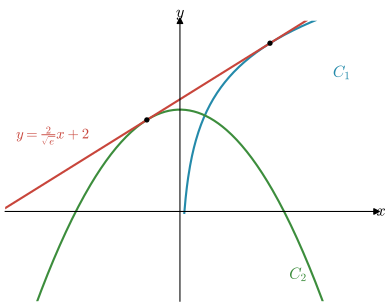
3. The common tangent. The tangent to $C_1$ at the point with abscissa $s > 0$ is
$$y = \frac{x}{s} + \log(2s) + \frac32.$$The tangent to $C_2$ at the point with abscissa $t$ is $y = -4tx + 2t^2 + a$. Matching coefficients, $-4t = \frac1s$ and $2t^2 + a = \log(2s) + \frac32$. With $t = -\frac{1}{4s}$,
$$g(s) = \log(2s) + \frac32 - \frac{1}{8s^2} = a = 2 - \frac{1}{2e}.$$$g$ is increasing for $s > 0$ (a sum of two increasing functions), so the solution is unique. Trying $s = \frac{\sqrt e}{2}$: $\log(2s) = \frac12$ and $\frac{1}{8s^2} = \frac{1}{2e}$, so $g(s) = 2 - \frac{1}{2e}$. ✓
The slope is $\frac1s = \frac{2}{\sqrt e}$ and the intercept is $\log(2s) + \frac32 = 2$.
Answer
- (i) $2$; (ii) $\frac32$; (iii) $\frac83$.
- (i) $\sqrt e$; (ii) $2$. The common tangent is $y = \frac{2}{\sqrt e}x + 2$.
Question 3: two arithmetic progressions
Statement
For positive integers $m$ and $n$, consider the sets
$$A(m) = \{3k + 1 \mid k = 1, \dots, m\}, \qquad B(n) = \{2k \mid k = 1, \dots, n\}.$$- The largest integer in $A(18) \cap B(25)$ is $\boxed{\phantom{0}}$.
- $A(44) \cap B(77)$ contains (i) integers, while $A(44) \cup B(77)$ contains (ii).
- The values of $n$ for which the sum of the integers in $A(30) \cap B(n)$ is $252$ are (i) $\le n \le$ (ii). In this case, the largest integer in $A(30) \cap B(n)$ is (iii).
Solution
$A(m) = \{4, 7, 10, \dots, 3m + 1\}$ are the numbers $\equiv 1 \pmod 3$ from $4$ to $3m + 1$; $B(n) = \{2, 4, \dots, 2n\}$ are the even numbers up to $2n$. A number lies in both when it is even and $\equiv 1 \pmod 3$, that is, $\equiv 4 \pmod 6$:
$$A \cap B \subset \{4, 10, 16, 22, \dots\} = \{6j - 2 \mid j \ge 1\}.$$1. $A(18)$ goes up to $55$ and $B(25)$ up to $50$. The largest $6j - 2 \le 50$ is $46$.
2. $A(44)$ goes up to $133$ and $B(77)$ up to $154$. The numbers $6j - 2 \le 133$ are $j = 1, \dots, 22$: $22$ elements. By inclusion–exclusion, $|A \cup B| = 44 + 77 - 22 = 99$.
3. $A(30)$ goes up to $91$. If the intersection is $\{4, 10, \dots, 6J - 2\}$, its sum is
$$\sum_{j=1}^{J}(6j - 2) = 3J(J + 1) - 2J = J(3J + 1).$$$J(3J + 1) = 252$ gives $3J^2 + J - 252 = 0$, $J = \frac{-1 + 55}{6} = 9$. The largest element is $6\cdot 9 - 2 = 52$, and the next one, $58$, must not be included. So $52 \le 2n < 58$, that is, $26 \le n \le 28$.
Answer
- $46$.
- (i) $22$; (ii) $99$.
- (i) $26$; (ii) $28$; (iii) $52$.