
Euler's Eyes
2023-07-01
OBMEP 2022 - Second Phase - Level 1
OBMEP 2021: Second Phase - Level 1
Exercise 1
On the board, each letter of the word OBMEP represents an integer from 1 to 5. Different letters represent different numbers. Furthermore, each number written on the side of the board is the sum of the values of the letters on the board. corresponding horizontal line.
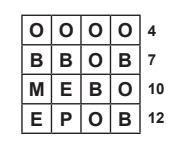
A) Find the value of the letter O.
Response: 1
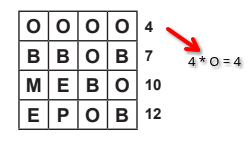
When we add the values from the first line, we have
$$O + O + O + O = 4. $$$$4\times O = 4. $$
Therefore, $O = 1.$
B) Find the value of the letter B.
Response: 11
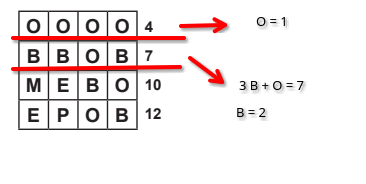
- From the letter A we have $O=1$.
- From line two we have:
Remember the scales, for more details see first degree equations.
$$B + B + O + B = 7$$$$3B + O = 7$$
$$3B + 1 {\color{red}{-1}} = 7 {\color{red}{-1}}$$
$$3B = 6$$
$$3B \times {\color{red}{\frac{1}{3}}} = 6 \times {\color{red}{\frac{1}{3}}}$$
$$B = 2$$
C) Find the value of the letter M.
- From (a) $O=1$
- From (b) $B=2$
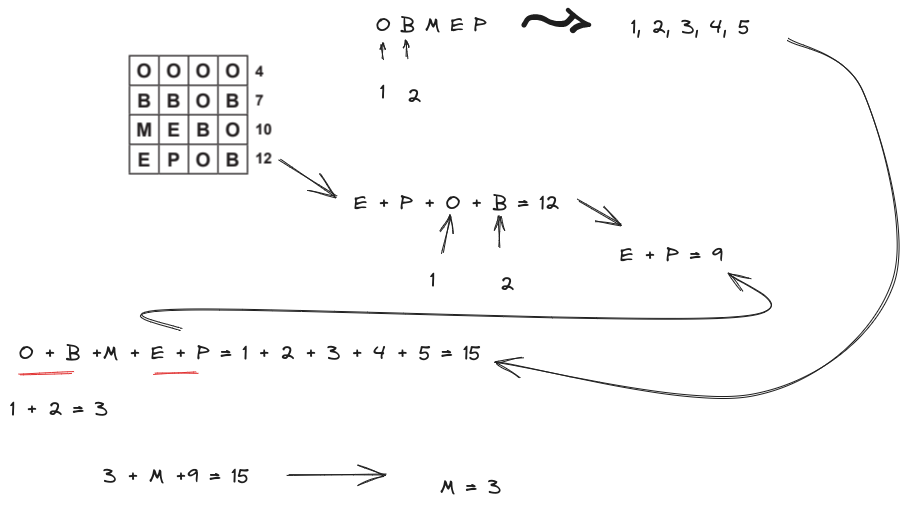
- When we add the values in the last line, we have
$$E + P + 1 + 2 = 12$$
$$E + P + 3 {\color{red}{-3}} = 12 {\color{red}{-3}}$$
$$E + P = 9$$
On the other hand, in the statement, the letters $O, B, M, E$ and $P$ represent, in some order, the numbers $1, 2, 3, 4$ and $5.$
Therefore,
Therefore, $M = 3.$
D) What letter represents the number 5?
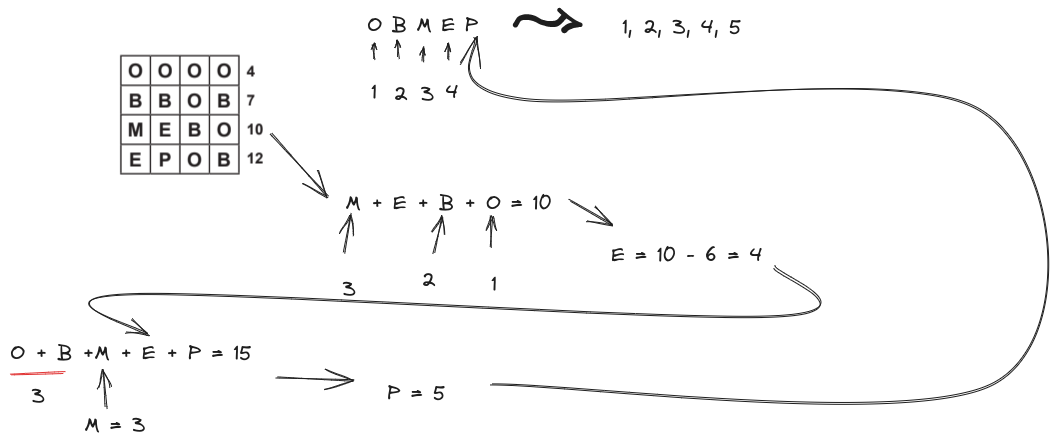
- We already have $O = 1$ and $B = 2$;
- from the third line follows $M + E = 7$
- $E=7-3 = 4$
- Therefore, $P = 5$
Exercise 2
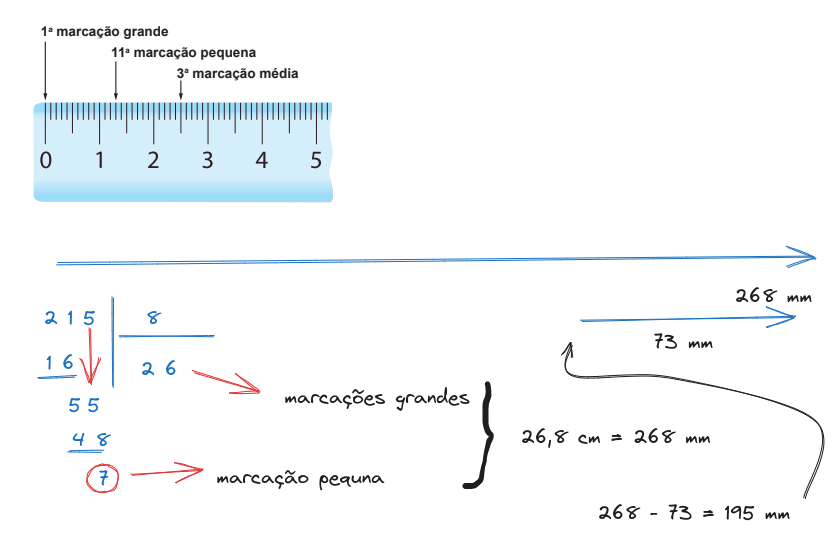
A 30 cm ruler is graduated in millimeters with large, medium and small markings as indicated in the figure.
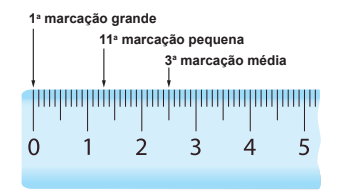
A) What is the distance, in millimeters, between the eleventh small mark and the third medium mark?
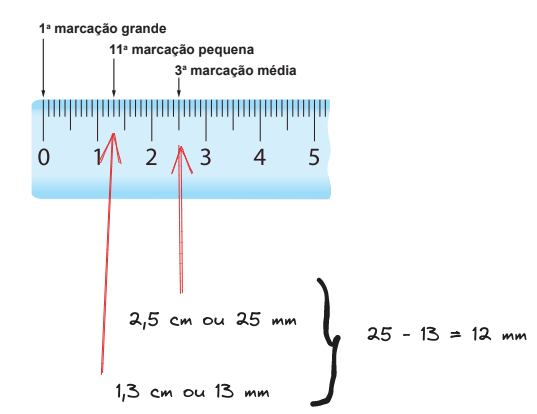
- The third middle marking marks 2,5 cm (25 mm).
- The eleventh small marking marks 1,3 cm (13 mm).
- The distance, in millimeters, between these markings is $25 - 13 = 12$ mm.
B) How many small markings are there on the entire ruler?
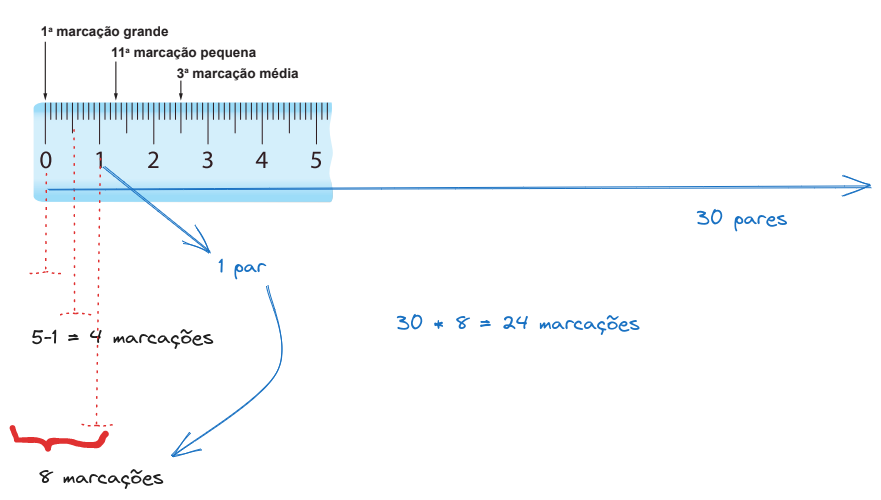
- The number of ticks is $5-1 = 4$ ticks;
- 1 pair have $8$ markings;
- 1 30 cm ruler has $30 \times 8 = 240$ markings;
C) What is the marking that is 73 millimeters away from the 215th small marking? Justify your answer.
To find between which pair of large markings is the 215th small marking, we must calculate the quotient of dividing 215 by 8.
 $$D=d\times q +r$$
$$215 = 26 × 8 + 7$$
- The 215th small marker is then on the 7th small marker after the 26th pair of large markers.
- The 215th small marking then marks 26,8 cm (268 mm).
- The marking that is at a distance of 73 millimeters from the 215th small marking necessarily occurs before this marking, otherwise it would be outside the rule.
- The marking that is at a distance of 73 millimeters from the 215th marking is a small mark, then
- $268 - 73 = 195$ mm at the 20th average marking.
Exercise 3
Alice, Beatriz and Cláudia live on a street 200 meters long. Alice lives at the beginning of the street, Beatriz 80 meters from Alice and Cláudia at the end of the street. road. They meet from time to time, always leaving their homes.
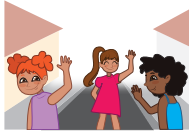
A) What is the sum of the distances that Alice and Beatriz travel when they meet? gather at Cláudia’s house?
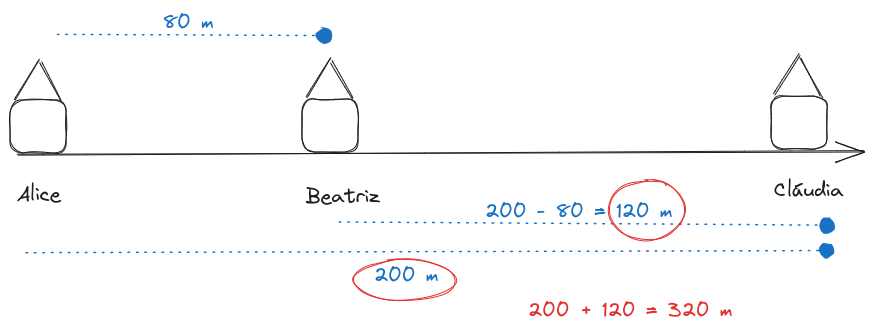
- Let $d_{ac} = 200m$ be the distance from Alice to Cláudia and
- $d_{bc}= 200-80=120m$ distance from Beatriz to Cláudia
- $d_{abc}$ distance from Alice to Cláudia and distance from Beatriz to Cláudia
B) If Alice, Beatriz and Cláudia meet on the street 150 meters from its beginning, what will be the sum of the distances what will they go through?
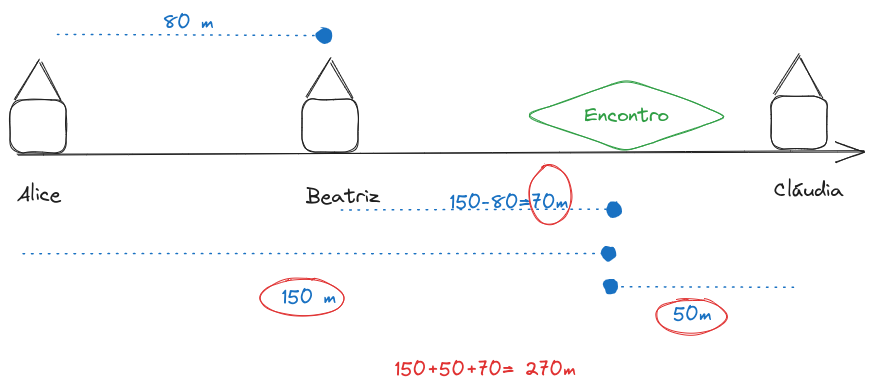
- Let $d_{ae} = 150m$ be the distance from Alice to the meeting point and
- $d_{ce}= 50m$ distance from Cláudia to the meeting point
- $d_{be}= 150-80 = 70m$ distance from Beatriz to meeting point
- $d_{t}$ total distance
C) The three friends decide to meet at some point on the street such that the sum of the distances covered by them be as small as possible. How many meters from the beginning of the street should they meet?
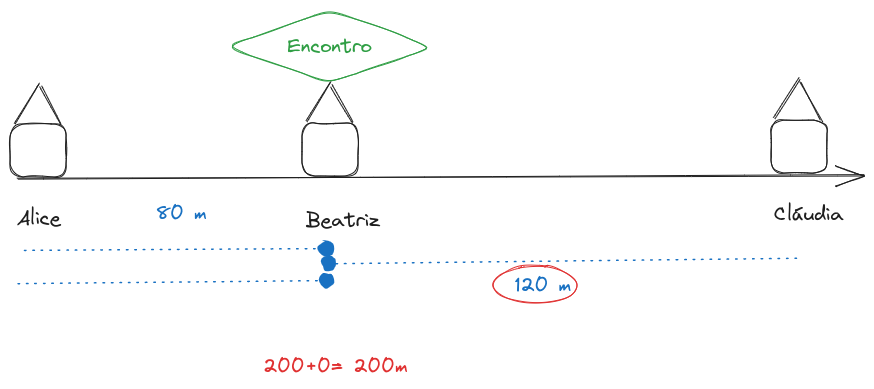
- The sum of the distance traveled between Alice and Cláudia will always be 200m at any meeting point.
- $d_{ac} + d_{ca}= 200m$ distance from Alice to Cláudia and distance from Cláudia to Alice
- To keep the distance traveled as short as possible, Beatriz should never leave the house, that is, the meeting point should be at Beatriz’s house.
- $d_{bc}= 0$ distance from Beatriz to Cláudia.
Therefore, the minimum distance is 200 m.
Exercise 4
Janaína cut a rectangular cardboard 16 cm long and 6 cm wide into four triangles equal rectangles, as shown in the figure.
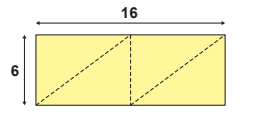
A) What is the area of each of these triangles?
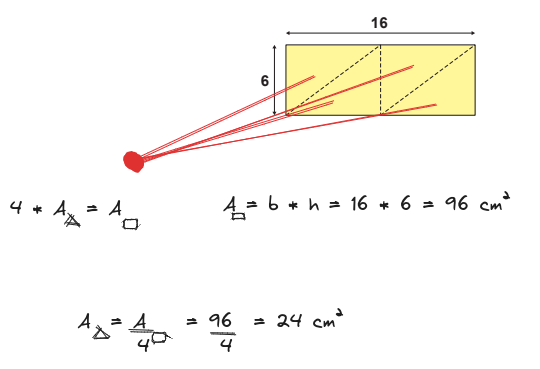
- How 4 triangles are equal
- just calculate the area of the cardboard sheet and divide by 4.
- Therefore, any of these triangles has an area equal to cm².
B) Then, Janaína used the four triangles to assemble a square with a hole inside, as shown in the figure. What is the area of the hole?
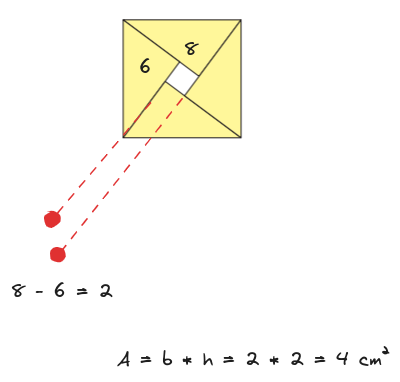
- The hole in the center of the square has a side whose size is equal to the difference between the measurements of the two sides of the triangles.
- side of the square $=8 - 6 = 2$ cm.
- Therefore, the area of the hole is $A_{\text{quad}} = 2 \times 2 = 4 cm^2$.
C) How long is the side of the square that Janaina assembled?
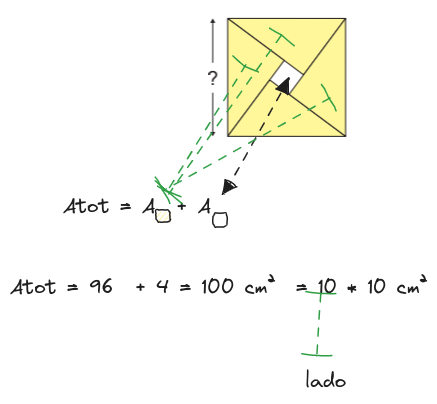
- The area of the square that Janaína created is equal to the sum of the areas of the 4 triangles, plus the area of the hole.
- Therefore, the area of this square is equal to
Therefore the side of the square is $10 cm$.
Exercise 5
Marco fills in squares 3 × 3 with the numbers 1, 2, 3, 4, 5, 6, 7, 8 and 9, without repeating any of them.
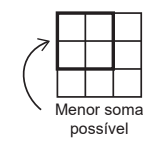
A) Marco filled in a grid so that the four numbers written in the square 2 × 2 highlighted have the smallest possible sum. What is the sum of the five written numbers outside this square?
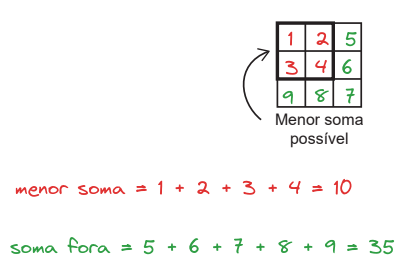
- By choosing four numbers from the numbers 1, 2, 3, 4, 5, 6, 7, 8 and 9.
- the smallest possible sum we can obtain occurs when these numbers are the smallest possible
- minor sum $=1 + 2 + 3 + 4 = 10$.
- Outside this square, he wrote the numbers 5, 6, 7, 8 and 9, whose
- sum out $=5 + 6 + 7 + 8 + 9 = 35.$
B) Marco managed to fill in another square so that the sum of the numbers written in one of the squares 2 × 2 highlighted is 21 and in the other, 26. The two figures below are representations of this same grid. What is the smallest number that Marco could have written in the central square of the grid?
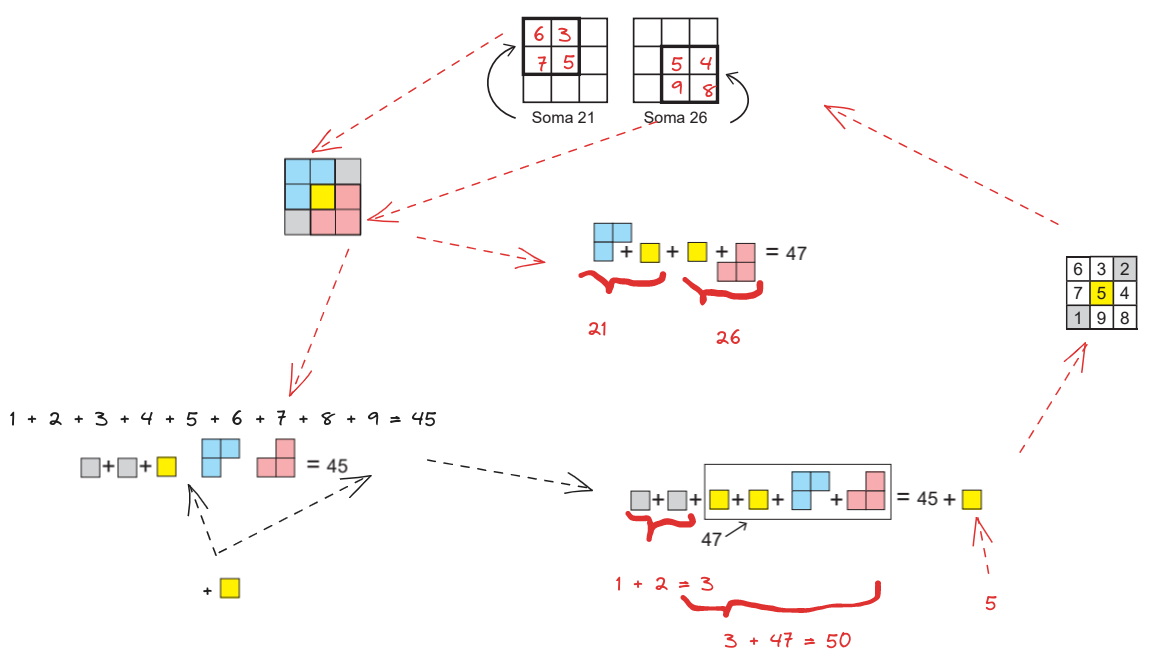
- the central house, common to these two squares, in yellow.
- The gray colored houses, one in the upper right corner and the other in the lower left corner, are outside the highlighted squares.
- the sum of the numbers that Marco wrote in the highlighted squares is equal to 21 + 26 = 47 .
This sum is:
$$ \text{azul} + \text{amarelo} + \text{amarelo} + \text{vermelho} = 47$$The sum of all the numbers written by Marco is
$$1 + 2 + 3 + 4 + 5 + 6 + 7 + 8 + 9 = 45$$which is written as
$$ \text{cinza}+ \text{cinza}+ {azul} + \text{amarelo} + \text{vermelho} = 45$$We use the scale method to add a yellow piece to both sides.
C) Marco managed to fill in a third grid so that the sums of the numbers written in the four highlighted 2 × 2 squares are 18, 25, 21 and 24. Furthermore, the sum of the numbers written in the four corners of the grid 3 × 3 is 16. The four figures below are representations of this same grid. What was the number that Marco wrote in the central box?
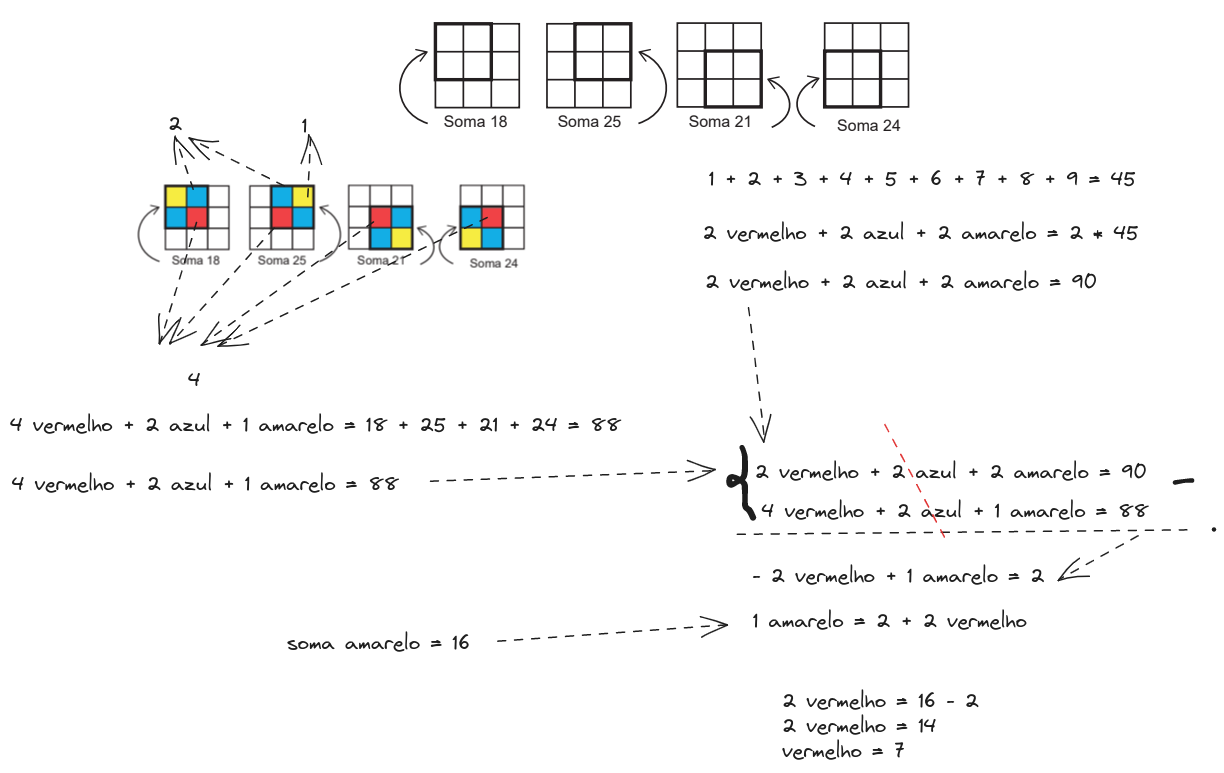
When we put together the possibilities with colors we have:
- red pieces appear 4 times
- blue pieces appear 2 times
- yellow pieces appear 2 times
- the sum of these pieces equals 88
On the other hand, the sum of possible numbers is 45
$$\text{vermelho}+\text{azul}+\text{amarelo}= 1 + 2+3+4+5+6+7+8+9=45$$When we multiply by 2
$$2\text{vermelho}+2\text{azul}+2\text{amarelo}= 90$$From the two equations we can subtract one from the other
We get
$$1\text{amarelo}- 2\text{vermelho}= 2$$$$1\text{amarelo}= 2 + 2\text{vermelho}$$
From the statement we have that the sum of the corners (yellow piece) is equal to 16. From this, we get:
$$1\text{amarelo}= 2 + 2\text{vermelho}$$$$16= 2 + 2\text{vermelho}$$
$$2\text{vermelho} = 14$$
$$\text{vermelho} = \dfrac{14}{2} = 7$$
Therefore, the red piece is worth 7.