
Euler's Eyes
2026-10-30
Laplace's demon
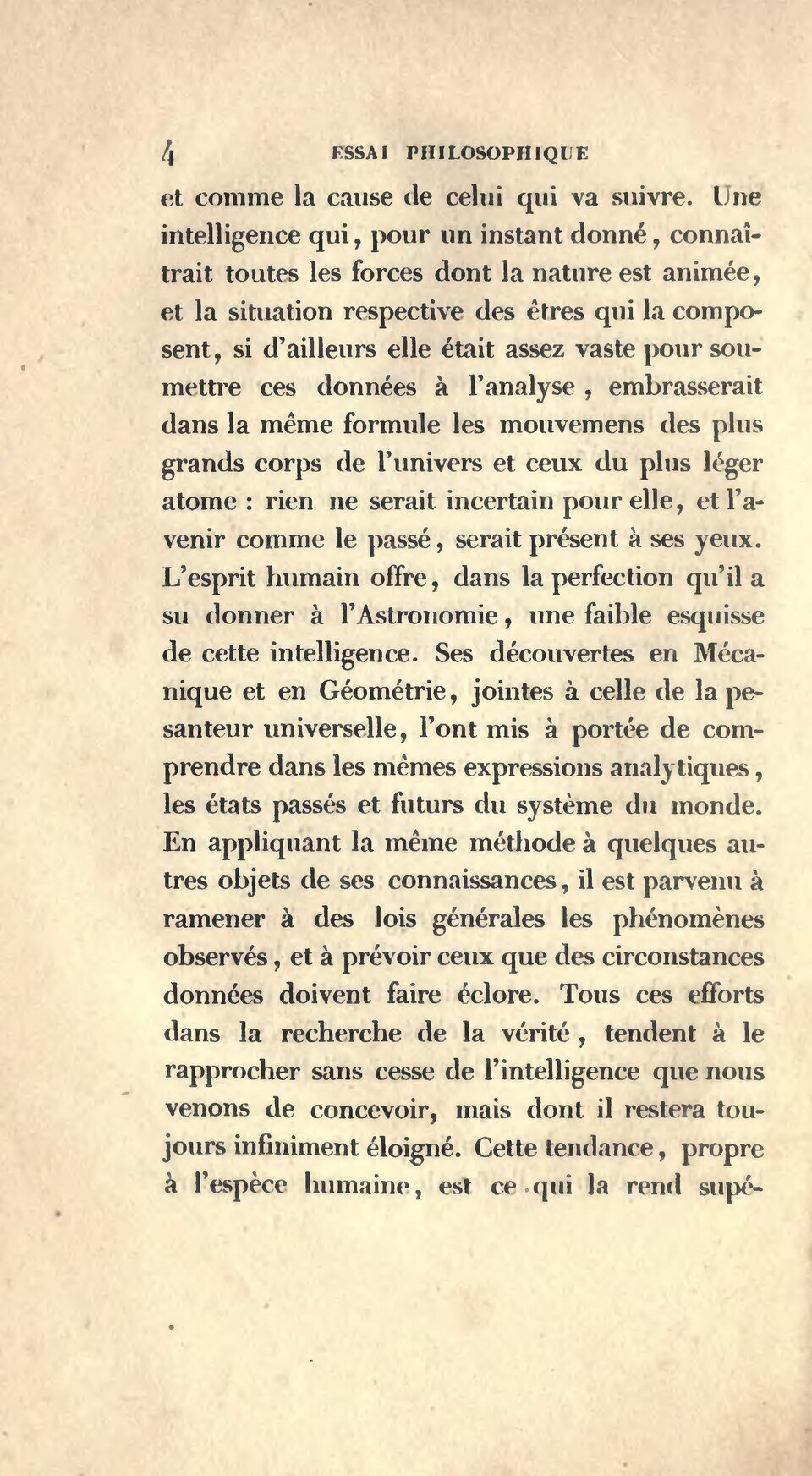
We ought to regard the present state of the universe as the effect of its previous state and as the cause of the one that is to follow. An intelligence which, at a given instant, knew all the forces that animate nature and the respective situation of the beings that compose it, and which was vast enough to submit these data to analysis, would embrace in the same formula the movements of the greatest bodies of the universe and those of the lightest atom: nothing would be uncertain for it, and the future, like the past, would be present to its eyes.
— Pierre-Simon Laplace, Philosophical Essay on Probabilities (1814)
This is Laplace’s most quoted passage. It sums up the world view of Newton’s mechanics carried to its end: if the laws of motion are exact and the present is known perfectly, the future is entirely determined. This is determinism.
A demon that was not a demon
Laplace never used the word “demon”: he spoke of an “intelligence”. The nickname came later, by analogy with other imaginary beings in physics. And the context of the passage is usually forgotten. It is at the beginning of a book on probability, and Laplace’s argument is the opposite of what it seems.
He says that the human mind offers only a faint image of this intelligence. We do not know all the forces or all the positions; we know only a part. And that is precisely why we need probability. For Laplace, probability does not measure a chance that exists in the world; it measures our partial ignorance. A tossed coin follows the laws of mechanics; we say the chance of heads is $\frac{1}{2}$ because we do not know exactly the force of the toss. It is the same view that lies behind the rule of succession: probability as the degree of belief of someone who knows little.
Chaos
Laplace’s determinism assumes that, knowing the present almost perfectly, we would know the future almost perfectly. In 1890 Henri Poincaré, studying the three-body problem, realized that this is not always so. In certain systems, a tiny difference in the initial conditions grows without stopping. In 1963 the meteorologist Edward Lorenz rediscovered the phenomenon in a simulation of the weather: what is now called chaos, or the butterfly effect.
A simple calculation shows the strength of the effect. Suppose an initial error of $10^{-10}$, one part in ten billion, doubles at each step. After $n$ steps the error is $2^n \cdot 10^{-10}$, and it reaches order 1, the size of the system itself, when
$$2^n = 10^{10} \quad\Longleftrightarrow\quad n = \frac{10}{\log_{10} 2} \approx 33.$$Thirty-three steps are enough for a precision of ten decimal places to be useless. And each extra decimal place adds only about 3.3 steps. Laplace’s intelligence would need infinite precision.
In the twentieth century quantum mechanics went further: according to Heisenberg’s uncertainty principle, the position and velocity of a particle cannot even be known at the same time with arbitrary precision. Laplace’s world, in which the present determines the future, gave way to a world in which probability is in the laws themselves.
Exercise: fifteen decimal places
A computer stores numbers with about 15 decimal places. If the error doubles at each step, after how many steps does a chaotic simulation lose all precision?
We need $2^n \cdot 10^{-15} \approx 1$, or $n = \frac{15}{\log_{10} 2} \approx \frac{15}{0.301} \approx 50$ steps. Even with the best arithmetic available, the prediction loses its meaning after some five dozen doublings.
Exercise: the limit of weather forecasting
Suppose that, in the atmosphere, errors double every 2 days and that a forecast becomes useless when the error reaches 100% of the measured value. With initial measurements having a 1% error, how many days ahead can we forecast? And if the initial error fell to 0.1%?
With 1%, the error must grow 100 times: $2^n = 100$, $n = \log_2 100 \approx 6.6$ doublings, or about 13 days. With 0.1%, the factor is 1000: $n = \log_2 1000 \approx 10$ doublings, about 20 days. Measuring ten times better yields only one more week of forecast. That is why, despite supercomputers, detailed weather forecasts do not go beyond two weeks.
Sources: Pierre-Simon Laplace, Essai philosophique sur les probabilités (1814), introduction · Henri Poincaré, “Sur le problème des trois corps et les équations de la dynamique”, Acta Mathematica 13 (1890) · Edward N. Lorenz, “Deterministic Nonperiodic Flow”, Journal of the Atmospheric Sciences 20 (1963) · Ian Stewart, Does God Play Dice? The Mathematics of Chaos (1989) · Ian Hacking, The Taming of Chance (1990).
All topics on Pierre-Simon Laplace · ← The speed of sound · The legacy of Pierre-Simon Laplace →