
Euler's Eyes
2026-10-13
Galois and Cayley: an algebra for things that are not numbers
In the small hours of 30 May 1832, in Paris, a young man of twenty spent the night writing. Évariste Galois had a duel arranged for dawn and knew he would probably not survive it. He wrote a long letter to his friend Auguste Chevalier summarising the ideas the Academy of Sciences had rejected or lost, and asked that it be shown to Jacobi and Gauss, “not on the truth, but on the importance of these theorems”. In the margin of a manuscript he left a sentence that became famous:
There is something to complete in this proof. I do not have the time.
— Évariste Galois, marginal note on a manuscript (1832)
Galois was wounded in the duel and died the next day. His memoirs were only published in 1846, by Joseph Liouville, and took decades to be understood. They settled a centuries-old question: why do equations of degree $2$, $3$ and $4$ have formulas with radicals, like the quadratic formula, while those of degree $5$ in general do not? The Norwegian Niels Henrik Abel, dead of tuberculosis at 26, had already proved in 1824 that there is no general formula for degree $5$. Galois explained why, and to do so he invented a new idea: the group.
An algebra of moves
Galois’s idea is easier to see with a figure than with an equation. Cut an equilateral triangle out of paper, number its vertices $1$, $2$ and $3$ and draw its outline on a sheet. In how many ways can you lift the triangle and put it back exactly on the outline? Six: leave it still, turn it a third of a turn, turn it two thirds, or flip it over about one of its three axes of symmetry.
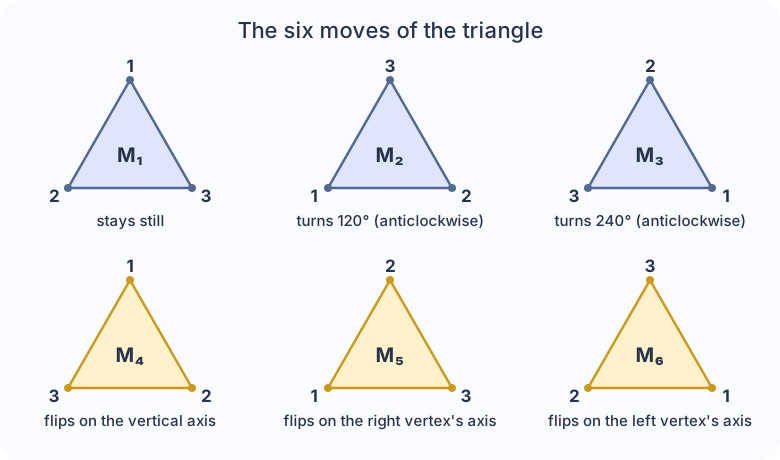
The old texts on this site called these moves $M_1,\dots,M_6$ and wrote $M_i\star M_j$ for “do $M_j$, then $M_i$”. Two moves in a row always give a third move from the same list, and that is what makes them a group. All the combinations fit in a table, which the site called the group times table:
$$\begin{array}{c|cccccc} \star & M_1 & M_2 & M_3 & M_4 & M_5 & M_6\\ \hline M_1 & M_1 & M_2 & M_3 & M_4 & M_5 & M_6\\ M_2 & M_2 & M_3 & M_1 & M_5 & M_6 & M_4\\ M_3 & M_3 & M_1 & M_2 & M_6 & M_4 & M_5\\ M_4 & M_4 & M_6 & M_5 & M_1 & M_3 & M_2\\ M_5 & M_5 & M_4 & M_6 & M_2 & M_1 & M_3\\ M_6 & M_6 & M_5 & M_4 & M_3 & M_2 & M_1 \end{array}$$(the row gives the move done last, the column the move done first). Notice what has happened from a semiotic point of view. A physical move, turning or flipping a triangle, has become a symbol, and combining moves has become reading a table. There is no longer any need to imagine the triangle: the table does the work.
Order matters
The table shows something that multiplying numbers never showed. Look up $M_2\star M_5$ (row $M_2$, column $M_5$): it gives $M_6$. Now look up $M_5\star M_2$: it gives $M_4$.
$$M_2\star M_5=M_6\qquad\text{but}\qquad M_5\star M_2=M_4.$$The order of the factors changes the product. Turning and then flipping is not the same as flipping and then turning; try it with the paper triangle. In the table you can see it at a glance: it is not symmetric about the diagonal. Groups in which order does not matter were named abelian groups, in honour of Abel. The triangle’s group is not one of them.
Galois realised that the roots of an equation can also be “moved”, swapped among themselves without breaking the algebraic relations between them, and that these swaps form a group. The equation has a formula with radicals exactly when its group can be taken apart into abelian pieces in a special way. For degree $5$, in general, it cannot. The question about formulas became a question about tables.
Cayley: a whole system in one letter
In 1750 the Swiss Gabriel Cramer published a rule for solving systems of linear equations. It worked, but it was described in words and indices, equation by equation, and became unreadable as the system grew. A way of writing the system as a whole was missing.
It came in 1858, when the Englishman Arthur Cayley published his Memoir on the Theory of Matrices. The idea is to gather the coefficients in an array and treat the array as a single thing. The system
$$\begin{cases}2x+y=5\\ x+3y=10\end{cases} \qquad\text{becomes}\qquad \begin{pmatrix}2&1\\1&3\end{pmatrix}\begin{pmatrix}x\\y\end{pmatrix}=\begin{pmatrix}5\\10\end{pmatrix}, \qquad\text{that is,}\qquad AX=B.$$The resemblance to $ax=b$ is no coincidence: it is the reason the notation works. If $ax=b$ is solved by $x=a^{-1}b$, the writing suggests that $AX=B$ is solved by $X=A^{-1}B$, and Cayley showed how to give meaning to $A^{-1}$. At the same time the notation warns where the analogy breaks: with matrices, $AB$ and $BA$ are in general different. A good notation suggests what to do and also lets you see what you cannot do.
Groups and matrices tell the same story. In the nineteenth century algebra stopped being only the art of calculating with unknown numbers and became the art of calculating with anything that obeys rules: moves, permutations, arrays of numbers. Notation was what made that leap possible. By writing $M_i\star M_j$ or $AB$, mathematicians could operate on new objects with the same hand that operated on $x$ and $y$, and the differences (such as $AB\ne BA$) were written in plain sight.
Exercise: correct the probe's attitude
A problem from the site’s old texts: a triangle-shaped probe undergoes, in sequence, the moves $M_5$, $M_4$, $M_3$, $M_6$ and $M_6$ (the first to happen is $M_5$). What position is it in, and what move brings it back?
From the table, working from the inside out:
$$M_6\star\big(M_6\star(M_3\star(M_4\star M_5))\big)=M_6\star\big(M_6\star(M_3\star M_3)\big)=M_6\star(M_6\star M_2)=M_6\star M_5=M_2.$$The probe is as if it had turned $120^\circ$. To bring it back, look for $X$ with $X\star M_2=M_1$: the table gives $X=M_3$, the $240^\circ$ turn. Nobody had to imagine the probe turning: reading the table was enough.
Exercise: solve the system with matrices
For $A=\begin{pmatrix}2&1\\1&3\end{pmatrix}$ we have $\det A=2\cdot3-1\cdot1=5$ and
$$A^{-1}=\frac15\begin{pmatrix}3&-1\\-1&2\end{pmatrix},\qquad X=A^{-1}B=\frac15\begin{pmatrix}3\cdot5-1\cdot10\\-1\cdot5+2\cdot10\end{pmatrix}=\frac15\begin{pmatrix}5\\15\end{pmatrix}=\begin{pmatrix}1\\3\end{pmatrix}.$$So $x=1$ and $y=3$. Check: $2+3=5$ and $1+9=10$.
Chapter index · ← Cauchy and the limit: how to write the infinitely small · Hamilton, Gibbs and Heaviside: the war of the arrows →