
Euler's Eyes
2026-11-05
MEXT 2025 – Mathematics (Specialized Training College) solved
Source: MEXT / Study in Japan – Mathematics paper and official answers (mathematics is on the last page). Files on the past exams page.
This is the Mathematics exam for scholarship applicants to specialized training colleges (専修学校, senmon gakkō: two- to three-year vocational courses such as design, tourism, IT or nursing). It lasts 60 minutes and has four fill-in questions, shorter and more direct than the undergraduate ones. The statements below follow the original English.
Answer key
| Item | Topic | Answer |
|---|---|---|
| 1 (1) | $x^2 + \frac{1}{x^2}$ | $6$ |
| 1 (2) | Trigonometric expression | $1$ |
| 1 (3) | $\lvert x + 2\rvert = 4$ | $-6$ and $2$ |
| 1 (4) | Vertex of the parabola | $(1, -4)$ |
| 2 (1) | Two blue balls | $\frac13$ |
| 2 (2) | Divisors of 1400 | $24$; $3720$ |
| 3 (1) | Product of logarithms | $1$ |
| 3 (2) | Roots of a cubic | $-2$ and $3$ |
| 3 (3) | Tangent line | $y = -8x + 12$ |
| 3 (4) | Area | $12$ |
| 3 (5) | $a + a^{-1}$ | $7$ |
| 4 (1) | Arithmetic progression | $42$ |
| 4 (2) | Sums | $-155$; $\frac{19}{20}$ |
Question 1: four short items
Item (1)
Statement. If $x = \sqrt2 - 1$, compute $x^2 + \dfrac{1}{x^2}$.
Solution. Rationalizing, $\frac1x = \frac{1}{\sqrt2 - 1} = \sqrt2 + 1$. So $x + \frac1x = 2\sqrt2$ and
$$x^2 + \frac{1}{x^2} = \left(x + \frac1x\right)^2 - 2 = 8 - 2 = 6.$$Answer: $6$.
Item (2)
Statement. Simplify $\sin10^\circ\cos80^\circ - \sin100^\circ\cos170^\circ$.
Solution. Complementary and supplementary angles swap sine and cosine: $\cos80^\circ = \sin10^\circ$, $\sin100^\circ = \cos10^\circ$ and $\cos170^\circ = -\cos10^\circ$. So
$$\sin10^\circ\cos80^\circ - \sin100^\circ\cos170^\circ = \sin^2 10^\circ + \cos^2 10^\circ = 1.$$Answer: $1$.
Item (3)
Statement. Solve $|x + 2| = 4$.
Solution. $x + 2 = 4$ or $x + 2 = -4$, that is, $x = 2$ or $x = -6$.
Answer: $-6$ and $2$ (in either order).
Item (4)
Statement. Give the vertex of the parabola $y = x^2 - 2x - 3$.
Solution. Completing the square, $y = (x - 1)^2 - 4$.
Answer: $(1, -4)$.
Question 2: probability and divisors
Item (1)
Statement. One bag has 8 blue balls and 6 green ones; another has 7 blue and 5 green. Drawing one ball from each bag, what is the probability that both are blue?
Solution. The draws are independent: $\frac{8}{14}\cdot\frac{7}{12} = \frac47\cdot\frac{7}{12} = \frac13$.
Answer: $\frac13$.
Item (2)
Statement. How many positive divisors does 1400 have, and what is their sum?
Solution. $1400 = 2^3\cdot5^2\cdot7$. Each divisor picks an exponent for each prime, so there are $(3 + 1)(2 + 1)(1 + 1) = 24$. The sum factors the same way:
$$(1 + 2 + 4 + 8)(1 + 5 + 25)(1 + 7) = 15\cdot31\cdot8 = 3720.$$Answer: $24$ divisors, with sum $3720$.
Question 3: five items of algebra and calculus
Item (1)
Statement. Simplify $\log_2 3\cdot\log_3 4\cdot\log_4 2$.
Solution. By the change of base, each factor is a quotient of natural logarithms, and the product cancels in a chain:
$$\frac{\ln3}{\ln2}\cdot\frac{\ln4}{\ln3}\cdot\frac{\ln2}{\ln4} = 1.$$Answer: $1$.
Item (2)
Statement. One solution of $x^3 - 7x - 6 = 0$ is $x = -1$. What are the others?
Solution. Dividing by $x + 1$: $x^3 - 7x - 6 = (x + 1)(x^2 - x - 6) = (x + 1)(x - 3)(x + 2)$.
Answer: $x = -2$ and $x = 3$ (in either order).
Item (3)
Statement. Let $f(x) = x^2 - x^3$. Give the tangent line to the curve $y = f(x)$ at the point $(2, f(2))$.
Solution. $f(2) = 4 - 8 = -4$ and $f'(x) = 2x - 3x^2$, so $f'(2) = 4 - 12 = -8$. The tangent is $y = -8(x - 2) - 4 = -8x + 12$.
Answer: $y = -8x + 12$.
Item (4)
Statement. Find the area bounded by $y = x^2 + 3$, the $x$-axis and the lines $x = -1$ and $x = 2$.
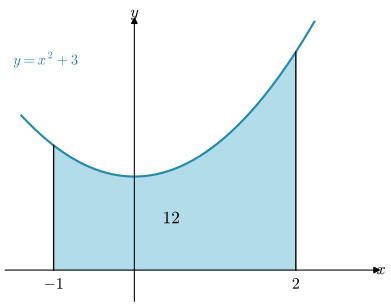
Solution. The curve lies above the $x$-axis, so the area is the integral:
$$\int_{-1}^{2}(x^2 + 3)\,dx = \left[\frac{x^3}{3} + 3x\right]_{-1}^{2} = \left(\frac83 + 6\right) - \left(-\frac13 - 3\right) = 3 + 9 = 12.$$Answer: $12$.
Item (5)
Statement. If $a^{\frac12} + a^{-\frac12} = 3$, what is $a + a^{-1}$?
Solution. Squaring: $a + 2 + a^{-1} = 9$, so $a + a^{-1} = 7$.
Answer: $7$.
Question 4: progressions and sums
Item (1)
Statement. In an arithmetic progression, $a_3 = 6$ and $a_6 = 18$. What is $a_{12}$?
Solution. From $a_3$ to $a_6$ there are three common differences: $3d = 12$, $d = 4$. From $a_6$ to $a_{12}$ there are six: $a_{12} = 18 + 24 = 42$.
Answer: $42$.
Item (2)
Statement. Compute $\displaystyle\sum_{n=1}^{10}(1 - 3n)$ and $\displaystyle\sum_{n=1}^{19}\frac{1}{n(n + 1)}$.
Solution.
1. $\sum_{n=1}^{10}(1 - 3n) = 10 - 3\cdot\frac{10\cdot11}{2} = 10 - 165 = -155$.
2. Since $\frac{1}{n(n + 1)} = \frac1n - \frac{1}{n + 1}$, the sum telescopes:
$$\sum_{n=1}^{19}\left(\frac1n - \frac{1}{n + 1}\right) = 1 - \frac{1}{20} = \frac{19}{20}.$$Answer: $-155$ and $\frac{19}{20}$.