
Euler's Eyes
2026-11-05
MEXT 2019 – Mathematics (Specialized Training College) solved
Source: MEXT / Study in Japan – Mathematics paper and official answers. Files on the past exams page.
This is the Mathematics exam for scholarship applicants to specialized training colleges (専修学校, senmon gakkō: two- to three-year vocational courses). It lasts 60 minutes and has three fill-in questions. The statements below follow the original English.
Answer key
| Item | Topic | Answer |
|---|---|---|
| 1 (1) | $\lvert x + 3\rvert < 4x$ | $x > 1$ |
| 1 (2) | Solutions of $x + y + z = 4$ | $15$ |
| 1 (3) | Circle with diameter $OA$ | $3$, $4$, $5$ |
| 1 (4) | Logarithms | $3$, $2$, $4$ |
| 1 (5) | Radicals | $\sqrt5$ |
| 1 (6) | Geometric progression | $a = 2$, $r = -3$ |
| 1 (7) | Perpendicular vector | $2$, $1$, $2$ |
| 1 (8) | Median | $\frac78$; $\sqrt{10}$ |
| 1 (9) | Tangent and area | $y = x + 2$; $\frac56$ |
| 2 | Triangle with a 15° angle | $1$; $\frac{\sqrt6}{2}$; $\frac{2\sqrt3 - \sqrt6}{2}$; $\frac{\sqrt6 - \sqrt2}{2}$; $\frac{\sqrt6 - \sqrt2}{4}$; $\frac{\sqrt6 + \sqrt2}{4}$ |
| 3 | Five graphs | ⑨, ⑤, ⑬, ⑮, ⑦ |
Question 1: nine short items
Item (1)
Statement. Solve $|x + 3| < 4x$.
Solution. The left-hand side is not negative, so we need $4x > 0$, that is, $x > 0$. With $x > 0$, $x + 3 > 0$ and the inequality becomes $x + 3 < 4x$, that is, $x > 1$.
Answer: $x > 1$.
Item (2)
Statement. How many solutions $(x, y, z)$ does $x + y + z = 4$ have with $x, y, z$ non-negative integers?
Solution. Think of 4 balls and 2 dividers in a row: each arrangement gives a solution (the balls before the first divider are $x$, between the two are $y$, after are $z$). There are $\binom{6}{2} = 15$ arrangements.
Answer: $15$.
Item (3)
Statement. Given $O(0, 0)$ and $A(6, 8)$, the circle with diameter $OA$ is $(x - \text{①})^2 + (y - \text{②})^2 = \text{③}^2$.
Solution. The center is the midpoint $(3, 4)$ and the radius is half of $OA = \sqrt{36 + 64} = 10$.
Answer: $3$, $4$, $5$.
Item (4)
Statement. $\log_4 9 = \log_2\text{①}$, $\log_9 4 = \log_3\text{②}$, hence $(\log_2 3 + \log_4 9)(\log_3 2 + \log_9 4) = \text{③}$.
Solution. $\log_4 9 = \frac{\log_2 9}{\log_2 4} = \frac{2\log_2 3}{2} = \log_2 3$ and, likewise, $\log_9 4 = \log_3 2$. The product is $2\log_2 3\cdot 2\log_3 2 = 4\cdot1 = 4$.
Answer: $3$, $2$, $4$.
Item (5)
Statement. Compute $\sqrt[6]{25}\times\sqrt[3]{25}\div\sqrt5$.
Solution. In powers of 5: $5^{\frac13}\cdot5^{\frac23}\cdot5^{-\frac12} = 5^{\frac12} = \sqrt5$.
Answer: $\sqrt5$.
Item (6)
Statement. In a geometric progression, $a_1 + a_2 + a_3 = 14$ and $a_2 + a_3 + a_4 = -42$. Give the first term $a$ and the common ratio $r$.
Solution. The second sum is the first one times $r$: $14r = -42$, $r = -3$. Then $a(1 - 3 + 9) = 7a = 14$, $a = 2$.
Answer: $a = 2$, $r = -3$.
Item (7)
Statement. Let $\vec a = (1, 0, -1)$, $\vec b = (-2, 2, 1)$ and $\vec c = (x, y, z)$ with $x > 0$ and $|\vec c| = 3$. If $\vec c$ is perpendicular to both $\vec a$ and $\vec b$, what are $x$, $y$ and $z$?
Solution. $\vec a\cdot\vec c = x - z = 0$ and $\vec b\cdot\vec c = -2x + 2y + z = 0$. With $z = x$: $y = \frac x2$. Then $|\vec c|^2 = x^2 + \frac{x^2}{4} + x^2 = \frac94x^2 = 9$, and with $x > 0$, $x = 2$, $y = 1$, $z = 2$.
Answer: $2$, $1$, $2$.
Item (8)
Statement. In triangle $ABC$, with $BC = 8$, $CA = 4$ and $AB = 6$, let $M$ be the midpoint of $BC$. Compute $\cos\angle ABC$ and $AM$.
Solution. By the law of cosines, $\cos B = \frac{6^2 + 8^2 - 4^2}{2\cdot6\cdot8} = \frac{84}{96} = \frac78$. In triangle $ABM$, with $BM = 4$:
$$AM^2 = 36 + 16 - 2\cdot6\cdot4\cdot\frac78 = 52 - 42 = 10.$$Answer: $\frac78$ and $\sqrt{10}$.
Item (9)
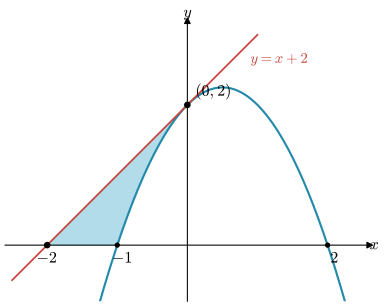
Statement. Give the tangent to the curve $f(x) = -x^2 + x + 2$ at the point $(0, 2)$ and the area of the region bounded by the curve, the tangent and the $x$-axis.
Solution.
1. The tangent. $f'(x) = -2x + 1$ and $f'(0) = 1$: $y = x + 2$.
2. The region. The tangent meets the $x$-axis at $x = -2$, and the curve meets it at $x = -1$ (and at $x = 2$). The region lies between $x = -2$ and $x = 0$, below the tangent and above the $x$-axis and the curve. It is the triangle under the tangent minus the part under the curve:
$$\frac12\cdot2\cdot2 - \int_{-1}^{0}(-x^2 + x + 2)\,dx = 2 - \left[-\frac{x^3}{3} + \frac{x^2}{2} + 2x\right]_{-1}^{0} = 2 - \frac76 = \frac56.$$(At the lower limit, $-\frac{(-1)^3}{3} + \frac12 - 2 = -\frac76$, and the integral is $0 - \left(-\frac76\right) = \frac76$.)
Answer: $y = x + 2$ and $\frac56$.
Question 2: a triangle with a 15° angle
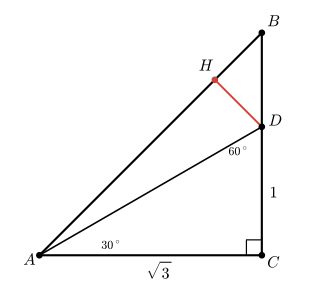
Statement. In triangle $ABC$, $AC = BC$ and $\angle ACB = 90^\circ$. The point $D$ is on side $BC$, with $DC = 1$ and $\angle ADC = 60^\circ$; $H$ is the foot of the perpendicular from $D$ to $AB$.
- The radius of the circumcircle of triangle $ADC$.
- The radius of the circumcircle of triangle $ABC$.
- The radius of the incircle of triangle $ABC$, in the form $\frac{\text{①}\sqrt{\text{②}} - \sqrt{\text{③}}}{\text{④}}$.
- $DH$, in the form $\frac{\sqrt{\text{①}} - \sqrt{\text{②}}}{\text{③}}$.
- $\sin\angle DAH$ and 6. $\cos\angle DAH$, in the forms $\frac{\sqrt{\text{①}} \mp \sqrt{\text{②}}}{\text{③}}$.
Solution.
1. Triangle $ADC$. It is right-angled at $C$, with $\angle ADC = 60^\circ$: $AC = \sqrt3$ and $AD = 2$. The hypotenuse is a diameter of the circumcircle, so the radius is $1$.
2. Triangle $ABC$. $AC = BC = \sqrt3$ and $AB = \sqrt6$. The radius is half the hypotenuse: $\frac{\sqrt6}{2}$.
3. The inradius. In a right triangle with legs $p, q$ and hypotenuse $h$, $r = \frac{p + q - h}{2}$: $r = \frac{2\sqrt3 - \sqrt6}{2}$.
4. $DH$. $BD = \sqrt3 - 1$ and the angle at $B$ is $45^\circ$, so $DH = BD\sin45^\circ = \frac{\sqrt3 - 1}{\sqrt2} = \frac{\sqrt6 - \sqrt2}{2}$.
5–6. The angle $DAH$. $\angle DAH = \angle BAC - \angle DAC = 45^\circ - 30^\circ = 15^\circ$. In triangle $ADH$, right-angled at $H$, with hypotenuse $AD = 2$:
$$\sin15^\circ = \frac{DH}{AD} = \frac{\sqrt6 - \sqrt2}{4}, \qquad \cos15^\circ = \sqrt{1 - \sin^2 15^\circ} = \sqrt{\frac{8 + 2\sqrt{12}}{16}} = \frac{\sqrt6 + \sqrt2}{4}.$$(It is the geometric route to the values of $\sin15^\circ$ and $\cos15^\circ$, without the subtraction formula.)
Answer: $1$; $\frac{\sqrt6}{2}$; $2, 3, 6, 2$; $6, 2, 2$; $6, 2, 4$; $6, 2, 4$.
Question 3: five graphs to identify
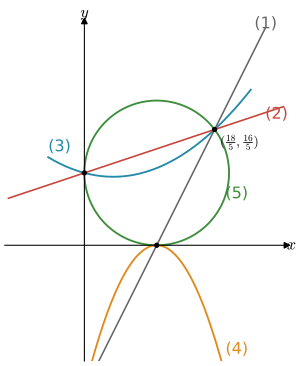
Statement. The $xy$-plane shows two lines, (1) and (2), two parabolas, (3) and (4), and a circle, (5). The circle touches both axes, at $(0, 2)$ and $(2, 0)$; parabola (4) has its vertex at $(2, 0)$ and opens downward; parabola (3) passes through $(0, 2)$; line (2) passes through $(0, 2)$ with a small positive slope; line (1) passes through $(2, 0)$ with a steep slope; lines (1), (2), parabola (3) and the circle pass through a common point. Choose the equation of each graph from:
| ① $x + 3y + 6 = 0$ | ② $4x - y - 4 = 0$ | ③ $x^2 + 4x + y^2 + 4y + 4 = 0$ |
| ④ $5x^2 - 30y + 8x + 60 = 0$ | ⑤ $x - 3y + 6 = 0$ | ⑥ $x^2 + y + 4x + 4 = 0$ |
| ⑦ $x^2 - 4x + y^2 - 4y + 4 = 0$ | ⑧ $5x^2 - 30y - 8x - 60 = 0$ | ⑨ $2x - y - 4 = 0$ |
| ⑩ $x^2 + y - 4x - 4 = 0$ | ⑪ $x^2 - 4x - y^2 - 4y + 4 = 0$ | ⑫ $x - 3y - 6 = 0$ |
| ⑬ $5x^2 - 30y - 8x + 60 = 0$ | ⑭ $2x + y + 4 = 0$ | ⑮ $x^2 + y - 4x + 4 = 0$ |
Solution. Each graph is recognized by one or two points and its shape.
(5) The circle. Tangent to both axes at $(2, 0)$ and $(0, 2)$: center $(2, 2)$ and radius 2, that is, $(x - 2)^2 + (y - 2)^2 = 4$, which expanded is $x^2 - 4x + y^2 - 4y + 4 = 0$ (⑦). (③ has center $(-2, -2)$; ⑪ is a hyperbola.)
(4) The lower parabola. Vertex $(2, 0)$, opening downward: $y = -(x - 2)^2$, that is, $x^2 + y - 4x + 4 = 0$ (⑮).
(2) The gently sloped line. It passes through $(0, 2)$ with positive slope: among the options, only ⑤ ($y = \frac x3 + 2$) fits.
(3) The upper parabola. It passes through $(0, 2)$ and opens upward. ⑬ gives $y = \frac{5x^2 - 8x + 60}{30}$, which equals $2$ at $x = 0$ and has its vertex at $x = \frac45 > 0$, as in the figure. (④ has its vertex on the left, and ⑧ does not pass through $(0, 2)$.)
(1) The steep line. It passes through $(2, 0)$: only ② and ⑨ fit. The common point of (2), (3) and (5) comes from $x = 3y - 6$ on the circle: $(3y - 8)^2 + (y - 2)^2 = 4$, or $5y^2 - 26y + 32 = 0$, with $y = 2$ (the point $(0, 2)$) or $y = \frac{16}{5}$, $x = \frac{18}{5}$. Line ⑨ ($y = 2x - 4$) passes through $\left(\frac{18}{5}, \frac{16}{5}\right)$; ② does not.
Answer: (1) ⑨, (2) ⑤, (3) ⑬, (4) ⑮, (5) ⑦.