
Euler's Eyes
2022-09-12
First Degree Equations
First-degree equations have made life difficult for many children. But this is due to teaching, in which a rule is imposed without showing the basis. As children, many have heard that in equations the number jumps to the other side and changes the sign. The child says my god 😥😥. As a result, the child’s vision is…

Or like this:
What to do?
Traditional school method
The traditional school method shows techniques that scare students and make them terrified of mathematics. For example:

Scale method
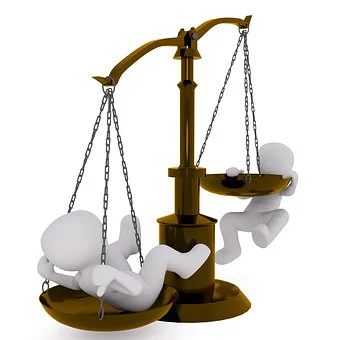
When talking about first degree equations, we must keep in mind that a balance.
Balance
In order to balance the scale, we put more mass on one side to achieve balance.

Balance must be maintained, that is, the left side must be equal to the right.

Polynomial equations
The first definition we should keep in mind is polynomials.
Definition: polynomials are algebraic expressions formed by coefficients (numeric values) and unknowns (variables).
Degrees of the equation
Polynomial equations are classified according to their degree.
Definition: the degree of a polynomial equation is given by the highest power that has a non-zero coefficient.
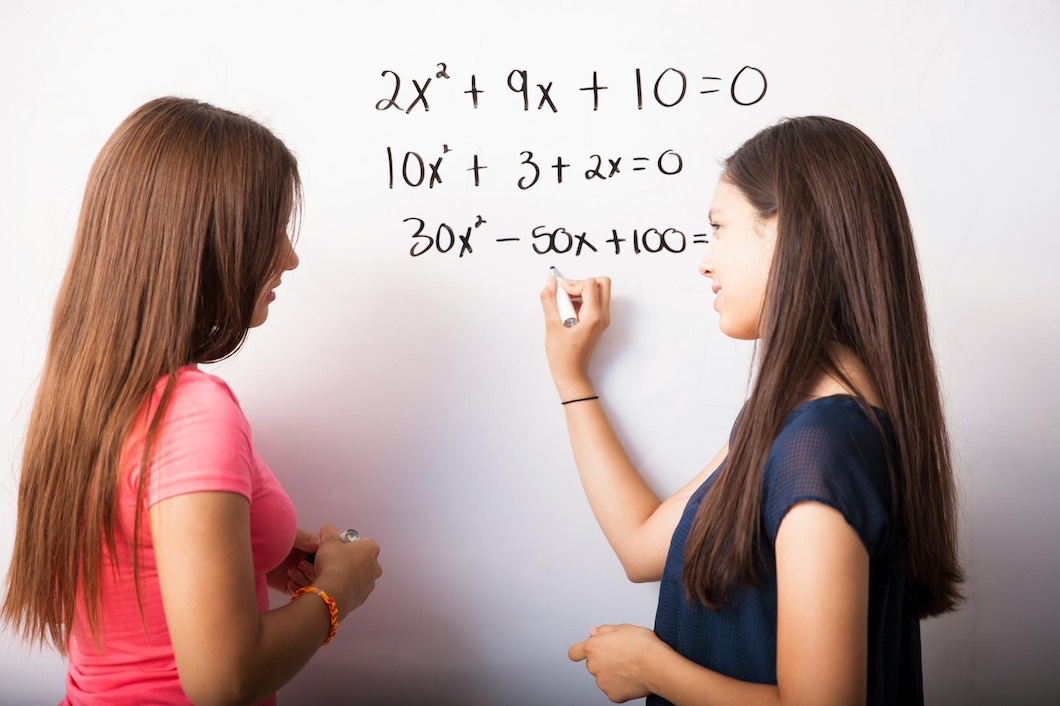
Below we present some examples of degrees of a polynomial equation.
-
First degree:
- $10x-2=0$
-
Second degree:
- $2x^2-5x-3=0$
-
Third degree:
- $5x^3-2x^2 + x - 8=0$
$\vdots$
-
nth degree:
- $5x^n-\dots+2x^2 + x - 8=0$
First degree equations
In the scale method, to maintain balance, what we do with one piece of data in the equation, we do with the other.
Definition: we say an equation is a mathematical sentence that has at least one unknown, which we call a variable (see algebraic expressions) and an equality.
An equation can be classified according to its degree (in this case first) and number of unknowns.
Example with integers
See how we do it:

This way:
- If we subtract from one side 2,
- we subtract the same 2 from the other.
With $x=3$ both sides of the equality are satisfied or we obtain balance. In fact,
Example with rational numbers
In the previous section, we presented an example with integers. Now let’s apply the equations for rational numbers.
Calculate $3x - 2 = 8$
Calculate $\dfrac{x}{5} = 9$

In this post we address the scale methodology for first degree equations. Wait for the next posts.