
Euler's Eyes
2026-10-14
The Lagrange points: where gravity balances
On 25 December 2021 a rocket lifted off from French Guiana carrying the James Webb Space Telescope. It was not placed in orbit around the Earth, like Hubble. It travelled for a month to an empty point in space, 1.5 million kilometres from here, always on the side opposite the Sun, and stayed there. The address of that point comes from a prize-winning paper by Lagrange, from 1772. It is called L2.
Three bodies
Newton completely solved the motion of two bodies that attract each other, like the Sun and a planet: each traces an ellipse. With three bodies, for instance the Sun, the Earth and the Moon, everything gets complicated. Each body pulls on the other two, and the motion can become chaotic. Eighteenth-century mathematicians knew it would not be easy, and the Paris Academy set the problem several times as a prize subject.
In 1772 the prize was shared between Euler and Lagrange. Lagrange’s paper, Essay on the Three-Body Problem, did not find the general solution, which in fact does not exist as a formula, as Poincaré would show in 1890. But it found something surprising: special solutions in which the three bodies rotate together, like a rigid block, without ever changing the shape of the figure they form.
There are two ways for this to happen. The three bodies can stay in a line, a solution Euler had already found in 1767. Or they can sit at the vertices of an equilateral triangle, of any size, rotating about the centre of mass. That second one was Lagrange’s discovery.
The five points
When one of the three bodies is very small, like a spacecraft near the Sun and the Earth, these solutions become five places in space. A spacecraft placed at one of them goes round the Sun together with the Earth, always keeping the same position relative to the two.
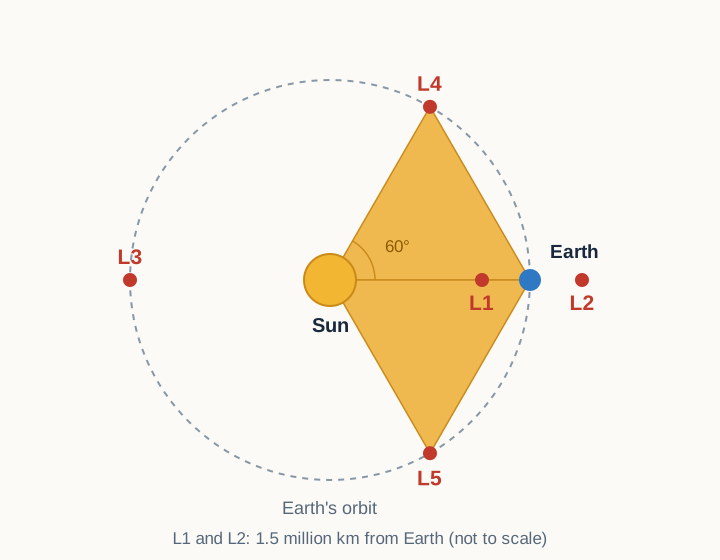
- L1 lies between the Earth and the Sun, where the Earth’s pull cancels a little of the Sun’s.
- L2 lies on the far side of the Earth, where the pulls of the two add up.
- L3 lies on the far side of the Sun, a little farther away than the Earth.
- L4 and L5 are the vertices of the equilateral triangles.
The calculation for L2
Why is L2 1.5 million kilometres away, and not somewhere else? A body at a distance $r$ beyond the Earth is $R+r$ from the Sun, where $R$ is the Earth–Sun distance. To rotate together with the Earth, it must go round in the same time, one year. Farther from the Sun, the Sun’s pull alone would be too weak for that; the Earth’s pull, acting in the same direction, makes up the difference.
Writing the equality between the total pull and the force needed to follow the curve, and using the fact that $r$ is much smaller than $R$, one arrives at a simple formula:
$$r\approx R\,\sqrt[3]{\frac{m}{3M}},$$where $m$ is the mass of the Earth and $M$ that of the Sun. The Earth has about $3\times10^{-6}$ of the Sun’s mass, and
$$\begin{aligned}r&\approx R\,\sqrt[3]{10^{-6}}=\frac{R}{100}\\&\approx\frac{150\ \text{million km}}{100}\\&=1.5\ \text{million km}.\end{aligned}$$L1 is at the same distance, on this side. It is a calculation of Lagrange’s that is done today with pencil and paper to choose where to park a telescope.
The Trojans
L4 and L5 are different. In the nineteenth century the Englishman Edward Routh showed that they are stable, like a ball at the bottom of a valley, provided the larger body has at least about 25 times the mass of the second. The Sun has about 1047 times the mass of Jupiter, so there ought to be things gathered there, trapped for billions of years.
In 1906 the German astronomer Max Wolf, in Heidelberg, found an asteroid exactly 60° ahead of Jupiter in its orbit. He named it Achilles, after the Greek hero of the Iliad. The next ones received the names of other heroes of the Trojan War, and the group became known as the Trojan asteroids. More than 10,000 are known today. By convention, those at L4 bear Greek names and those at L5 Trojan names, with two exceptions that predate the rule: Hector, a Trojan, is in the Greek camp, and Patroclus, a Greek, is in the Trojan one.
In 2021 NASA launched the Lucy probe to visit several of Jupiter’s Trojans. The name honours the famous human fossil, which was in turn named after a Beatles song. The Trojans are leftovers from the time the planets formed, kept at a point Lagrange found with paper and ink.
Exercise: how far from the Moon is the L1 point of the Earth–Moon system?
The Moon has about $0.0123$ of the Earth’s mass and is at $R\approx384\,400$ km. By the formula,
$$r\approx384\,400\cdot\sqrt[3]{\frac{0.0123}{3}}\approx384\,400\cdot0.160\approx61\,500\ \text{km}.$$The exact value is close to $58\,000$ km. The difference comes from the approximation $r\ll R$, which is less good here because the Moon is too heavy relative to the Earth.
Exercise: how far from the Sun and from the Earth are the Earth's Trojans?
At L4 and L5 the three bodies form an equilateral triangle, so both sides measure the same as the Earth–Sun distance: about 150 million km, or 1 astronomical unit. The Earth does in fact have at least two known Trojans, the asteroids 2010 TK7 and 2020 XL5, both at L4.
Sources: Joseph-Louis Lagrange, Essai sur le problème des trois corps (1772), in volume 6 of the Œuvres de Lagrange · biography of Lagrange, MacTutor · What is a Lagrange Point?, NASA.
All Lagrange topics · ← The Analytical Mechanics: a book without figures · Four squares are enough →