
Euler's Eyes
2026-11-03
EJU 2019 (1st session) – Mathematics Course 2 solved
Source: JASSO – Mathematics paper in English, in Japanese and official answer key. Files on the page for the 1st session of 2019.
Course 2 is the advanced mathematics paper of the EJU. Each letter $\boxed{\text{A}}$, $\boxed{\text{B}}$, … is a digit from 0 to 9 or the minus sign; in some blanks the answer is the number of a choice. The statements below are summarized from the official English version.
Answer key
| Question | Topic | Answers |
|---|---|---|
| I | Same as Question I of Course 1 | A=9, B=7, C=7, D=8, E=9, F=9, G=7, H=6, I=4, J=0, K=4; L=2, M=1, NO=17, PQRS=2549, TUVW=2449, X=4, Y=1 |
| II Q1 | Tetrahedron inscribed in a sphere | A=6, B=5, C=2, D=1, E=8, F=4, G=2, H=3, I=7, J=6, K=4, L=3 |
| II Q2 | Triangle in the complex plane | M=1, N=3, O=2, P=1, Q=2, R=3, S=1, T=3, U=2, V=3, W=9, X=3, Y=4 |
| III | Projections of two points on a circle | A=3, B=2, C=4, D=3, E=4, F=4, G=3, H=2, I=3, J=3, K=8, L=3, M=9, N=0, O=5, P=6, Q=0, R=4, S=6 |
| IV | $x - 1 \ge \log x$ and an area | A=1, B=1, C=1, D=0, E=2, F=2, G=1, H=2, I=2, J=1, K=1, L=2, M=2, N=2, O=1, P=2, Q=1, R=1, S=1, T=2, U=2, V=2, W=0 |
Question I
Question I of Course 2 is identical to that of Course 1 (the signs of the coefficients of a parabola and a loaded die). The full solution is in the Course 1 post.
Answers: A=9, B=7, C=7, D=8, E=9, F=9, G=7, H=6, I=4, J=0, K=4; L=2, M=1, NO=17, PQRS=2549, TUVW=2449, X=4, Y=1.
Question II
Q1: a tetrahedron inscribed in a sphere
Statement. In blanks $\boxed{\text{A}}$, $\boxed{\text{B}}$, $\boxed{\text{D}}$, $\boxed{\text{E}}$ and $\boxed{\text{G}}$, choose from ⓪ $\vec a$, ① $\vec b$, ② $\vec c$, ③ $\vec a - \vec b$, ④ $\vec b - \vec c$, ⑤ $\vec c - \vec a$, ⑥ $\vec a + \vec b$, ⑦ $\vec b + \vec c$, ⑧ $\vec c + \vec a$, ⑨ $\vec a + \vec b + \vec c$; in the others, write the number.
On a sphere of radius 2 and center $O$, the tetrahedron $ABCD$ has all four vertices on the sphere, $AB = BC = CA = 2$, and edge $BD$ is a diameter. Let $\vec a = \vec{OA}$, $\vec b = \vec{OB}$ and $\vec c = \vec{OC}$.
- Let $M$ and $N$ be the midpoints of $DA$ and $BC$. Then $\vec{DA} = \boxed{\text{A}}$ and $\vec{MN} = \dfrac{\boxed{\text{B}}}{\boxed{\text{C}}} + \boxed{\text{D}}$.
- Let $P$ be the midpoint of $MN$ and $G$ the centroid of triangle $BCD$. Then $\vec{OP} = \dfrac{\boxed{\text{E}}}{\boxed{\text{F}}}$, $\vec{OG} = \dfrac{\boxed{\text{G}}}{\boxed{\text{H}}}$ and $|\vec{PG}| = \dfrac{\sqrt{\boxed{\text{I}}}}{\boxed{\text{J}}}$. Moreover, since $\vec{AG} = \dfrac{\boxed{\text{K}}}{\boxed{\text{L}}}\vec{AP}$, the points $A$, $P$ and $G$ are collinear.
Solution.
1. The point $D$. $BD$ is a diameter, so $D$ is antipodal to $B$: $\vec{OD} = -\vec b$.
2. The required vectors. $\vec{DA} = \vec a - (-\vec b) = \vec a + \vec b$ (⑥). $\vec{OM} = \frac{\vec a - \vec b}{2}$ and $\vec{ON} = \frac{\vec b + \vec c}{2}$, so
$$\vec{MN} = \frac{\vec b + \vec c - \vec a + \vec b}{2} = \frac{\vec c - \vec a}{2} + \vec b \quad (\text{⑤},\ 2,\ \text{①}).$$3. $P$ and $G$. $\vec{OP} = \frac{\vec{OM} + \vec{ON}}{2} = \frac{\vec a + \vec c}{4}$ (⑧, 4) and $\vec{OG} = \frac{\vec b + \vec c - \vec b}{3} = \frac{\vec c}{3}$ (②, 3).
4. $|\vec{PG}|$. $\vec{PG} = \frac{\vec c}{3} - \frac{\vec a + \vec c}{4} = \frac{\vec c - 3\vec a}{12}$. Triangle $OAC$ has all three sides equal to 2 (two radii and $AC$), so it is equilateral and $\vec a\cdot\vec c = 4\cos60^\circ = 2$. Hence
$$|\vec c - 3\vec a|^2 = 4 + 36 - 6\cdot2 = 28, \qquad |\vec{PG}| = \frac{2\sqrt7}{12} = \frac{\sqrt7}{6}.$$5. Collinearity. $\vec{AP} = \frac{\vec a + \vec c}{4} - \vec a = \frac{\vec c - 3\vec a}{4}$ and $\vec{AG} = \frac{\vec c}{3} - \vec a = \frac{\vec c - 3\vec a}{3}$. So $\vec{AG} = \frac43\vec{AP}$.
Answers: A=6, B=5, C=2, D=1, E=8, F=4, G=2, H=3, I=7, J=6, K=4, L=3.
Q2: a triangle in the complex plane
Statement. The distinct complex numbers $\alpha$, $\beta$ and $\gamma$ represent the points $A$, $B$ and $C$ and satisfy
$$(\gamma - \alpha)^2 + (\gamma - \alpha)(\beta - \alpha) + (\beta - \alpha)^2 = 0 \quad \text{①}, \qquad |\beta - 2\alpha + \gamma| = 3 \quad \text{②}.$$We want the area of triangle $ABC$. From ①, $\dfrac{\gamma - \alpha}{\beta - \alpha} = \dfrac{-\boxed{\text{M}} \pm \sqrt{\boxed{\text{N}}}\,i}{\boxed{\text{O}}}$, so $\left|\dfrac{\gamma - \alpha}{\beta - \alpha}\right| = \boxed{\text{P}}$ and $\arg\dfrac{\gamma - \alpha}{\beta - \alpha} = \pm\dfrac{\boxed{\text{Q}}}{\boxed{\text{R}}}\pi$ (with $-\pi < \arg < \pi$). Since $\beta - 2\alpha + \gamma = (\beta - \alpha)\cdot\dfrac{\boxed{\text{S}} \pm \sqrt{\boxed{\text{T}}}\,i}{\boxed{\text{U}}}$, ② gives $|\beta - \alpha| = \boxed{\text{V}}$. The area of $ABC$ is $\dfrac{\boxed{\text{W}}\sqrt{\boxed{\text{X}}}}{\boxed{\text{Y}}}$.
Solution.
1. Dividing ① by $(\beta - \alpha)^2$ and calling $z = \frac{\gamma - \alpha}{\beta - \alpha}$: $z^2 + z + 1 = 0$, or $z = \frac{-1 \pm \sqrt3\,i}{2}$. These are the non-real cube roots of unity: $|z| = 1$ and $\arg z = \pm\frac{2\pi}{3}$.
2. $\beta - 2\alpha + \gamma = (\beta - \alpha) + (\gamma - \alpha) = (\beta - \alpha)(1 + z)$, and $1 + z = \frac{1 \pm \sqrt3\,i}{2}$ has modulus 1. So $|\beta - \alpha| = 3$.
3. The area. $AB = |\beta - \alpha| = 3$, $AC = |z|\cdot AB = 3$ and the angle at $A$ is $\frac{2\pi}{3}$:
$$\triangle ABC = \frac12\cdot 3\cdot 3\sin\frac{2\pi}{3} = \frac{9\sqrt3}{4}.$$Answers: M=1, N=3, O=2, P=1, Q=2, R=3, S=1, T=3, U=2, V=3, W=9, X=3, Y=4.
Question III: the projections of two points on a circle
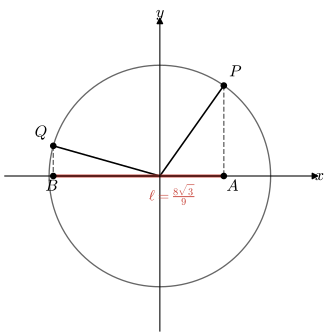
Statement. In the plane, $C$ is the circle of radius 1 centered at the origin $O$. For $0 \le \theta \le \pi$, $P$ and $Q$ are the points of $C$ on the rays making angles $\theta$ and $3\theta$ with the positive $x$-axis. $A$ and $B$ are the feet of the perpendiculars from $P$ and $Q$ to the $x$-axis, and $\ell = AB$.
- With $\theta = \frac\pi3$, $\ell = \dfrac{\boxed{\text{A}}}{\boxed{\text{B}}}$.
- We want the maximum of $\ell$. With $\cos\theta = t$, $\ell = \left|\boxed{\text{C}}\,t^{\boxed{\text{D}}} - \boxed{\text{E}}\,t\right|$. With $g(t) = \boxed{\text{C}}\,t^{\boxed{\text{D}}} - \boxed{\text{E}}\,t$, $g'(t) = \boxed{\text{F}}\left(\boxed{\text{G}}\,t^{\boxed{\text{H}}} - 1\right)$. When $\cos\theta = \pm\dfrac{\sqrt{\boxed{\text{I}}}}{\boxed{\text{J}}}$, $\ell$ is largest, with value $\dfrac{\boxed{\text{K}}\sqrt{\boxed{\text{L}}}}{\boxed{\text{M}}}$.
- There are two pairs of points at which $\ell$ is largest: $P\left(\frac{\sqrt{\boxed{\text{I}}}}{\boxed{\text{J}}}, \boxed{\text{N}}\right)$, $Q\left(\boxed{\text{O}}, \boxed{\text{P}}\right)$ and $P\left(-\frac{\sqrt{\boxed{\text{I}}}}{\boxed{\text{J}}}, \boxed{\text{Q}}\right)$, $Q\left(\boxed{\text{R}}, \boxed{\text{S}}\right)$. Choose $\boxed{\text{N}}$ to $\boxed{\text{S}}$ from ⓪ $\frac{\sqrt6}{3}$, ① $\frac{\sqrt6}{2}$, ② $\frac{4\sqrt3}{9}$, ③ $-\frac{4\sqrt3}{9}$, ④ $\frac{5\sqrt3}{9}$, ⑤ $-\frac{5\sqrt3}{9}$, ⑥ $\frac{\sqrt6}{9}$, ⑦ $-\frac{\sqrt6}{9}$, ⑧ $\frac{2\sqrt6}{9}$, ⑨ $-\frac{2\sqrt6}{9}$.
Solution.
1. $A = (\cos\theta, 0)$ and $B = (\cos3\theta, 0)$, so $\ell = |\cos\theta - \cos3\theta|$. With $\theta = \frac\pi3$: $\left|\frac12 - \cos\pi\right| = \frac32$.
2. In terms of $t$. $\cos3\theta = 4t^3 - 3t$, so $\ell = |t - 4t^3 + 3t| = |4t^3 - 4t|$. With $g(t) = 4t^3 - 4t$, $g'(t) = 12t^2 - 4 = 4(3t^2 - 1)$, which vanishes at $t = \pm\frac{1}{\sqrt3} = \pm\frac{\sqrt3}{3}$. On $[-1, 1]$, $g$ is $0$ at the endpoints and at $t = 0$, and at the critical points
$$|g| = \left|\frac{4}{3\sqrt3} - \frac{4}{\sqrt3}\right| = \frac{8}{3\sqrt3} = \frac{8\sqrt3}{9}.$$That is the maximum of $\ell$.
3. The points. With $\cos\theta = \frac{\sqrt3}{3}$ and $0 \le \theta \le \pi$, $\sin\theta = \sqrt{1 - \frac13} = \frac{\sqrt6}{3}$ (⓪). Then
$$\cos3\theta = 4\cdot\frac{\sqrt3}{9} - \sqrt3 = -\frac{5\sqrt3}{9}\ (\text{⑤}), \qquad \sin3\theta = 3\sin\theta - 4\sin^3\theta = \sqrt6 - \frac{24\sqrt6}{27} = \frac{\sqrt6}{9}\ (\text{⑥}).$$With $\cos\theta = -\frac{\sqrt3}{3}$, the sine is the same, $\frac{\sqrt6}{3}$ (⓪); $\cos3\theta$ changes sign (it is odd in $t$), $\frac{5\sqrt3}{9}$ (④); and $\sin3\theta$, which depends only on $\sin\theta$, stays $\frac{\sqrt6}{9}$ (⑥).
Answers: A=3, B=2, C=4, D=3, E=4, F=4, G=3, H=2, I=3, J=3, K=8, L=3, M=9, N=0, O=5, P=6, Q=0, R=4, S=6.
Question IV: x − 1 ≥ log x and an area
Statement. Here $\log$ is the natural logarithm.
-
Let $f(x) = x - 1 - \log x$. Then $f'(x) = \boxed{\text{A}} - \dfrac{\boxed{\text{B}}}{x}$. $f$ is smallest at $x = \boxed{\text{C}}$, with value $\boxed{\text{D}}$. Hence $x - 1 \ge \log x$.
-
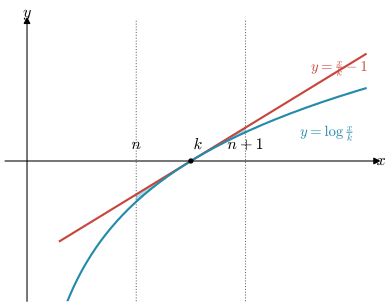
In blank $\boxed{\text{G}}$, choose from ⓪ $x(\log x + 1)$, ① $x(\log x - 1)$, ② $\frac{\log x + 1}{x}$, ③ $\frac{\log x - 1}{x}$. Let $k > 0$ be real and $n$ a positive integer, and let $S$ be the area bounded by the lines $y = \frac xk - 1$, $x = n$, $x = n + 1$ and the curve $y = \log\frac xk$. Using (1),
$$S = \left[\frac{x^{\boxed{\text{E}}}}{\boxed{\text{F}}\,k} - x - \boxed{\text{G}} + x\log k\right]_n^{n+1} = \frac{\boxed{\text{H}}\,n + 1}{\boxed{\text{I}}\,k} + \log k - (n + \boxed{\text{J}})\log(n + \boxed{\text{K}}) + n\log n.$$ -
With $n$ fixed and $k > 0$ varying, let $a_n$ be the minimum of $S$. Differentiating, $\dfrac{dS}{dk} = \dfrac{\boxed{\text{L}}\,k - (\boxed{\text{M}}\,n + 1)}{\boxed{\text{N}}\,k^2}$, and $S$ is smallest at $k = n + \dfrac{\boxed{\text{O}}}{\boxed{\text{P}}}$. Hence
$$a_n = \boxed{\text{Q}} - \log\left\{\left(\boxed{\text{R}} + \frac{\boxed{\text{S}}}{n}\right)^n\cdot\frac{\boxed{\text{T}}\,n + \boxed{\text{U}}}{\boxed{\text{V}}\,n + 1}\right\},$$and $\lim_{n\to\infty} a_n = \boxed{\text{W}}$.
Solution.
1. $f'(x) = 1 - \frac1x$ is negative on $(0, 1)$ and positive afterwards: minimum $f(1) = 0$. So $f \ge 0$, that is, $x - 1 \ge \log x$, with equality only at $x = 1$.
2. The area. By (1) with $\frac xk$ in place of $x$, the line lies above the curve. So
$$S = \int_n^{n+1}\left(\frac xk - 1 - \log x + \log k\right)dx.$$Since $\int\log x\,dx = x(\log x - 1)$ (①), an antiderivative is $\frac{x^2}{2k} - x - x(\log x - 1) + x\log k = \frac{x^2}{2k} - x\log x + x\log k$. Between $n$ and $n + 1$:
$$S = \frac{2n + 1}{2k} + \log k - (n + 1)\log(n + 1) + n\log n.$$3. The minimum in $k$.
$$\frac{dS}{dk} = -\frac{2n + 1}{2k^2} + \frac1k = \frac{2k - (2n + 1)}{2k^2},$$negative before $k = n + \frac12$ and positive after. At $k = n + \frac12$, the first term equals 1, and
$$a_n = 1 + \log\left(n + \tfrac12\right) - \log\frac{(n + 1)^{n+1}}{n^n} = 1 - \log\left\{\left(1 + \frac1n\right)^n\cdot\frac{2n + 2}{2n + 1}\right\}.$$4. The limit. $\left(1 + \frac1n\right)^n \to e$ and $\frac{2n + 2}{2n + 1} \to 1$, so $a_n \to 1 - \log e = 0$.
Answers: A=1, B=1, C=1, D=0, E=2, F=2, G=1, H=2, I=2, J=1, K=1, L=2, M=2, N=2, O=1, P=2, Q=1, R=1, S=1, T=2, U=2, V=2, W=0.