
Euler's Eyes
2026-10-11
The life of Isaac Newton
Timeline
- 1643Born on 4 January at Woolsthorpe, England. In English records of the time the date is 25 December 1642.
- 1661Enters Trinity College, Cambridge, as a poor student.
- 1665–1667With the university closed by the plague, he returns home. He develops series, fluxions, the theory of colours and his first ideas on gravity.
- 1669Aged 26, becomes Lucasian Professor of Mathematics, succeeding Isaac Barrow.
- 1672Presents his reflecting telescope and publishes his theory of light and colours.
- 1687Publishes the Principia, paid for out of Edmond Halley’s own pocket.
- 1696Moves to the Royal Mint in London, first as Warden and, from 1699, as Master.
- 1703Becomes President of the Royal Society.
- 1704Publishes Opticks.
- 1727Dies on 31 March in London. He is buried in Westminster Abbey.
- He is born on a farm, the posthumous son of a farmer, and goes to school in nearby Grantham.
- He enters Trinity College as a poor student who pays his way by serving other students.
- With the university closed by the plague, he goes home. He develops series, fluxions, the theory of colours and his first ideas on gravity.
- He holds the Lucasian chair, builds the reflecting telescope and writes the Principia (1687).
- He runs the Royal Mint, at the Tower of London, and presides over the Royal Society. He dies in 1727 and is buried in Westminster Abbey.
- 1643–1661 · Woolsthorpe
- 1661–1665 · Cambridge
- 1665–1667 · Woolsthorpe
- 1667–1696 · Cambridge
- 1696–1727 · London
Newton’s life
A childhood without his parents
Newton was born on a small farm at Woolsthorpe, in Lincolnshire. His father, also called Isaac, was a farmer who could not sign his own name. He died three months before his son was born. The baby came early and was so tiny that, as his mother would later say, he could have fitted into a quart pot.
When Isaac was three, his mother, Hannah, married a wealthy clergyman from a nearby village and went to live with him. The boy stayed with his grandmother. The separation left its mark: at 19, in a list of “sins” he wrote in a notebook, Newton confessed to “threatening my father and mother Smith to burn them and the house over them”.
At school in Grantham he lodged with an apothecary and was fascinated by the jars, herbs and recipes. He loved building things: sundials, model windmills and a kite with a lantern tied to its tail, which frightened the neighbours at night.
When his stepfather died, his mother returned to Woolsthorpe and took him out of school to run the farm. It was a disaster. Newton read while the sheep wandered off and the pigs got into a neighbour’s crops. The headmaster and an uncle persuaded his mother that the young man had to go to university.
Cambridge and the plague years
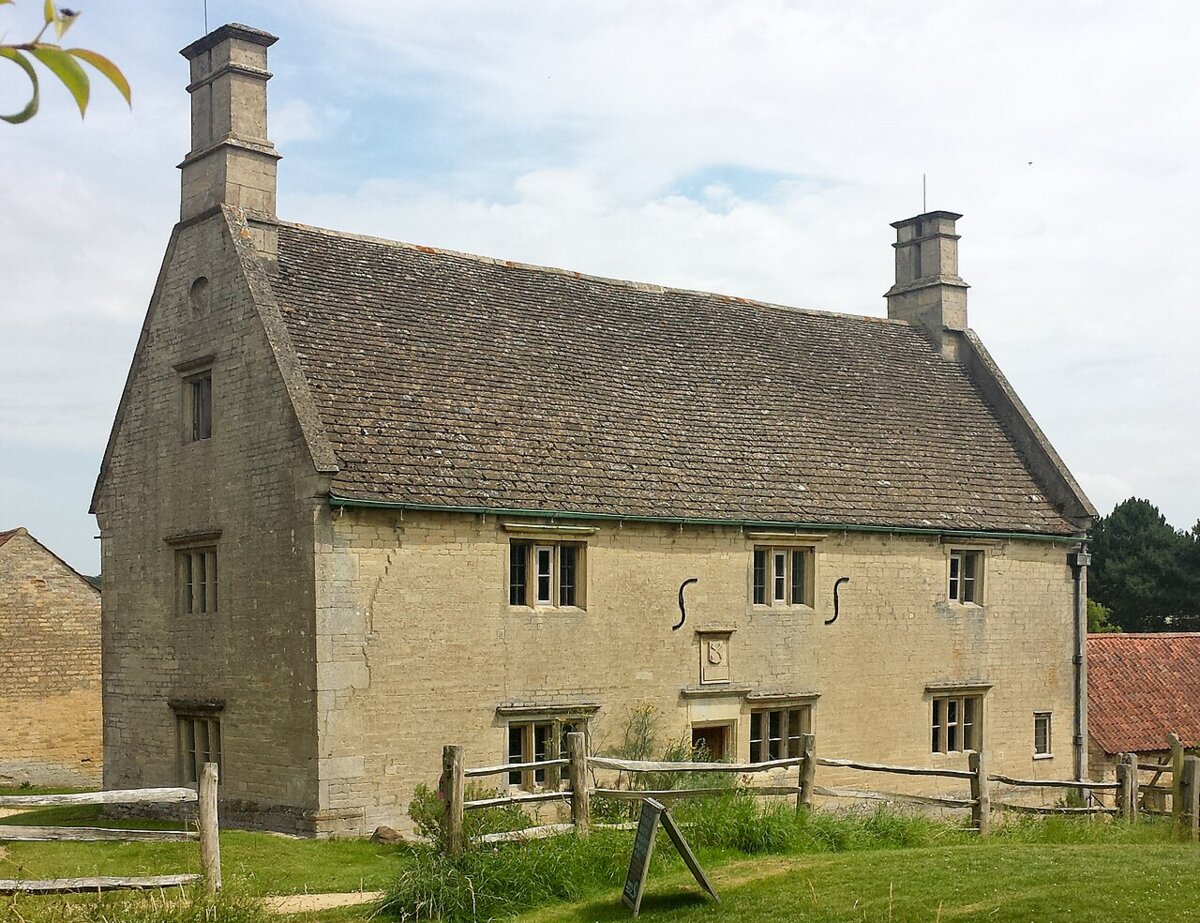
In 1661 Newton entered Trinity College, Cambridge, as a subsizar: a student who paid part of his way by doing chores for wealthier students. The official curriculum was still Aristotle, but on his own he read Descartes, Galileo, Kepler and John Wallis’s Arithmetic of Infinites. In a notebook he wrote in Latin: “Plato is my friend, Aristotle is my friend, but my best friend is truth.”
In 1665 bubonic plague reached London and the university closed. Newton went back to Woolsthorpe and spent almost two years there, largely on his own. In this period, later called his annus mirabilis or “wonderful year”, he:
- generalized the binomial to fractional and negative exponents;
- created the method of fluxions, which we now call differential and integral calculus;
- showed with prisms that white light is a mixture of colours;
- began to ask whether the force that brings down an apple is the same force that holds the Moon.
Newton himself, as an old man, summed it up: “In those days I was in the prime of my age for invention.” Yet almost none of this was published at the time. The theory of gravitation in particular would take another twenty years to complete.
A professor at 26
Back in Cambridge, Newton showed some of his results to Isaac Barrow, the professor of mathematics. Barrow was so impressed that in 1669 he stepped down and recommended Newton for the Lucasian chair. Newton was 26.
His lectures were so poorly attended that, according to an assistant, he often lectured to the walls. But Newton did not need an audience. In 1668 he built with his own hands a telescope using a mirror, about 15 centimetres long, that magnified as much as a lens telescope ten times its size. The Royal Society was delighted and elected him a Fellow in 1672.
Quarrels
Soon afterwards Newton sent the Royal Society his theory of colours. Robert Hooke, the Society’s curator of experiments, criticized it condescendingly. Newton replied furiously and for years refused to publish anything. He wrote to a friend that natural philosophy was “such an impertinently litigious lady” that he was better off keeping away from her.
His relationship with Hooke never improved. A letter of 1676 contains Newton’s most famous sentence: “If I have seen further it is by standing on the shoulders of Giants.” The phrase was old, and some read in it a jab at Hooke, who was short and stooped.
Far worse was the quarrel with Leibniz over the invention of calculus, which we tell in the legacy.
The Principia
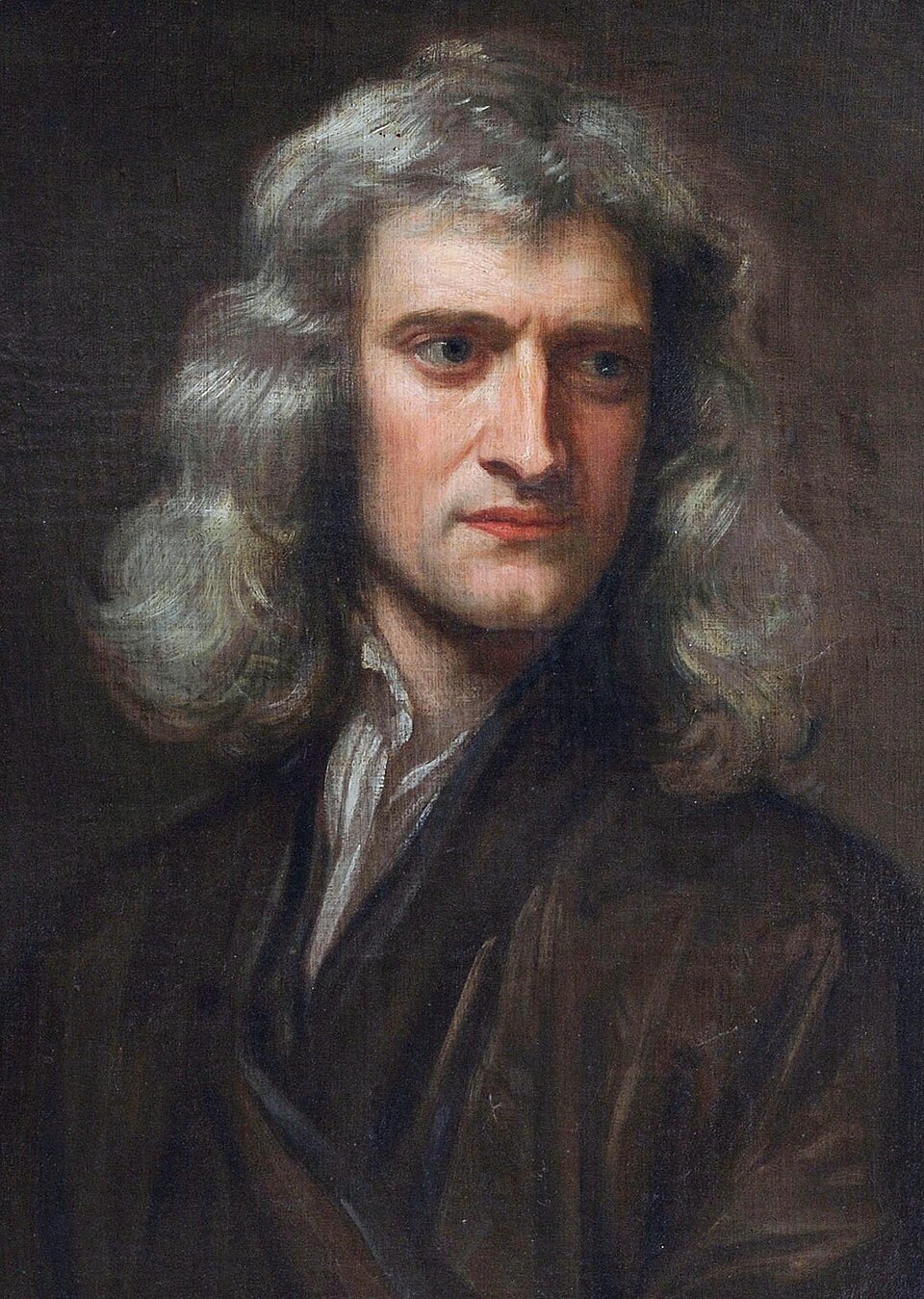
In August 1684 the astronomer Edmond Halley came to Cambridge with a question nobody in London could answer: if the Sun attracts the planets with a force that decreases with the square of the distance, what shape will the orbits be? Newton answered at once: an ellipse. Halley asked how he knew. “Why, I have calculated it.” Newton looked for the paper and could not find it. He promised to redo the calculation.
Three months later he sent Halley a nine-page text. Over the next two years it grew into the Philosophiæ Naturalis Principia Mathematica (“Mathematical Principles of Natural Philosophy”), published in 1687. The Royal Society had no money to print it: it had spent everything on a book about the history of fishes. Halley paid for the edition himself.
Halley also wrote a Latin ode to open the book. Its last line reads:
No mortal may approach nearer to the gods.
— Edmond Halley, ode to Newton in the Principia (1687)
In the Principia, the same laws explained the fall of a stone, the tides, the orbit of the Moon and the paths of comets. For the first time, heaven and Earth obeyed the same rules.
London: the Royal Mint
In 1693 Newton suffered a nervous breakdown. For months he barely slept and wrote incoherent letters to friends, accusing them of plotting against him. He recovered, but his great creative period was over.
In 1696 he left Cambridge for London to work at the Royal Mint, which struck the coins of the realm. No one expected him to take the post seriously, but Newton organized the recoinage of all England’s silver coins and pursued counterfeiters personally, going in disguise to taverns and interrogating suspects. The most notorious counterfeiter, William Chaloner, was hanged in 1699.
In 1703 he became President of the Royal Society and ran it with an iron hand until his death. In 1705 Queen Anne knighted him: he became Sir Isaac Newton.
The final years
Newton never married. Besides mathematics and physics, he wrote more than a million words on alchemy and as many again on theology and biblical prophecy. In one of those calculations he concluded that the world would not end before 2060. The economist John Maynard Keynes, who bought some of these manuscripts in 1936, wrote that Newton “was not the first of the age of reason. He was the last of the magicians.”
He died on 31 March 1727, aged 84, and was given a state funeral in Westminster Abbey. Voltaire, who was in London, was struck: England buried a mathematician as if he were a king.
Shortly before his death, Newton is said to have remarked:
I do not know what I may appear to the world, but to myself I seem to have been only like a boy playing on the seashore, and diverting myself in now and then finding a smoother pebble or a prettier shell than ordinary, whilst the great ocean of truth lay all undiscovered before me.
— Isaac Newton, as reported by Joseph Spence
Sources: Newton Project timeline · MacTutor biography.
All Isaac Newton topics · The generalized binomial: beyond whole-number powers →