
Euler's Eyes
2026-10-11
Concept, elements and classification
The triangle is the simplest and most useful polygon: any other polygon can be divided into triangles.
Who discovered
Triangles appear in ornaments, constructions and area calculations since Egypt and Mesopotamia: the Rhind papyrus (c. 1650 BC) already presents problems about the area of triangular lands. The classification used to this day is from Euclid (c. 300 BC). In the definitions I.20 and I.21 of The Elements, he separates the triangles by the sides — equilateral, isosceles and scalene — and by the angles — rectangle, obtuse angle and acutangle.

The story
The names are Greek and descriptive: isosceles means “equal legs”, and scalene, “lame” or “unequal”. equilateral triangle has a place of honor: it is the first construction of the The Elements (proposition I.1), made with two circles and a ruler.
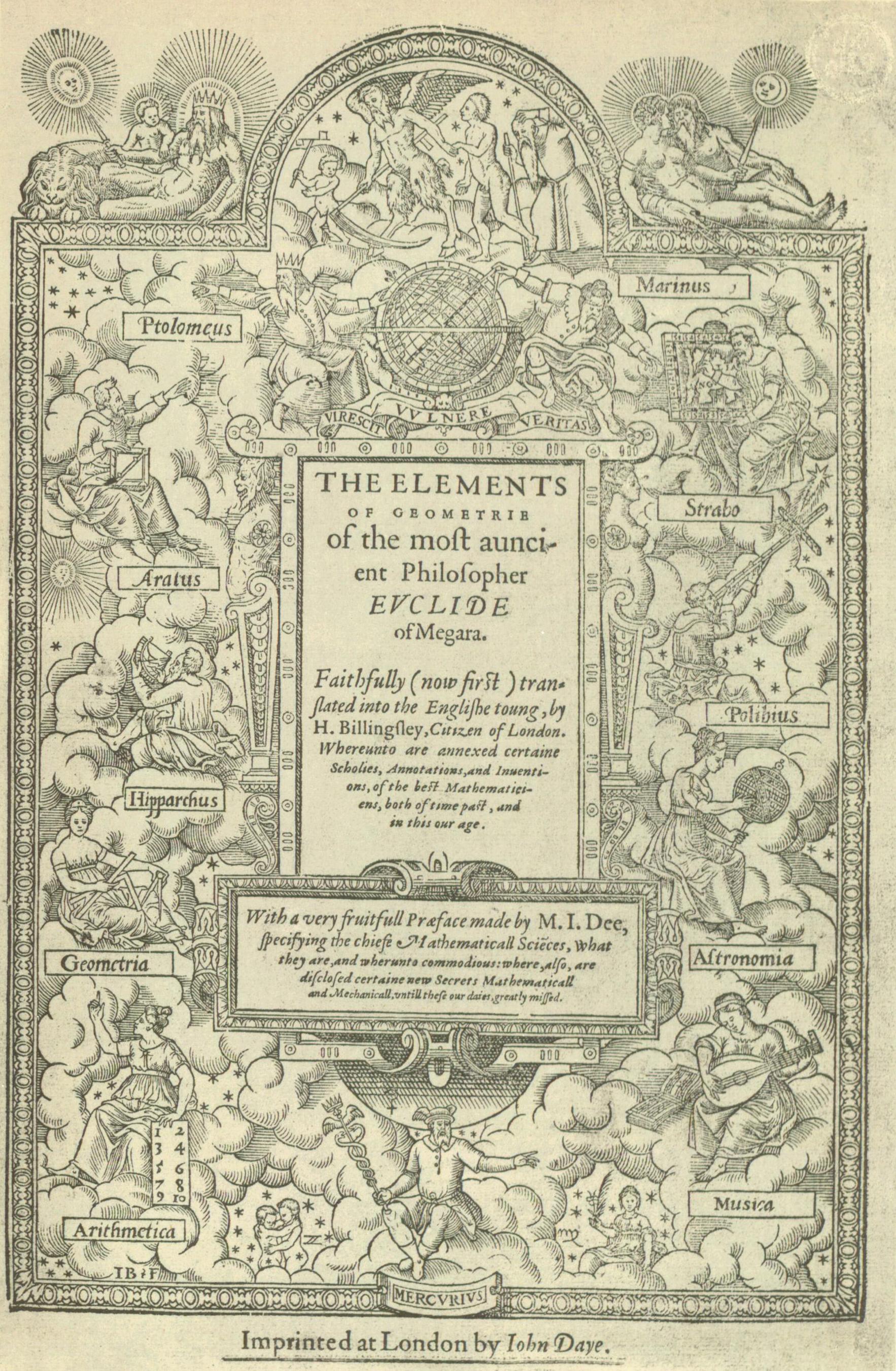
The Elements were copied by hand for over a thousand years, translated into Arabic, Latin, and English, and first printed in 1482 in Venice. It is, after the Bible, one of the books with the most editions in history.
In everyday life
- Trustes. Roofs, metal bridges, and cranes use triangles because they do not deform when the sides are fixed.
- Bicycle. The traditional frame is formed by two triangles, which makes it light and rigid.
- Signs. The “Give way” sign is equilateral triangle upside down, and the car’s safety triangle is equilateral.
- 3D graphics. Characters and scenarios in games and animated films are meshes of thousands of triangles.
Sources: Elements, definition I.20 · Elements, proposition I.1 · Euclid (MacTutor).
Theory and constructions
DefiniçãoTriangle
Given three non-collinear points $A$, $B$ and $C$, the meeting of the segments $\overline{AB}$, $\overline{AC}$ and $\overline{BC}$ is called triangle $ABC$:
$$\triangle ABC = \overline{AB} \cup \overline{AC} \cup \overline{BC}.$$DefiniçãoElements
- Vertices: the points $A$, $B$ and $C$.
- Sides: $\overline{BC}$ (measurement $a$), $\overline{AC}$ (measurement $b$) and $\overline{AB}$ (measurement $c$).
- Angles (internal): $B\hat{A}C$ or $\hat{A}$, $A\hat{B}C$ or $\hat{B}$ and $A\hat{C}B$ or $\hat{C}$.
Side $\overline{BC}$ and angle $\hat{A}$ are opposites; the same goes for $\overline{AC}$ and $\hat{B}$ and for $\overline{AB}$ and $\hat{C}$.
The interior of the triangle is the intersection of three open half-planes: the origin on the line $BC$ which contains $A$, the origin on the line $AC$ which contains $B$ and the origin on the line $AB$ which contains $C$. The interior is a convex region; the exterior (which is neither a triangle nor an interior) is concave. The triangle together with its interior is the triangular surface.
DefiniçãoClassification
As for the sides, a triangle is:
- equilateral if the three sides are congruent;
- isosceles if it has two congruent sides;
- scalene if it does not have two congruent sides.
As for angles, a triangle is:
- rectangle if it has a right angle;
- acutangle if it has three acute angles;
- obtuseangle if it has an obtuse angle.
In isosceles triangle, the side that is not congruent to the others is the base, and the angle opposite it is the vertex angle. All equilateral triangle is also isosceles. In the right triangle, the side opposite the right angle is the hypotenuse, and the other two are the legs.