
Euler's Eyes
2026-10-11
The Pascaline: a sum made of gears
In 1640 Étienne Pascal was appointed tax commissioner for Normandy. The job meant adding up column after column of figures late into the night, and his son Blaise, then 17, helped. To make matters worse, French money was not decimal:
$$1\ \text{livre}=20\ \text{sols},\qquad 1\ \text{sol}=12\ \text{deniers}.$$Adding $3$ livres, $15$ sols and $8$ deniers to $2$ livres, $7$ sols and $9$ deniers needs three kinds of carry:
- deniers: $8+9=17$, which is $1$ sol and $5$ deniers;
- sols: $15+7+1=23$, which is $1$ livre and $3$ sols;
- livres: $3+2+1=6$.
Result: $6$ livres, $3$ sols and $5$ deniers. Do that a thousand times a night and you will make mistakes. In 1642 Blaise began building a machine that would not.
Wheels that count
The idea of the Pascaline is simple. Each digit of the number has a wheel with the figures $0$ to $9$. To add $7$, you put a stylus in the hole for $7$ and turn the wheel until it reaches a stop. The number shows in a small window.
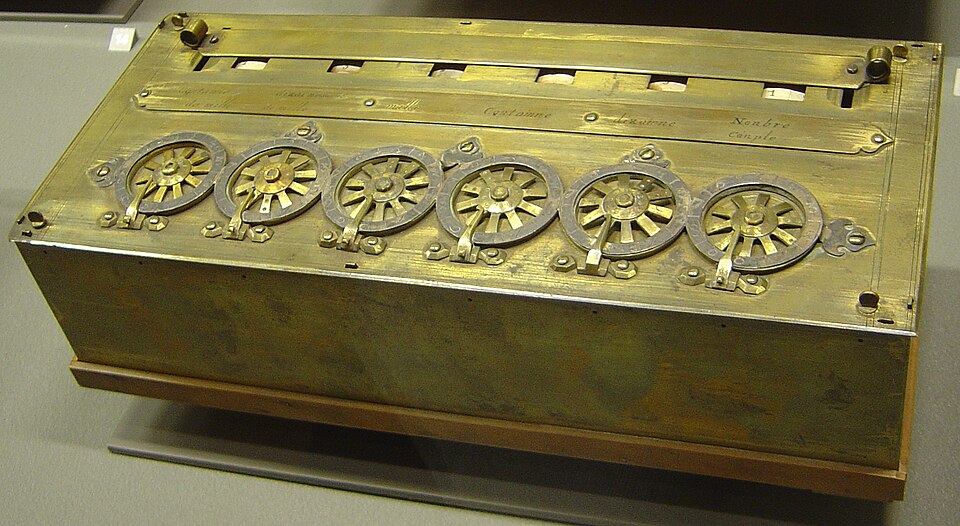
The hard part is the carry. When the units wheel goes from $9$ to $0$, the tens wheel has to move on one position by itself. And sometimes it spreads:
$$999+1=1000.$$Here a single turn of the units wheel has to move all four wheels at once. If all the force comes from the finger doing the turning, the gears jam.
The jumper
Pascal’s solution was a part called the sautoir, or jumper: a small weighted lever between one wheel and the next. As the wheel turns from $0$ to $9$, two pins gradually lift the jumper. On the step from $9$ to $0$ it is released, falls under its own weight and pushes the next wheel one place forward.
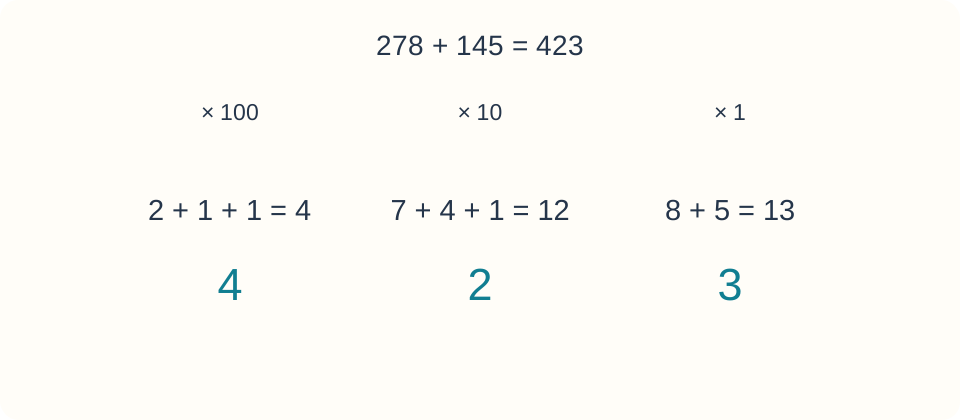
The force of the carry comes from gravity, stored up little by little while counting. That is why the carry can run through many wheels in a row without locking. In the sum $278+145$:
- units: $8+5=13$, the wheel shows $3$ and the jumper pushes the tens;
- tens: $7+4+1=12$, the wheel shows $2$ and the jumper pushes the hundreds;
- hundreds: $2+1+1=4$.
Subtracting with a machine that only adds
The jumper came at a price: the wheels could turn in only one direction. So how do you subtract? Pascal used the nines’ complement. Each window showed two numbers: the digit and what it lacks to make $9$. For three digits, the complement of $x$ is $999-x$.
To work out $423-145$:
- the complement of $423$ is $999-423=576$;
- the machine adds as usual: $576+145=721$;
- the complement of $721$ is $999-721=278$.
And indeed $423-145=278$. The reason is that $999-\big((999-a)+b\big)=a-b$. Using only additions, the machine subtracts.
Before and after
The Pascaline was not the first calculating machine: in 1623 the German Wilhelm Schickard had designed a “calculating clock”, but it was lost in a war and nobody knew about it at the time. Pascal’s was the first to be manufactured, sold and copied. Thirty years later Leibniz saw one in Paris and decided to go further: he wanted a machine that could also multiply.
Exercise: add 596 and 407, following the carries
Units: $6+7=13$, write $3$ and carry one. Tens: $9+0+1=10$, write $0$ and carry one. Hundreds: $5+4+1=10$, write $0$ and carry one into the thousands. The result is $1003$: three jumpers fell in a cascade.
Exercise: work out 500 − 137 the Pascaline way
The complement of $500$ is $499$. Adding, $499+137=636$. The complement of $636$ is $363$. Indeed, $500-137=363$.
Sources: Pascal biography, MacTutor · the Pascaline, Musée des Arts et Métiers.
All Pascal topics · ← The Chevalier de Méré’s dice and the fair split · The mystic hexagram: six points on a conic →