
Euler's Eyes
2026-11-03
EJU 2020 (2nd session) – Mathematics Course 2 solved
Source: JASSO – Mathematics paper in English, in Japanese and official answer key. Files on the page for the 2nd session of 2020.
Course 2 is the advanced mathematics paper of the EJU. Each letter $\boxed{\text{A}}$, $\boxed{\text{B}}$, … is a digit from 0 to 9 or the minus sign. In some blanks the answer is the number of a choice. The statements below are summarized from the official English version.
Answer key
| Question | Topic | Answers |
|---|---|---|
| I | Same as Question I of Course 1 | A=1, B=4, C=4, D=2, E=2, FG=48, H=6, I=8, J=2, K=9, LM=40, N=5, O=9; P=4, QR=35, ST=87, U=6, VW=21, XY=40 |
| II Q1 | Sum of $a_n a_{n+5}$ | A=1, B=4, C=9, D=3, EF=10, G=5, H=8, I=1, J=8, K=9, L=6 |
| II Q2 | Roots of complex numbers | MN=16, O=3, P=3, Q=2, R=6, S=1, T=3, U=5, V=7, W=4, XY=−4 |
| III | Two tangents to a cubic | A=3, B=2, C=4, DE=−1, F=6, G=3, H=2, I=4, J=2, K=3, L=4, M=2, N=8, OP=12, Q=2, R=4, ST=−1, U=8, V=9, W=7 |
| IV | $\sin x + \frac{\sin2x}{2} + \frac{\sin3x}{3}$ | A=2, B=1, C=2, D=1, E=4, F=2, G=3, H=3, I=4, J=4, K=0, L=2, M=3, N=1, O=3, P=4, Q=0, R=1, S=3, T=4, UV=20, W=9 |
Question I
Question I of Course 2 is identical to that of Course 1 (a translated parabola and the ways of climbing a staircase). The full solution is in the Course 1 post.
Answers: A=1, B=4, C=4, D=2, E=2, FG=48, H=6, I=8, J=2, K=9, LM=40, N=5, O=9; P=4, QR=35, ST=87, U=6, VW=21, XY=40.
Question II
Q1: the sum of products of terms of a progression
Statement. The sum of the first $n$ terms of the sequence $(a_n)$ is $S_n = \dfrac{n^2 - 17n}{4}$, and $b_n = a_n\cdot a_{n+5}$.
-
In blanks $\boxed{\text{A}}$ to $\boxed{\text{C}}$, choose from the options below. Since $a_n = \boxed{\text{A}}$, $b_n = \boxed{\text{B}}$, and the sum of the first $n$ terms of $(b_n)$ is $T_n = \boxed{\text{C}}$.
⓪ $\frac{n - 7}{2}$; ① $\frac{n - 9}{2}$; ② $\frac{n - 11}{2}$; ③ $\frac{n^2 - 12n + 27}{4}$; ④ $\frac{n^2 - 13n + 36}{4}$; ⑤ $\frac{n^2 - 14n + 45}{4}$; ⑥ $\frac{n(n^2 - 17n + 83)}{12}$; ⑦ $\frac{n(n^2 - 17n + 89)}{12}$; ⑧ $\frac{n(n^2 - 18n + 83)}{12}$; ⑨ $\frac{n(n^2 - 18n + 89)}{12}$.
-
The minimum of $T_n$. If $n \le \boxed{\text{D}}$ or $\boxed{\text{EF}} \le n$, $b_n > 0$; if $\boxed{\text{G}} \le n \le \boxed{\text{H}}$, $b_n < 0$. So $T_n$ is smallest at $n = \boxed{\text{I}}$, $n = \boxed{\text{J}}$ and $n = \boxed{\text{K}}$ (with $\boxed{\text{I}} < \boxed{\text{J}} < \boxed{\text{K}}$), and the minimum is $\boxed{\text{L}}$.
Solution.
1. The general term. For $n \ge 2$, $a_n = S_n - S_{n-1} = \frac{(n^2 - 17n) - ((n - 1)^2 - 17(n - 1))}{4} = \frac{2n - 18}{4} = \frac{n - 9}{2}$, and $a_1 = S_1 = -4$ also follows the formula (①). It is an arithmetic progression with common difference $\frac12$.
2. $b_n$. $b_n = \frac{(n - 9)(n - 4)}{4} = \frac{n^2 - 13n + 36}{4}$ (④).
3. $T_n$. With the formulas for $\sum k^2$ and $\sum k$:
$$T_n = \frac14\left[\frac{n(n + 1)(2n + 1)}{6} - \frac{13n(n + 1)}{2} + 36n\right] = \frac{n}{24}\left(2n^2 - 36n + 178\right) = \frac{n(n^2 - 18n + 89)}{12}$$(⑨).
4. The sign of $b_n$. $(n - 9)(n - 4) > 0$ for $n \le 3$ or $n \ge 10$, and $< 0$ for $5 \le n \le 8$; $b_4 = b_9 = 0$.
5. The minimum — with a catch. $T_n$ increases up to $n = 3$, stays put at $n = 4$, decreases from $n = 5$ to $8$, stays put at $n = 9$ and increases forever after. The candidates for the minimum are $T_1$ and $T_8 = T_9$:
| $n$ | 1 | 2 | 3 | 4 | 5 | 6 | 7 | 8 | 9 |
|---|---|---|---|---|---|---|---|---|---|
| $b_n$ | 6 | 3.5 | 1.5 | 0 | −1 | −1.5 | −1.5 | −1 | 0 |
| $T_n$ | 6 | 9.5 | 11 | 11 | 10 | 8.5 | 7 | 6 | 6 |
The minimum is $6$, attained at $n = 1$, $n = 8$ and $n = 9$. (The formula confirms: $T_1 = \frac{72}{12}$ and $T_8 = \frac{8\cdot9}{12}$, $T_9 = \frac{9\cdot8}{12}$.)
Answers: A=1, B=4, C=9, D=3, EF=10, G=5, H=8, I=1, J=8, K=9, L=6.
Q2: fourth and eighth roots
Statement.
- In polar form, $8 + 8\sqrt3\,i = \boxed{\text{MN}}\left(\cos\dfrac{\pi}{\boxed{\text{O}}} + i\sin\dfrac{\pi}{\boxed{\text{P}}}\right)$.
- Consider the complex numbers $z$ with $z^4 = 8 + 8\sqrt3\,i$ and $0 \le \arg z < 2\pi$. Then $|z| = \boxed{\text{Q}}$. There are four of them; calling them $z_1, z_2, z_3, z_4$ in increasing order of argument, $\arg\dfrac{z_1z_2z_3}{z_4} = \dfrac{\pi}{\boxed{\text{R}}}$.
- Consider the numbers $w$ with $w^8 - 16w^4 + 256 = 0$ and $0 \le \arg w < 2\pi$. There are eight; calling them $w_1, \dots, w_8$ in increasing order of argument, four of them coincide with the $z_k$: $w_{\boxed{\text{S}}} = z_1$, $w_{\boxed{\text{T}}} = z_2$, $w_{\boxed{\text{U}}} = z_3$, $w_{\boxed{\text{V}}} = z_4$. Moreover, $w_1w_8 = \boxed{\text{W}}$ and $w_3w_4 = \boxed{\text{XY}}\,i$.
Solution.
1. $|8 + 8\sqrt3\,i| = 8\sqrt{1 + 3} = 16$, and the argument has cosine $\frac12$ and sine $\frac{\sqrt3}{2}$: it is $\frac\pi3$.
2. $|z|^4 = 16$, so $|z| = 2$. The arguments are $\frac{\pi}{12} + k\frac{\pi}{2}$: $\frac{\pi}{12}, \frac{7\pi}{12}, \frac{13\pi}{12}, \frac{19\pi}{12}$. The argument of $\frac{z_1z_2z_3}{z_4}$ is $\frac{(1 + 7 + 13 - 19)\pi}{12} = \frac{\pi}{6}$.
3. The eighth roots. The equation is quadratic in $w^4$: $w^4 = 8 \pm \sqrt{64 - 256} = 8 \pm 8\sqrt3\,i = 16\left(\cos\frac\pi3 \pm i\sin\frac\pi3\right)$. The $+$ sign gives the $z_k$; the $-$ sign (argument $\frac{5\pi}{3}$) gives arguments $\frac{5\pi}{12}, \frac{11\pi}{12}, \frac{17\pi}{12}, \frac{23\pi}{12}$. In order, the arguments (in units of $\frac{\pi}{12}$) are
$$1, 5, 7, 11, 13, 17, 19, 23,$$with the $z_k$ in the odd positions: $w_1 = z_1$, $w_3 = z_2$, $w_5 = z_3$, $w_7 = z_4$.
4. The products. All have modulus 2, so the products have modulus 4. $\arg(w_1w_8) = \frac{(1 + 23)\pi}{12} = 2\pi$, so $w_1w_8 = 4$. $\arg(w_3w_4) = \frac{(7 + 11)\pi}{12} = \frac{3\pi}{2}$, so $w_3w_4 = -4i$.
Answers: MN=16, O=3, P=3, Q=2, R=6, S=1, T=3, U=5, V=7, W=4, XY=−4.
Question III: the angle between two tangents to a cubic
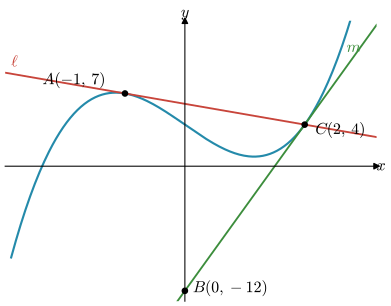
Statement. Let $f(x) = x^3 - 4x + 4$. The line $\ell$ is tangent to the graph at the point $A(-1, 7)$, and the line $m$ is tangent to the graph and passes through $B(0, -12)$. $C$ is the intersection of $\ell$ and $m$, and $\theta$ ($0 < \theta < \frac\pi2$) is the angle between them at $C$. We want $\tan\theta$.
- $f'(x) = \boxed{\text{A}}\,x^{\boxed{\text{B}}} - \boxed{\text{C}}$. The slope of $\ell$ is $\boxed{\text{DE}}$ and $\ell: y = \boxed{\text{DE}}\,x + \boxed{\text{F}}$.
- Let $a$ be the $x$-coordinate of the point of tangency of $m$. Then $m: y = \left(\boxed{\text{G}}\,a^{\boxed{\text{H}}} - \boxed{\text{I}}\right)x - \boxed{\text{J}}\,a^{\boxed{\text{K}}} + \boxed{\text{L}}$. Since $m$ passes through $B$, $a = \boxed{\text{M}}$ and $m: y = \boxed{\text{N}}\,x - \boxed{\text{OP}}$. The point $C$ is $\left(\boxed{\text{Q}}, \boxed{\text{R}}\right)$.
- Let $\alpha$ and $\beta$ be the angles of $\ell$ and $m$ with the positive direction of the $x$-axis. Then $\tan\alpha = \boxed{\text{ST}}$, $\tan\beta = \boxed{\text{U}}$, and $\tan\theta = \dfrac{\boxed{\text{V}}}{\boxed{\text{W}}}$.
Solution.
1. $f'(x) = 3x^2 - 4$, and $f'(-1) = -1$. So $\ell: y = -(x + 1) + 7 = -x + 6$.
2. The tangent at $x = a$ is
$$y = (3a^2 - 4)(x - a) + a^3 - 4a + 4 = (3a^2 - 4)x - 2a^3 + 4.$$Passing through $(0, -12)$: $-2a^3 + 4 = -12$, $a^3 = 8$, $a = 2$. So $m: y = 8x - 12$. The intersection with $\ell$: $-x + 6 = 8x - 12$, $x = 2$, $y = 4$. (The point $C = (2, 4)$ is the point of tangency of $m$ itself, because $\ell$ meets the cubic again there: $x^3 - 4x + 4 = -x + 6$ gives $(x + 1)^2(x - 2) = 0$.)
3. $\tan\alpha = -1$ and $\tan\beta = 8$. By the tangent of a difference,
$$\tan(\beta - \alpha) = \frac{8 - (-1)}{1 + 8\cdot(-1)} = -\frac97.$$The acute angle between the lines has tangent $\frac97$.
Answers: A=3, B=2, C=4, DE=−1, F=6, G=3, H=2, I=4, J=2, K=3, L=4, M=2, N=8, OP=12, Q=2, R=4, ST=−1, U=8, V=9, W=7.
Question IV: the function sin x + sin 2x/2 + sin 3x/3
Statement. Consider, on $0 \le x \le \pi$,
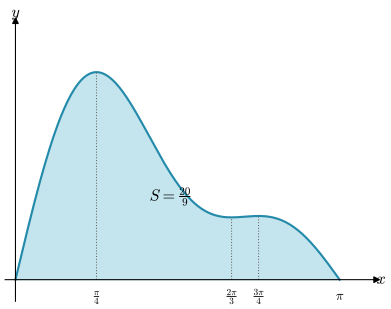
$$f(x) = \sin x + \frac{\sin 2x}{2} + \frac{\sin 3x}{3}.$$We want to show that $f(x) > 0$ on $0 < x < \pi$ and find the area $S$ of the region bounded by the graph and the $x$-axis.
- In blanks $\boxed{\text{K}}$, $\boxed{\text{N}}$, $\boxed{\text{Q}}$ and $\boxed{\text{R}}$, answer ⓪ (increasing) or ① (decreasing); in the others, write the number. Differentiating, $f'(x) = \left(\boxed{\text{A}}\cos^2x - \boxed{\text{B}}\right)\left(\boxed{\text{C}}\cos x + \boxed{\text{D}}\right)$. On $[0, \pi]$, $f' = 0$ at three points, which in increasing order are $\dfrac{\pi}{\boxed{\text{E}}}$, $\dfrac{\boxed{\text{F}}}{\boxed{\text{G}}}\pi$ and $\dfrac{\boxed{\text{H}}}{\boxed{\text{I}}}\pi$. So $f$ is $\boxed{\text{K}}$ on $[0, \frac{\pi}{\boxed{\text{J}}}]$, $\boxed{\text{N}}$ on $[\frac{\pi}{\boxed{\text{J}}}, \frac{\boxed{\text{L}}}{\boxed{\text{M}}}\pi]$, $\boxed{\text{Q}}$ on $[\frac{\boxed{\text{L}}}{\boxed{\text{M}}}\pi, \frac{\boxed{\text{O}}}{\boxed{\text{P}}}\pi]$ and $\boxed{\text{R}}$ on $[\frac{\boxed{\text{O}}}{\boxed{\text{P}}}\pi, \pi]$. Moreover, $f(0) = 0$, $f(\pi) = 0$ and $f\left(\frac{\boxed{\text{L}}}{\boxed{\text{M}}}\pi\right) = \dfrac{\sqrt{\boxed{\text{S}}}}{\boxed{\text{T}}} > 0$. Hence $f(x) > 0$ on $0 < x < \pi$.
- The area is $S = \dfrac{\boxed{\text{UV}}}{\boxed{\text{W}}}$.
Solution.
1. The derivative. $f'(x) = \cos x + \cos2x + \cos3x$. By the sum of cosines, $\cos3x + \cos x = 2\cos2x\cos x$, so
$$f'(x) = \cos2x\,(2\cos x + 1) = (2\cos^2x - 1)(2\cos x + 1).$$2. The zeros. $\cos^2x = \frac12$ gives $x = \frac\pi4$ and $\frac{3\pi}{4}$; $\cos x = -\frac12$ gives $x = \frac{2\pi}{3}$. In order: $\frac\pi4 < \frac{2\pi}{3} < \frac{3\pi}{4}$.
3. The signs.
| Interval | $\cos 2x$ | $2\cos x + 1$ | $f$ |
|---|---|---|---|
| $(0, \frac\pi4)$ | $+$ | $+$ | increasing |
| $(\frac\pi4, \frac{2\pi}{3})$ | $-$ | $+$ | decreasing |
| $(\frac{2\pi}{3}, \frac{3\pi}{4})$ | $-$ | $-$ | increasing |
| $(\frac{3\pi}{4}, \pi)$ | $+$ | $-$ | decreasing |
4. Why $f > 0$. The only interior local minimum is at $\frac{2\pi}{3}$:
$$f\left(\frac{2\pi}{3}\right) = \frac{\sqrt3}{2} + \frac12\left(-\frac{\sqrt3}{2}\right) + \frac{\sin2\pi}{3} = \frac{\sqrt3}{4} > 0.$$Since $f(0) = f(\pi) = 0$, $f$ rises from $0$, falls to $\frac{\sqrt3}{4}$, rises and then falls to $0$ at $\pi$: it stays positive on the whole interior.
5. The area.
$$S = \int_0^\pi f(x)\,dx = \left[-\cos x - \frac{\cos2x}{4} - \frac{\cos3x}{9}\right]_0^\pi = \left(1 - \frac14 + \frac19\right) - \left(-1 - \frac14 - \frac19\right) = 2 + \frac29 = \frac{20}{9}.$$Answers: A=2, B=1, C=2, D=1, E=4, F=2, G=3, H=3, I=4, J=4, K=0, L=2, M=3, N=1, O=3, P=4, Q=0, R=1, S=3, T=4, UV=20, W=9.