
Euler's Eyes
2022-08-15
Proportions and Geometry
In previous posts we talked about proportions and their main applications. Here, we will approach it in geometric form and it is very important for continuity in mathematics studies. These concepts were heavily addressed by Euclid, who was a Greek mathematician who lived in the 3rd century BC and who was responsible for creating the geometry we know today.
This type of situation appears a lot in geometry, for example, triangle similarity, Thales’ theorem, among others.
The notion of similarity and proportionality was used by mathematicians in ancient Greece and found methods to calculate the sizes of stars, such as the Earth, the Sun and the Moon.
Similarity of Triangles
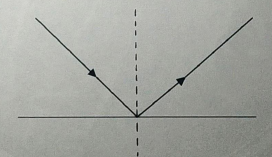
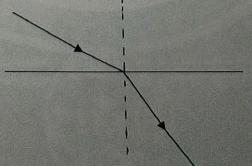
The optics used in entrance exams were discovered by Pierre Fermat in his work Variar Opera Mathematica de 1679. His original name is Clement Samuel Fermat, but he became known as Pierre Fermat. From Fermat’s studies we highlight two important results:
| Reflection of Light | Refraction of Light |
|---|---|
|
|
This is an example, in which we use the similarity of triangles. Triangle similarity is a concept that says that two triangles are similar if they have the same proportions between sides and angles.
The main reason for the similarity of triangles is precisely the particular case of quadrilaterals. Let’s remember the definition:
Triangle is a three-sided polygon, in which we use straight segments for the sides. It is a particular case of quadrilaterals, as it is a quadrilateral divided by 2.

In particular, a triangle is formed by 3 vertices.
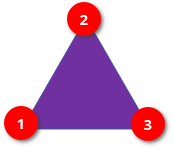
Another definition for triangle is by the origin of the name:
- Tri is defined as 3 (three);
- Angle is the “opening” between two straight segments, connected by a vertex.
Angle - Angle Congruence
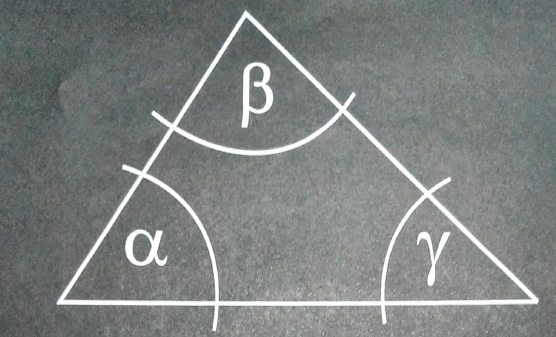
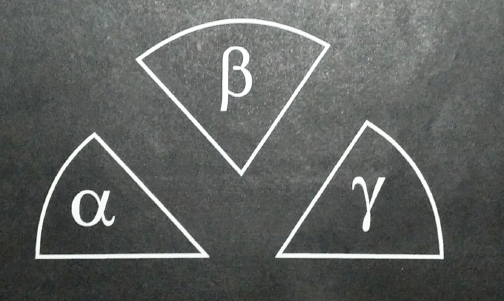
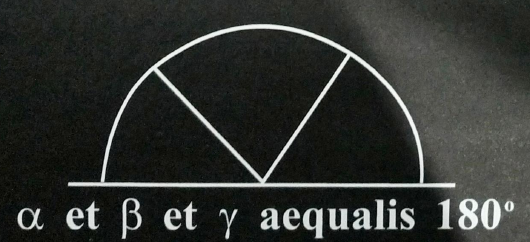
The first Canon (law of God) defined by Euclid is:
Canon α et (more) β et (more) γ aequalis (equal) 180°
Law of God α + β + γ = 180°
| Triangle | Angles | Half Turn |
|---|---|---|
|
|
|
In this way, we can define the first criteria for proportionality of triangles by angles.
Criterion (angle, angle): if two triangles neatly obtain two angles that are congruent to each other, then they will be similar.
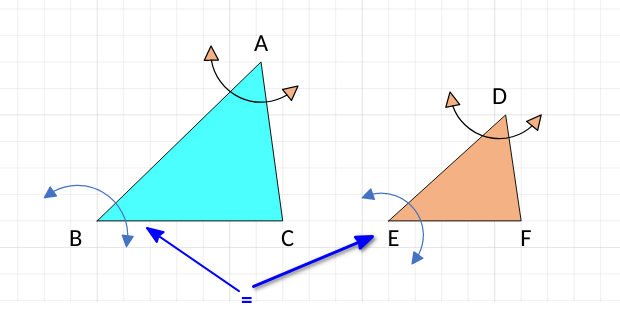
From the figure we obtain:
- Vertex angle B is congruent $\equiv$ (equal) to vertex angle E;
- $\angle B \equiv \angle E$
- Angle of vertex A is congruent $\equiv$ (equal) to angle of vertex D;
- $\angle A \equiv \angle D$
Congruence Side - Angle - Side
Criterion (side, angle, side): if two triangles have two corresponding sides proportional to each other, and the angles between such sides are congruent (equal), then the triangles will be similar.
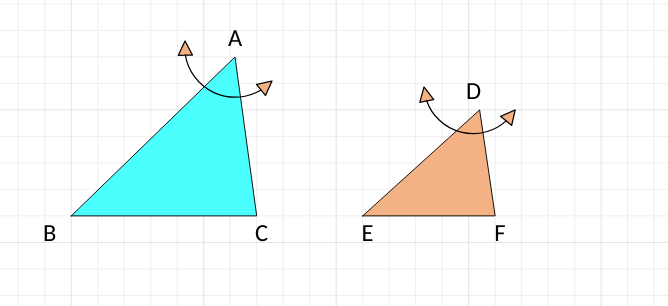
In this way, we obtain the following proportionality:
$$\dfrac{\bar{AB} }{\bar{CD} } = \dfrac{\bar{AC} }{\bar{EF} }$$Side - Side - Side Congruence
Criterion (side, side, side): if two triangles have three corresponding sides proportional to each other, then they will be similar.
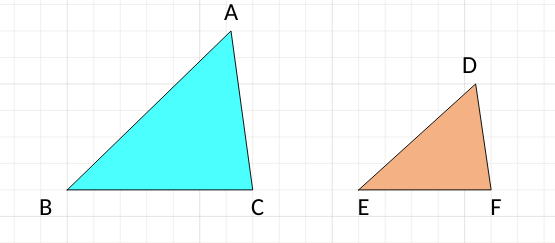
In this way, we obtain the following proportionality:
$$\dfrac{\bar{AB} }{\bar{DE} } = \dfrac{\bar{AC} }{\bar{DF} } = \dfrac{\bar{BC} }{\bar{EF} }$$Classic Example
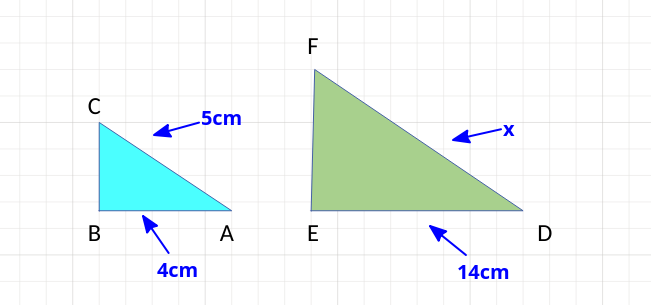
Classic: The following two triangles are similar. Determine the measure of segment DF.
Resolution:
From the similarity of triangles we obtain:
$$\dfrac{\bar{AC} }{\bar{AB} } = \dfrac{\bar{DF} }{\bar{DE} }$$$$\dfrac{5 }{4 } = \dfrac{x }{14 }$$
$$x = \dfrac{35 }{2 }$$
Example of Entrance Examination (Fuvest)
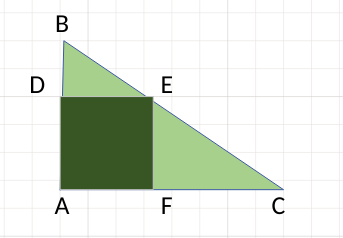
Fuvest: In the following figure, the triangle ABC is right-angled at A, ADEF is a square, $AB=1$ and $AC=3.$ How long is the side of the square?
Resolution:
Initially, we will apply the criterion (side, angle, side). Since angle A is right, we can apply the criterion (side, side, side).
$$\dfrac{\bar{DB} }{\bar{DE} } = \dfrac{\bar{FE} }{\bar{FC} }$$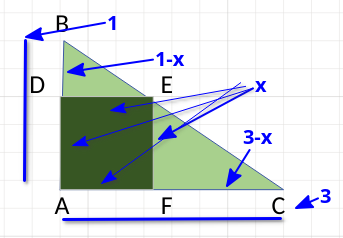
In this way, we have:
$$\dfrac{1-x }{x } = \dfrac{x }{3-x }$$$$(1-x)(3-x) = x~.~x$$
$$x = \dfrac{3}{4}$$
Therefore, the side of the square is $\dfrac{3}{4}$.
Thales’ theorem
The next topic using proportionalities is the theorem of Thales of Miletus. This great geometer was highly recognized in the 6th century BC.
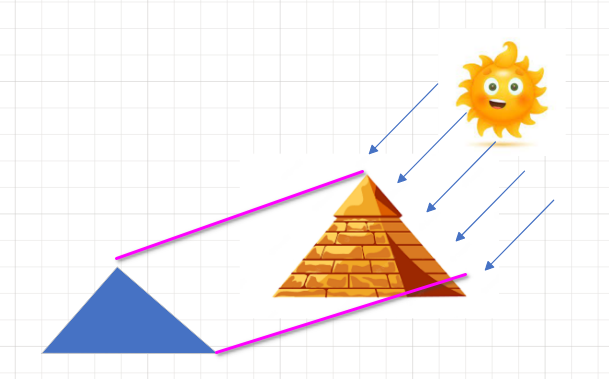
These great contributions made him recognized as one of the precursors of descriptive geometry.
Tales’ Theorem: it is proportionality applied to geometry. If a bundle of parallel lines, with at least three straight lines, is intersected by two transversal lines, then any two segments of one of the transversals are proportional to the corresponding segments of the other.
Three parallels cut by two transversals, forming four segments.
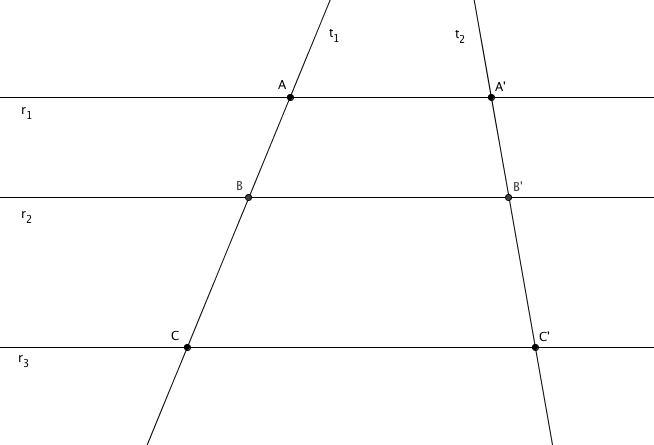
When using the concept of similarity of triangles, we observe the following figure:
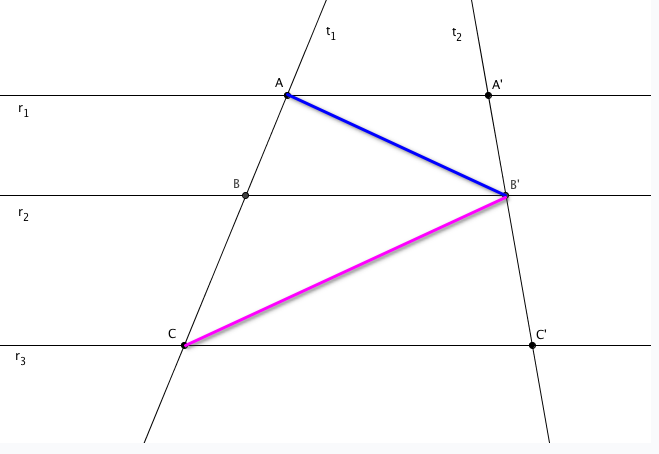
Therefore, we obtain the following proportionality relationship.
$$\dfrac{\bar{AB} }{\bar{A^\prime B^\prime} } = \dfrac{\bar{BC} }{\bar{B^\prime C^\prime} }$$Tales Example
Find the $x$.
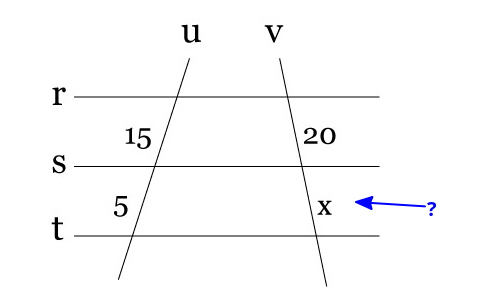
From Tales’ theorem we obtain:
$$\dfrac{15}{5} = \dfrac{20 }{x }$$$$x = \dfrac{100 }{15 }$$
$$x = \dfrac{20 }{3 }$$