I think, therefore I am.
— René Descartes, Discourse on Method (1637)
Every time you mark a point $(x, y)$ on a graph, you are using an idea from René Descartes (1596–1650). He realized that geometric figures can be described by equations, and that equations can be seen as figures. This bridge between geometry and algebra, analytic geometry, It paved the way for Newton’s and Leibniz’s calculus and for almost all mathematics that came after.
Descartes is best known as a philosopher, the “father of modern philosophy.” In this chapter of the book History of Mathematics we tell his life and retrace, with the calculations in sight, six of his discoveries. The figures are interactive: drag the points, move the controls and click the buttons.
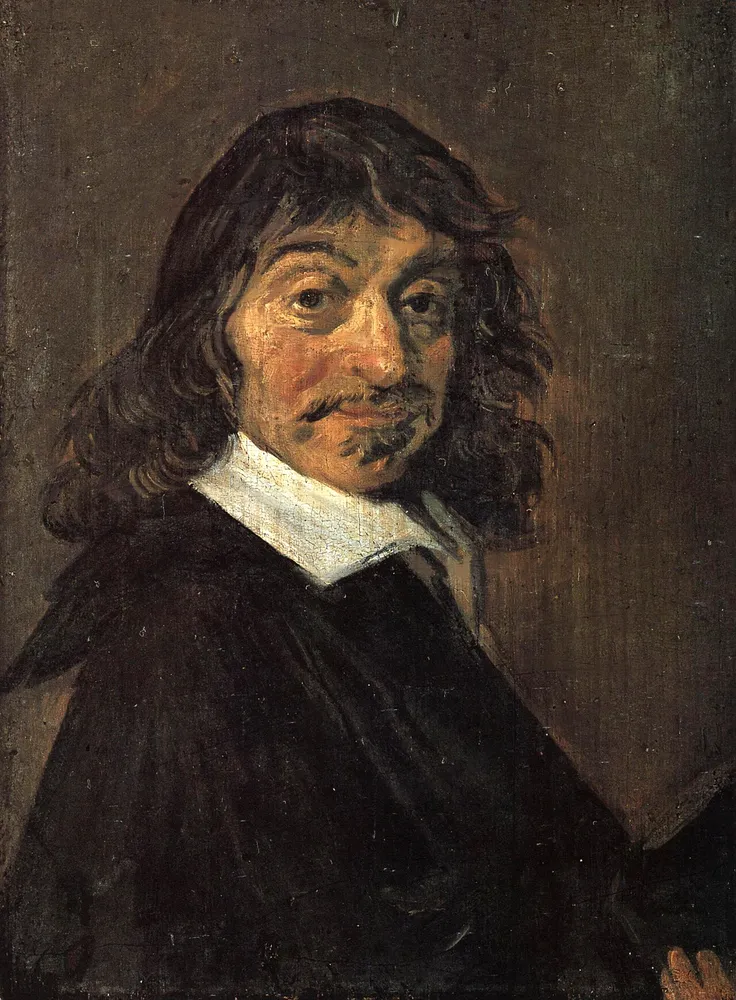
Who was it
René Descartes
- Nascimento
- 31 March 1596, La Haye
- Morte
- 11 February 1650, Stockholm
- Origem
- France
- Áreas
- Geometry, algebra, optics, philosophy
“I think, therefore I am.”
Reading script
Biography and timeline
Discovery and demonstration
- Coordinates: geometry becomes algebra
- Square root with ruler and compass
- The rule of signs
- The angles of polyhedra and Euler’s formula
- The kissing circles theorem
- Why does the rainbow appear at 42°
Introduction to function studies
Functions and interpretations
- A reading of the Cogito: listening and speaking
- Descartes and the problem of cannons
- The word “function”
- Physis: deciphering the traits of nature
- Infinity and division by zero