
Euler's Eyes
2026-10-14
The life of James Clerk Maxwell
Timeline
- 1831Born on 13 June in Edinburgh, Scotland. Spends his childhood on the family estate, Glenlair.
- 1839His mother dies of cancer, when he is 8.
- 1846At 14, a paper of his on oval curves is read at the Royal Society of Edinburgh.
- 1850Enters the University of Cambridge.
- 1855Presents his theory of colour and the paper “On Faraday’s lines of force”.
- 1856Becomes a professor in Aberdeen, aged 25.
- 1859Publishes the essay on Saturn’s rings, which won the Adams Prize. Presents the distribution of molecular speeds.
- 1860Loses his job when two colleges merge. Moves to King’s College, London.
- 1861Shows the first colour photograph at the Royal Institution.
- 1862Calculates that electromagnetic waves travel at the speed of light.
- 1865Publishes “A dynamical theory of the electromagnetic field” and returns to Glenlair.
- 1871Becomes the first Cavendish Professor of Experimental Physics, in Cambridge.
- 1873Publishes the Treatise on Electricity and Magnetism.
- 1879Dies on 5 November in Cambridge, aged 48.
- Born on 13 June. Later he studies at the Edinburgh Academy and University; at 14 a paper of his on ovals is read at the Royal Society of Edinburgh.
- He spends his childhood on the family estate, asking “what’s the go of that?”. His mother dies when he is eight.
- He studies at Trinity College. He presents his theory of colours and his paper on Faraday’s lines of force.
- A professor at 25. He wins the Adams Prize with his essay on Saturn’s rings and loses his job when the colleges merge.
- At King’s College he shows the first colour photograph and discovers that light is an electromagnetic wave.
- He returns to the country and writes the Treatise on Electricity and Magnetism.
- The first Cavendish Professor, he founds the Cavendish Laboratory. He dies in 1879, aged 48.
- 1831 · Edinburgh
- 1831–1841 · Glenlair
- 1850–1856 · Cambridge
- 1856–1860 · Aberdeen
- 1860–1865 · London
- 1865–1871 · Glenlair
- 1871–1879 · Cambridge
“What’s the go o’ that?”
James Clerk Maxwell was born in Edinburgh, into a family of small landowners, and spent his childhood at Glenlair, an estate in south-west Scotland. He was a boy who wanted to know how everything worked. Faced with a lock, a bell or a stream, he would ask, in his Scots accent, “What’s the go o’ that?”, and if the answer did not satisfy him, he would insist: “But what’s the particular go of it?”.
His mother, who taught him at home, died of cancer when he was 8. His father hired a harsh tutor, who beat the boy, and eventually sent him to the Edinburgh Academy, at 10.
Dafty, who wrote about ovals
At school Maxwell turned up in clothes his father had designed, odd shoes and a country accent. His classmates nicknamed him Dafty. He did not mind: he drew, wrote poems and thought about geometry.
At 14 he invented a way of drawing oval curves with a string tied to pins, generalising the construction of the ellipse, in which the string is tied to the two foci. He showed that, fixing the string in different ways, one obtained curves with well-defined properties. His father took the work to James Forbes, professor of natural philosophy at the University of Edinburgh, and in 1846 it was read at the Royal Society of Edinburgh. The author was too young to present it himself.
Edinburgh and Cambridge
At 16 Maxwell entered the University of Edinburgh and, in 1850, went to Cambridge. There his fellow students found him eccentric: he would run along the corridors at two in the morning, believing it was healthy, and he studied how cats always land on their feet by dropping them from small heights. In 1854 he came second in Cambridge’s famous mathematics examination, the Tripos, and shared the Smith’s Prize with the man who came first.
At Cambridge he began studying colour with a coloured spinning top and read Michael Faraday’s work on electricity and magnetism. Faraday, the son of a blacksmith, knew no mathematics, but he imagined space filled with invisible lines of force. Maxwell decided to translate those lines into equations.
Aberdeen, Saturn and a lost job
In 1856, aged 25, Maxwell became a professor at Marischal College, Aberdeen. There he wrote an essay on Saturn’s rings, which won Cambridge’s Adams Prize, and began the theory of the speeds of the molecules of a gas. In 1858 he married Katherine Mary Dewar, daughter of the college principal. They had no children; Katherine helped with the experiments.
In 1860 Marischal College merged with King’s College, Aberdeen, and the new university kept only one professor of natural philosophy. They chose the other one. Maxwell, one of the greatest physicists in history, was out of a job. He applied for a post in Edinburgh and lost that too, to a former schoolmate.
London: the equations
That same year he was hired by King’s College London. His five years in London were the most productive of his life. In 1861 he showed the first colour photograph at the Royal Institution. In 1861 and 1862 he published a mechanical model of the electromagnetic field, made of spinning vortices and little wheels, and with it he discovered the displacement current and calculated that light is an electromagnetic wave. In 1865 he published “A dynamical theory of the electromagnetic field”, in which the equations appear without the mechanical scaffolding.
The same year he left London and returned to Glenlair, where he spent six years writing the Treatise on Electricity and Magnetism, published in 1873.
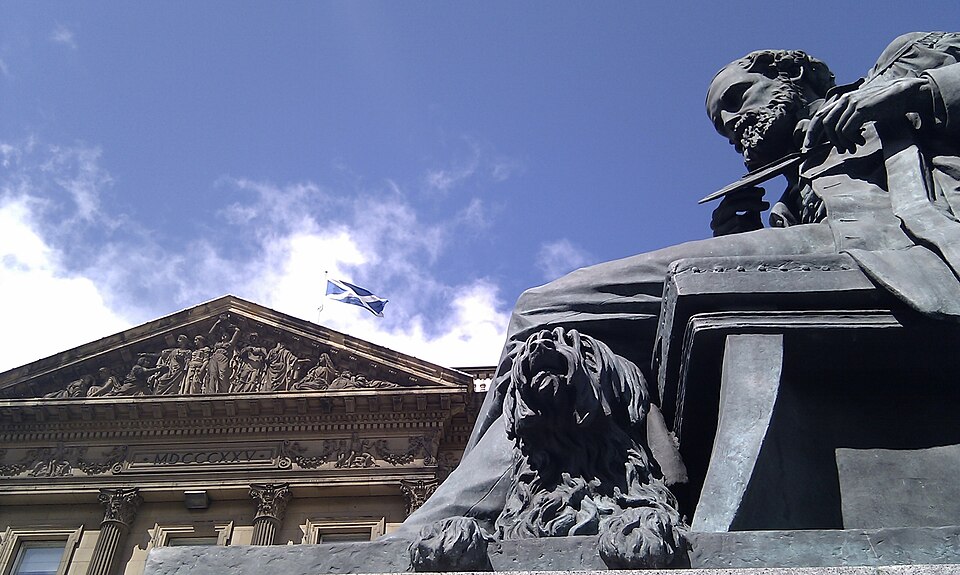
The Cavendish Laboratory
In 1871 the University of Cambridge created a chair of experimental physics, funded by the Duke of Devonshire, of the Cavendish family, and Maxwell was the first to hold it. He designed and oversaw the building of the Cavendish Laboratory, opened in 1874. In his last years he devoted himself to editing the manuscripts of Henry Cavendish, an eighteenth-century physicist who had made remarkable discoveries without publishing them.
In 1879 he fell ill. It was abdominal cancer, the same disease that had killed his mother at the same age. He died in Cambridge on 5 November 1879, aged 48. He is buried in the small church of Parton, near Glenlair.
Sources: biography of Maxwell, MacTutor · Basil Mahon, The Man Who Changed Everything: The Life of James Clerk Maxwell (Wiley, 2003) · James Clerk Maxwell Foundation.
All topics on James Clerk Maxwell · Colour: the spinning top and the tartan ribbon →