
Euler's Eyes
2026-11-05
MEXT 2017 – Mathematics (Specialized Training College) solved
Source: MEXT / Study in Japan – Mathematics paper. Files on the past exams page. The official 2017 answers were not published: the answers below are ours and were checked by computer.
This is the Mathematics exam for scholarship applicants to specialized training colleges (専修学校, senmon gakkō: two- to three-year vocational courses). It lasts 60 minutes and has three fill-in questions. The statements below follow the original English.
Answer key
| Item | Topic | Answer |
|---|---|---|
| 1 (1) | Radicals | $3\sqrt3 - 2$ |
| 1 (2) | $\left\lvert x - \frac32\right\rvert < \frac72$ | $-2 < x < 5$ |
| 1 (3) | Factoring | $(x - a + b)(x - a - b)$ |
| 1 (4) | Largest and smallest | $\sqrt[4]{9}$; $3\log_9 5$ |
| 1 (5) | Roots of $x^2 - 3x + p$ | $3$; $4$ |
| 1 (6) | Arrangements of $1, 2, 2, 3, 3, 3$ | $60$ |
| 1 (7) | Arithmetic progression | $138$ |
| 1 (8) | Collinear points | $x = 2$, $y = 3$ |
| 1 (9) | A cubic | $x^2 - 4x + 4$; $1$; $\frac23$ |
| 2 | The 6-8-10 triangle | $6$; $\frac35$; $90^\circ$; $5$; $32$; $-7$ |
| 3 | Parabola and two lines | $1, -4, 3$; $x - 1$; $-x + 3$; $1$ |
Question 1: nine short items
Item (1)
Statement. Compute $\sqrt{27} - \sqrt2\left(\sqrt6 + \sqrt2\right) + \dfrac{6}{\sqrt3}$.
Solution. $\sqrt{27} = 3\sqrt3$, $\sqrt2\left(\sqrt6 + \sqrt2\right) = \sqrt{12} + 2 = 2\sqrt3 + 2$ and $\frac{6}{\sqrt3} = 2\sqrt3$. Adding up: $3\sqrt3 - 2\sqrt3 - 2 + 2\sqrt3 = 3\sqrt3 - 2$.
Answer: $3\sqrt3 - 2$.
Item (2)
Statement. Solve $\left|x - \frac32\right| < \frac72$.
Solution. $-\frac72 < x - \frac32 < \frac72$, that is, $-2 < x < 5$.
Answer: $-2 < x < 5$.
Item (3)
Statement. Factor $x^2 - 2ax + a^2 - b^2$.
Solution. The first three terms form a square: $(x - a)^2 - b^2 = (x - a + b)(x - a - b)$.
Answer: $(x - a + b)(x - a - b)$.
Item (4)
Statement. Which is the largest of $\sqrt[3]{3}$, $\sqrt[4]{9}$ and $\sqrt[7]{27}$? And which is the smallest of $3$, $2\log_3 5$ and $3\log_9 5$?
Solution.
1. As powers of 3: $3^{\frac13}$, $3^{\frac24} = 3^{\frac12}$ and $3^{\frac37}$. Since $\frac13 < \frac37 < \frac12$, the largest is $\sqrt[4]{9}$ ($= \sqrt3$).
2. As base-3 logarithms: $3 = \log_3 27$, $2\log_3 5 = \log_3 25$ and $3\log_9 5 = \frac32\log_3 5 = \log_3 5^{\frac32} = \log_3\sqrt{125}$. Since $\sqrt{125} \approx 11.2 < 25 < 27$, the smallest is $3\log_9 5$.
Answer: $\sqrt[4]{9}$ and $3\log_9 5$.
Item (5)
Statement. Let $\alpha$ and $\beta$ be the solutions of $x^2 - 3x + p = 0$. Then $\alpha + \beta = \text{①}$; and if $\alpha^2 + \beta^2 = 1$, $p = \text{②}$.
Solution. By Vieta’s formulas, $\alpha + \beta = 3$ and $\alpha\beta = p$. Then $\alpha^2 + \beta^2 = 9 - 2p = 1$, and $p = 4$. (The roots are then complex conjugates: the discriminant is $9 - 16 < 0$. The statement does not require real roots.)
Answer: $3$ and $4$.
Item (6)
Statement. How many six-digit numbers can be formed with $1, 2, 2, 3, 3, 3$?
Solution. These are permutations with repetition: $\frac{6!}{1!\,2!\,3!} = \frac{720}{12} = 60$.
Answer: $60$.
Item (7)
Statement. $-5, -2, 1, \dots, 28$ is an arithmetic progression. Compute $(-5) + (-2) + 1 + \dots + 28$.
Solution. The common difference is 3, and $28 = -5 + 3(n - 1)$ gives $n = 12$ terms. The sum is $\frac{12(-5 + 28)}{2} = 6\cdot23 = 138$.
Answer: $138$.
Item (8)
Statement. In space, the points $A(1, 3, -2)$, $B(2, x, 1)$ and $C(y, 1, 4)$ are collinear. What are $x$ and $y$?
Solution. $\vec{AB} = (1, x - 3, 3)$ and $\vec{AC} = (y - 1, -2, 6)$ are parallel. The third coordinate shows that $\vec{AC} = 2\vec{AB}$. Then $y - 1 = 2$ and $-2 = 2(x - 3)$: $y = 3$ and $x = 2$.
Answer: $x = 2$ and $y = 3$.
Item (9)
Statement. Let $f(x) = \frac13x^3 - 2x^2 + 4x + 1$. Compute (i) $f'(x)$; (ii) the number of real solutions of $f(x) = 0$; (iii) $\int_{-1}^{1}f(x)\,dx$.
Solution.
(i) $f'(x) = x^2 - 4x + 4 = (x - 2)^2$.
(ii) $f'(x) \ge 0$, and it vanishes only at $x = 2$: $f$ is increasing. An increasing function crosses the $x$-axis at most once; and it does cross, because $f(-1) = -\frac{16}{3} < 0 < 1 = f(0)$. One real solution.
(iii) On a symmetric interval, the odd powers integrate to zero:
$$\int_{-1}^{1}f(x)\,dx = \int_{-1}^{1}(-2x^2 + 1)\,dx = -\frac43 + 2 = \frac23.$$Answer: $x^2 - 4x + 4$; $1$; $\frac23$.
Question 2: the 6-8-10 triangle
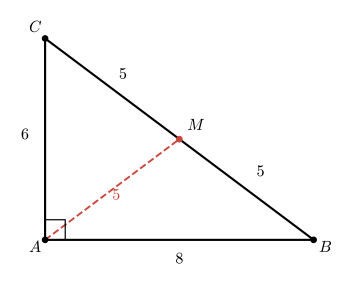
Statement. Triangle $ABC$ has $AB = 8$, $BC = 10$ and $\cos\angle ABC = \frac45$; $M$ is the midpoint of $BC$. Compute:
- $AC$; 2. $\sin\angle ABC$; 3. $\angle BAC$; 4. the radius of the circumscribed circle;
- $\vec{AB}\cdot\vec{AM}$; 6. $\vec{MA}\cdot\vec{MB}$.
Solution.
1. Law of cosines: $AC^2 = 64 + 100 - 2\cdot8\cdot10\cdot\frac45 = 164 - 128 = 36$, $AC = 6$.
2. $\sin B = \sqrt{1 - \frac{16}{25}} = \frac35$.
3. The sides are $6, 8, 10$, and $6^2 + 8^2 = 10^2$: the angle at $A$ is a right angle, $90^\circ$.
4. The hypotenuse $BC$ is a diameter of the circumcircle: radius $5$. The center is $M$ itself, so $MA = MB = MC = 5$.
5. $\vec{AM} = \frac12\left(\vec{AB} + \vec{AC}\right)$, and $\vec{AB}\cdot\vec{AC} = 0$ (right angle). So $\vec{AB}\cdot\vec{AM} = \frac12|\vec{AB}|^2 = 32$.
6. With origin at $A$, $\vec{MA} = -\frac{\vec{AB} + \vec{AC}}{2}$ and $\vec{MB} = \frac{\vec{AB} - \vec{AC}}{2}$. The product is $-\frac14\left(|\vec{AB}|^2 - |\vec{AC}|^2\right) = -\frac{64 - 36}{4} = -7$.
Answer: $6$; $\frac35$; $90^\circ$; $5$; $32$; $-7$.
Question 3: a parabola and two perpendicular lines
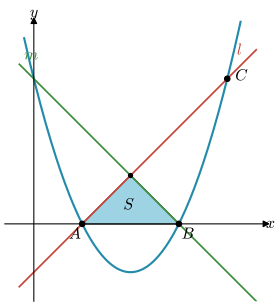
Statement. The parabola $y = ax^2 + bx + c$ passes through $A(1, 0)$, $B(3, 0)$ and $C(4, 3)$.
- Find $a$, $b$ and $c$.
- Give the line $l$ through $A$ and $C$.
- Give the line $m$ through $B$ perpendicular to $l$.
- Compute the area $S$ of the region bounded by $l$, $m$ and the $x$-axis.
Solution.
1. The roots are 1 and 3: $y = a(x - 1)(x - 3)$. At $C$: $a\cdot3\cdot1 = 3$, $a = 1$. So $y = x^2 - 4x + 3$: $a = 1$, $b = -4$, $c = 3$.
2. The slope of $AC$ is $\frac{3 - 0}{4 - 1} = 1$: $l: y = x - 1$.
3. The perpendicular has slope $-1$ and passes through $(3, 0)$: $m: y = -x + 3$.
4. The lines meet where $x - 1 = -x + 3$, that is, at $(2, 1)$. The region is the triangle with vertices $A(1, 0)$, $B(3, 0)$ and $(2, 1)$: base $2$, height $1$, $S = 1$.
Answer: $1, -4, 3$; $y = x - 1$; $y = -x + 3$; $S = 1$.