
Euler's Eyes
2022-10-21
Pythagorean Suits
Pythagorean suits are important in architectural constructions, which aroused the interests of the Greeks. They were extremely important, thanks to them we have one of the most beautiful and lasting architectures, which survives to this day.
The Pythagorean suits
Initially, let’s define what the Pythagorean suit is.
Definition (Pythagorean Terno): is any set of natural numbers $x,y$ and $z$ (terns) such that:
$$x^2 + y^2 = z^2$$
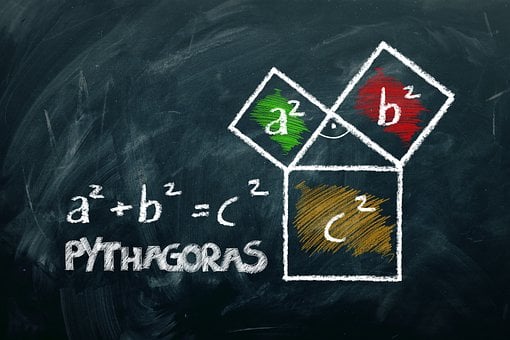
This definition was used by Euclid in Alexandria, who used concepts from the Pythagorean theorem, which corresponds to the right triangle:
It is worth remembering that the Sumerians knew Pythagoras’ theorem, long before the best-known author. They knew the most common relationship at the time, which was the suit $(x,y.z) = (3,4,5)$ given by:
$$3^2+ 4^2 = 5^2$$However, only Pythagoras proved that there are sets of natural numbers $(x,y,z)$ such that $x^2 + y^2 = z^2$
Pythagoras Theorem and the Right Triangle
In the introduction to this book, we started with the concepts of sides of a square. Our radix quadratum.
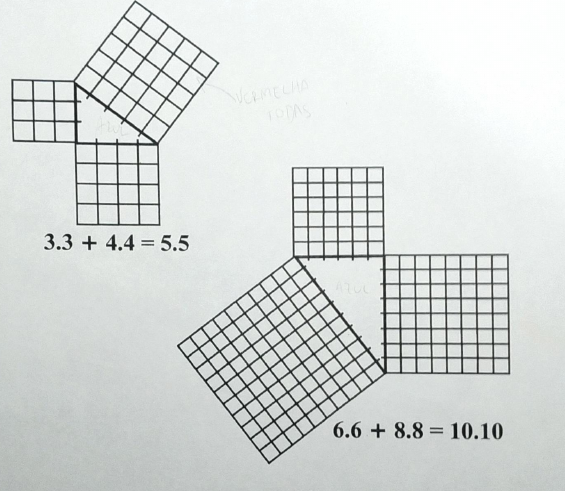
From the figure, we notice that we have area of squares, which in current mathematics is side $\times$ side.
Example 1:
$$\text{Area 1} = 3\times 3 = 9$$$$\text{Area 2} = 4\times 4 = 16$$
$$\text{Area 3} = 5\times 5 = 25$$
$$\text{Area 1} + \text{Area 1} = \text{Area 3}$$
Example 2:
$$\text{Area 1} = 6\times 6 = 36$$$$\text{Area 2} = 8\times 8 = 64$$
$$\text{Area 3} = 10\times 10 = 100$$
$$\text{Area 1} + \text{Area 1} = \text{Area 3}$$
When we generalize the concept, we have the Pythagorean Theorem.
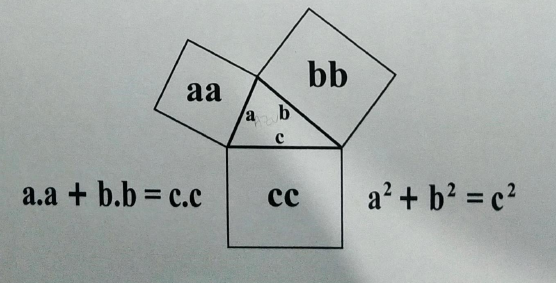
The square (quadratum) sideways (latus) a plus (et) the square (quadratum) sideways (latus) b
is equal (aequalis) to the square (quadratum) of side (latus) c.
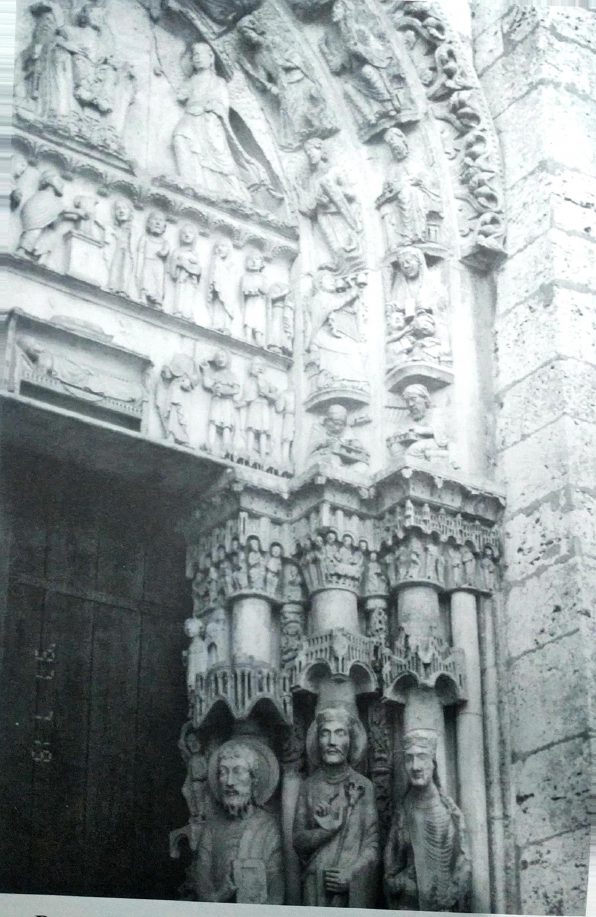
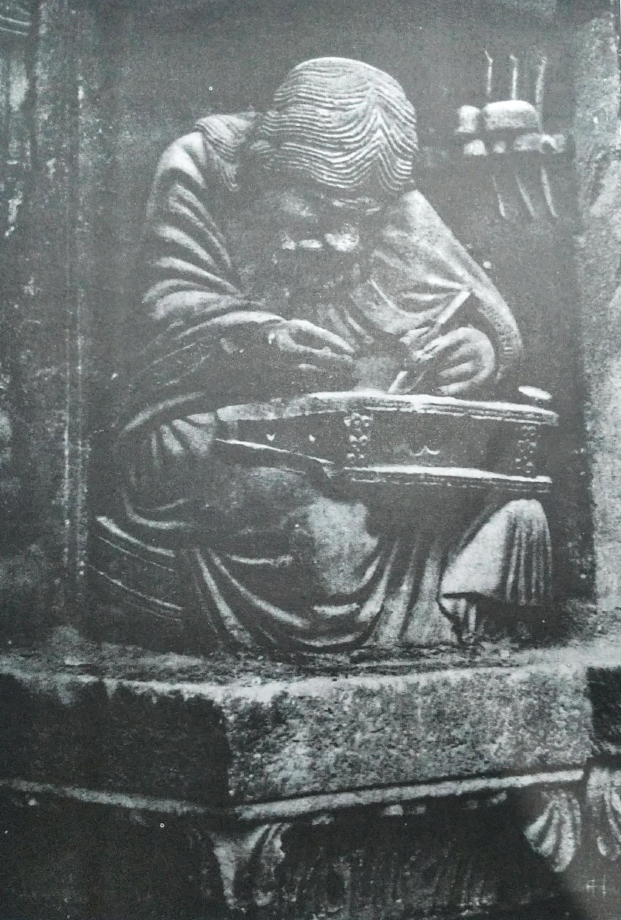
Pythagoras
Portal of the Cathedral of Our Lady of Chartres
| Cathedral of Our Lady of Chartres | Sculpture of Pythagoras |
|---|---|
|
|
Applications of the Pythagorean Theorem
Pythagoras’ theorem is so important that we see it in Arabic and Chinese manuscripts confirm the following figure.
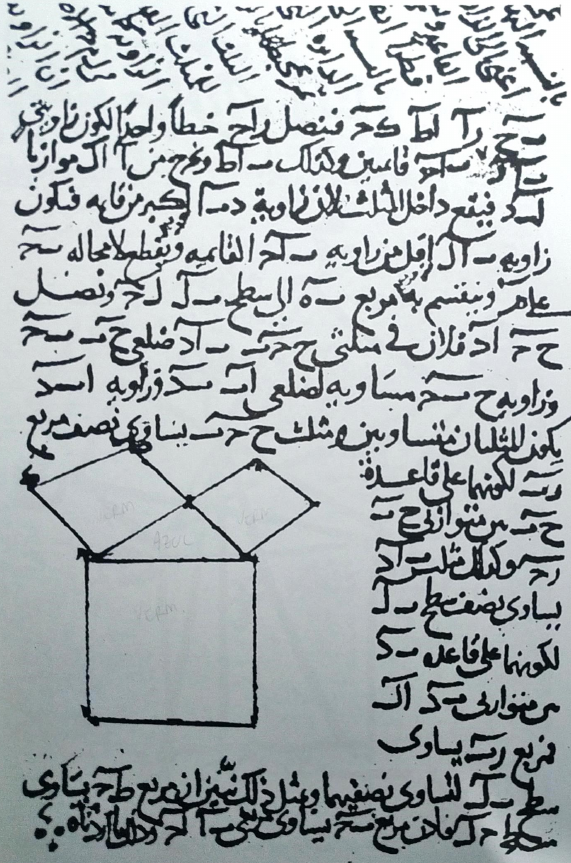
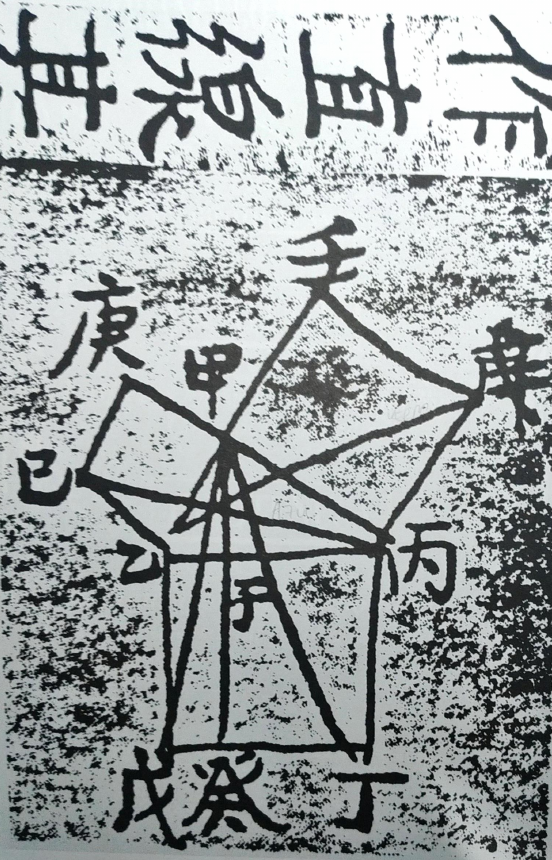
Rectangle Triangle
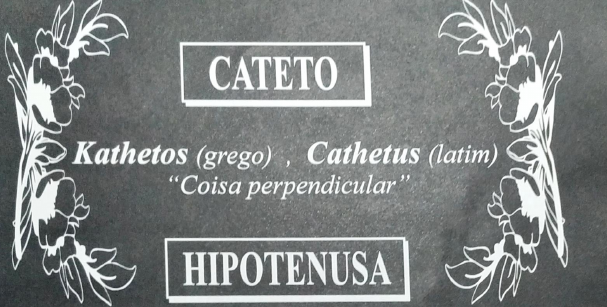
The right-angled triangle, as derived from the name, has one of the right angles, that is, two triangle data are perpendicular, as in two data of one square. Below, according to history, we present the names forcefully imposed by textbooks.
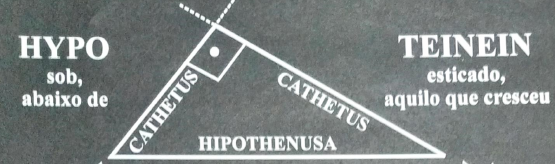
What we know as Catetos represents what is perpendicular ⊥, whereas what we know as Hipotenusa is what is below
two perpendicular lines (stretched).
equilateral triangle
equilateral triangle can be derived from the words equi (iguais) lateralo (lados) and can be obtained from a right-angled triangle. The right triangle is half (½) of a equilateral triangle.
From the right triangle we notice that the hypotenuse in the following example has distance a, one of the legs has distance h and the other leg a/2. As shown in the following figure:
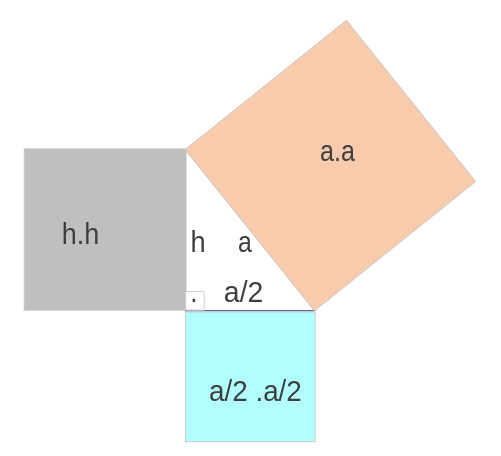
When we unfold the right triangle, we obtain the following equilateral triangle (3 equal sides).

Example 1:
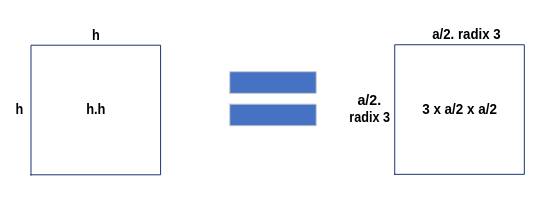
With this, we obtain:
$$h= \frac{a}{2}~.~\text{radix}~ 3$$
Example 2:
Example 3:
Therefore:
radix quadratum 9 aequalis 3
$$\sqrt{9} = 3$$
Fermat’s theorem
French Pierre de Fermat, lawyer and advisor to the Parliament of Toulouse.
Fermat was an excellent mathematician, however, an amateur and in one of his correspondences with other scholars he began to study number theory based on the writings of Diophantus of Alexandria.
Many historians say that Fermat made notes inspired by Diophantus’ studies. He stated theorems without presenting demonstrations.
His sons published many of Fermat’s articles after his death in 1665. Many of the theorems proposed by Fermat were demonstrated by mathematicians who lived shortly after him. The most famous of them is the author who speaks to you, Euler.
In particular, Fermat’s theorem stated below was the most difficult and lasted 350 years without a formal proof.
Fermat’s Last Theorem: For every natural number with $n$ greater than or equal to 3 $(n\geq 3)$ there is no solution to the equation:
$$x^n + y^n = z^n, \qquad \text{para x, y, z números naturais.}$$
In a corner of his book on Arithmetica, he referenced Diophantus’ book on the Pythagorean terms, stating as follows:
This result was demonstrated by Andrew Wiles in 1994 and requires extremely sophisticated mathematics and it is not the place of this post to reproduce this enormous and elegant demonstration. Most historians believe he was mistaken, but quite the opposite.
These are the concepts of the Pythagorean terms. Wait for the next posts.