Euler's Eyes
2022-09-25
Circle Area
Approximately 2300 years ago Eudoxus, Archimedes and others encouraged the area of the circle through the exhaustion method, which consists of circumscribing and inscribing regular polygons in the figure that is intended to evaluate the area.
Area of the circle - Greek Method
Initially, let’s define the area of a square region.
Definition: The area of a square region of side $a$ is $a^2$.

The Greeks verified that every polygonal region can be inscribed in a square through a finite number of operations with a ruler and compass.
Gauss later became enchanted with the Greeks’ idea and so studied the quadrature of non-polygonal regions. They dedicated much of their life to studying quadrature on a disk.
The Greeks like Hippocrates discovered how to square lunulas, which are parts of a disc bounded by another disc. Let us see below the technique used by the Greeks and later by Gauss in the study of integrals.
| $n$ | $A_n$ |
|---|---|
| $4$ | $2.0000 R^2$ |
| $8$ | $2.8484 R^2$ |
| $16$ | $3.06414 R^2$ |
| $32$ | $3.1214 R^2$ |
| $64$ | $3.1363 R^2$ |
| $128$ | $3.1411 R^2$ |
| $256$ | $3.1411 R^2$ |
| $\vdots$ | $\vdots$ |
| $\infty$ | $\pi R^2$ |

Conclusion
The Greeks concluded that the area of the circle according to Euclid was included between the values:
$$3.1411\dots R^2 $$$$3.1418\dots R^2 $$
The representation of the constant 3.14… by the very famous symbol in the history of mathematics, is one of the most important constants in mathematics.

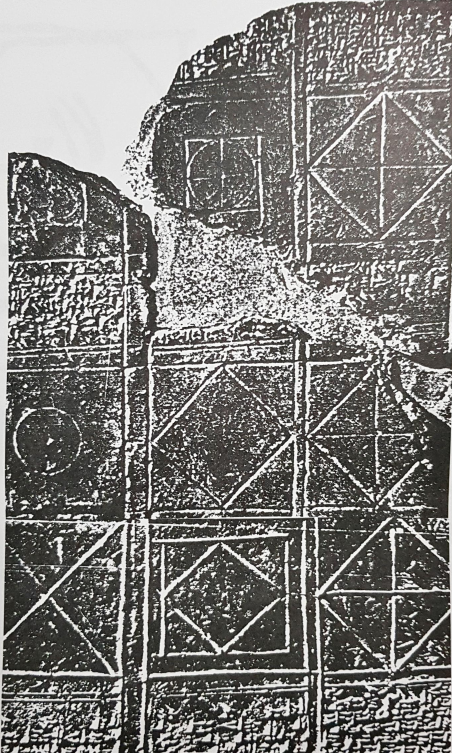
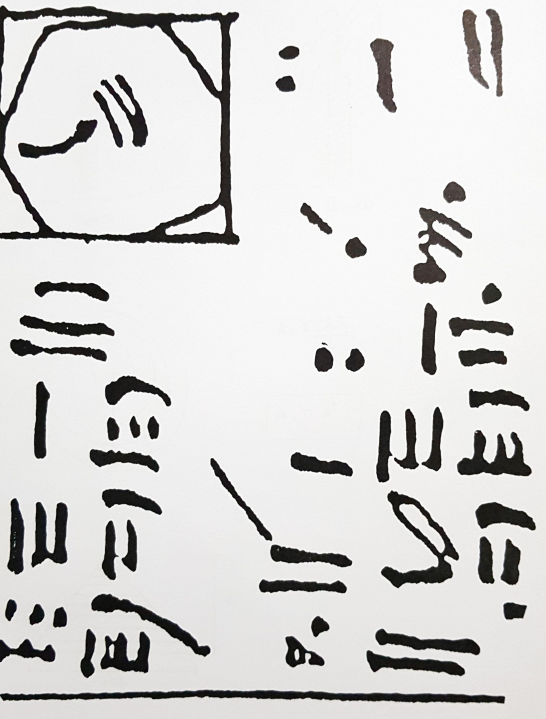
This symbol was created in 1706 by William Jones, who was inspired by the Greek, Egyptian and Babylonian origin of this number. Basically a beam over two columns.
| Babylonian Manuscript | Egyptian manuscript |
|---|---|
|
|
Area of the circle - Egyptian Method

| Cut in Papyrus | Opening of the Papyrus |
|---|---|

|

|
Area of the circle - Indian Method
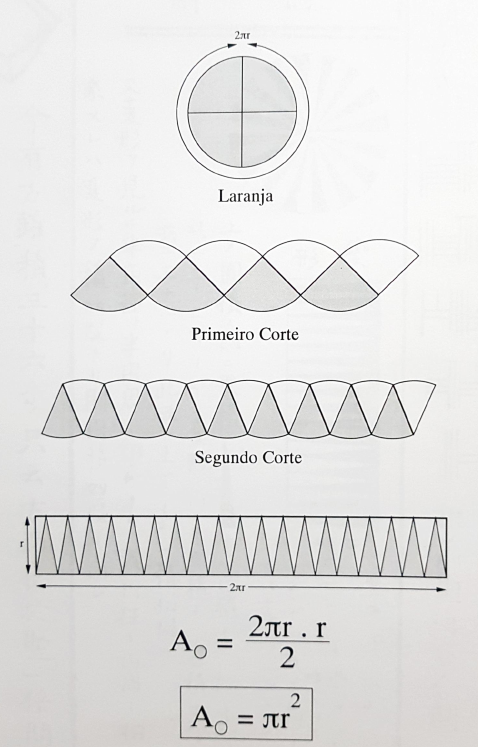
Area of the circle - Japanese Method
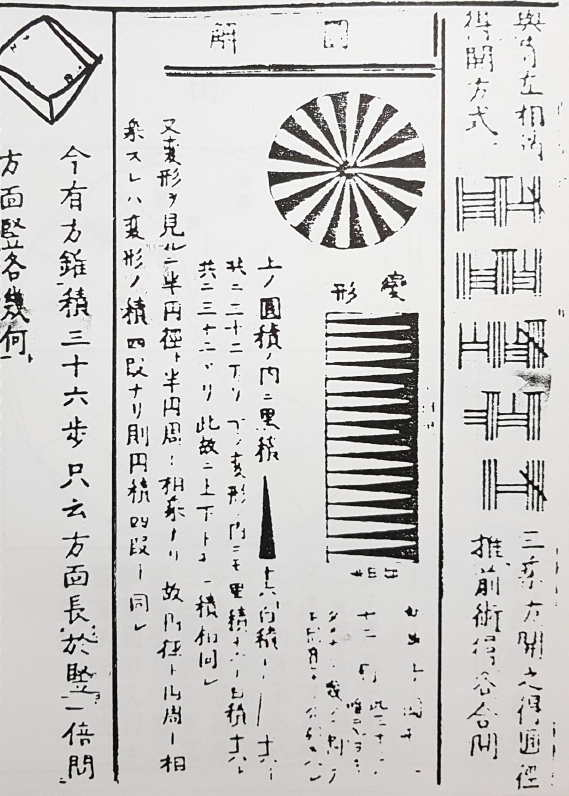
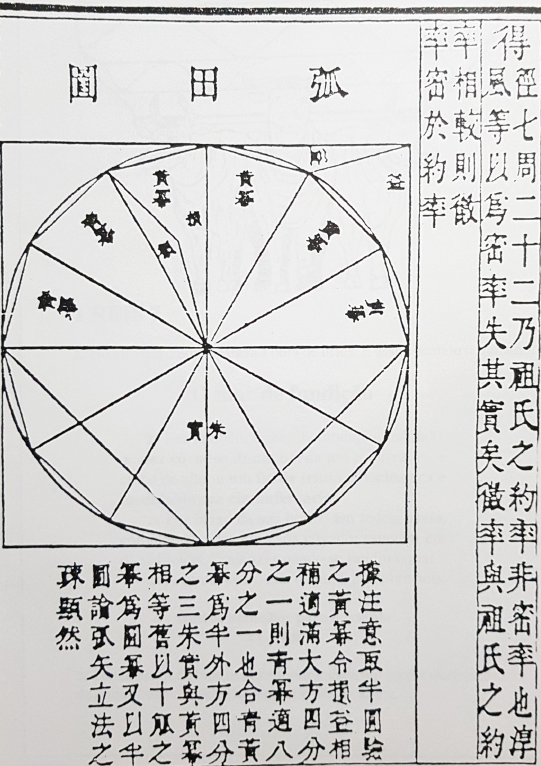
Area of the circle - Chinese Method