
Euler's Eyes
2026-10-11
Fluxions: how to measure an instantaneous change
A car leaves one city and reaches another, 90 km away, in one hour. Its average speed was 90 km/h. But at every instant the speedometer showed a different number. What exactly does it measure? Speed is distance divided by time, but in an instant no distance is covered and no time passes. Dividing zero by zero gives no answer.
That was the question Newton wanted to answer in 1665. His answer was the method of fluxions.
Flowing quantities
Newton pictured each varying quantity as something that flows with time, like water in a river. The flowing quantity he called a fluent; the rate at which it flows, a fluxion. To mark the fluxion he put a dot over the letter. In Quadratura curvarum, published in 1704, he wrote:
Let $x$, $y$, $z$ be fluent quantities; their fluxions will be denoted, respectively, by $\dot x$, $\dot y$, $\dot z$.
— Isaac Newton, Quadratura curvarum (1704)
If $x$ is position, $\dot x$ is velocity. In other words, velocity “flows” from space. Two dots, $\ddot x$, mean the fluxion of the fluxion: acceleration.
Newton’s calculation
To find out how $y=x^2$ changes, Newton let a tiny interval of time pass, which he called $o$. In that interval $x$ becomes $x+\dot x\,o$ and $y$ becomes $y+\dot y\,o$. Since the relation $y=x^2$ still holds:
$$y+\dot y\,o=(x+\dot x\,o)^2=x^2+2x\dot x\,o+\dot x^2o^2.$$Subtracting $y=x^2$ from both sides and dividing by $o$:
$$\dot y=2x\dot x+\dot x^2\,o.$$Now the bold step: since $o$ is “infinitely small”, Newton discarded the last term. What remains is $\dot y=2x\dot x$, that is, $y$ changes $2x$ times as fast as $x$.
The same calculation, today
With limits, we redo the argument without ghosts. The slope of the secant between $x$ and $x+h$, with $h\neq0$, is
$$\frac{(x+h)^2-x^2}{h}=\frac{2xh+h^2}{h}=2x+h.$$First we simplify, while $h$ is still not zero. Only then do we ask what value $2x+h$ approaches as $h$ gets smaller and smaller. The answer is $2x$:
$$\frac{d}{dx}\left(x^2\right)=2x.$$In the figure, the line that cuts the curve at two points is the secant. Decrease $h$ and watch the secant rotate until it matches the tangent.
Position, velocity and acceleration
The method of fluxions was born for motion. Suppose the position of a body, in metres, is
$$S=12-7t+t^2.$$The fluxion of $S$ is the velocity, and the fluxion of the velocity is the acceleration:
$$\dot S=-7+2t,\qquad \ddot S=2\ \text{m/s}^2.$$At first the velocity is negative: the body moves backwards. At $t=3.5$ s, $\dot S=0$ and it stops for an instant. Then it moves forward again, faster and faster. That instant of zero velocity is the lowest point of the graph of $S$, which shows that fluxions also find maxima and minima.
Units help check the calculations. For $S=12-7t+t^2$ to give metres, every term must be in metres: the $12$ is measured in m, the $7$ in m/s and the coefficient $1$ of $t^2$ in m/s². Each fluxion divides by one more second: $\dot S$ comes out in m/s and $\ddot S$ in m/s². If a calculation adds metres to metres per second, there is a mistake somewhere. This check, dimensional analysis, is one of the simplest and most useful tools in physics.
Fluxions, derivatives and Leibniz
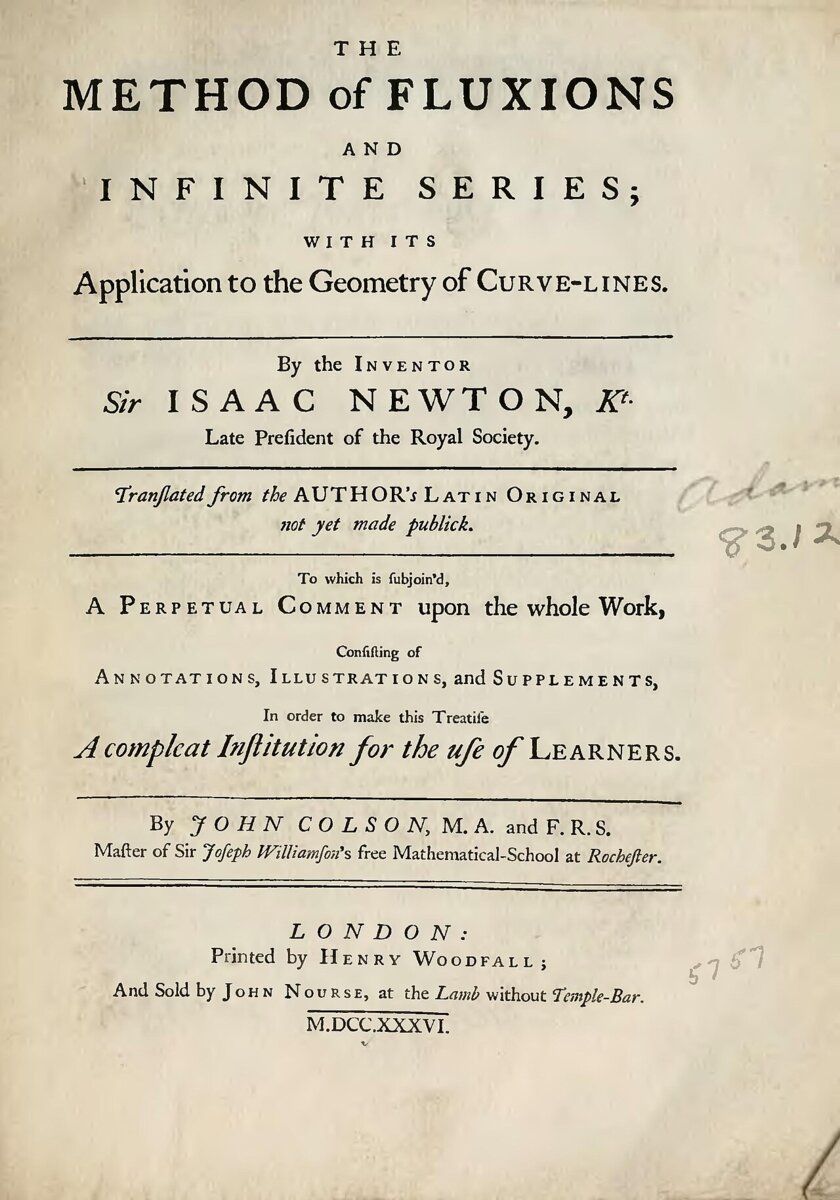
Newton’s treatise on fluxions was ready around 1671 but was only published in 1736, after his death. Meanwhile Leibniz reached the same ideas independently and published first, in 1684, with a different notation: $\dfrac{dy}{dx}$. Today we use Leibniz’s notation in calculus and Newton’s dot in physics, for derivatives with respect to time.
Exercise: what is the slope of y = x² at x = 3?
The derivative is $2x$, so the slope is $6$. The tangent at that point is $y-9=6(x-3)$, or $y=6x-9$.
Exercise: if S = 5t², what are the velocity and acceleration at t = 2?
$\dot S=10t$, so the velocity at $t=2$ is $20$. The acceleration $\ddot S=10$ is constant.
Sources: manuscripts on series and fluxions at the Newton Project · Newton and calculus, MacTutor.
All Isaac Newton topics · ← The generalized binomial: beyond whole-number powers · Areas and integration: the inverse of fluxions →