
Euler's Eyes
2026-10-15
Napier's bones: multiplying with rods
Logarithms were meant for the great calculations of astronomy. For everyday sums Napier invented something else, published in 1617, the year of his death, in a little book called Rabdologia, from the Greek rhabdos, rod, and lógos, calculation: calculation with rods.
The rods
Each rod, or “bone”, because the most expensive ones were made of ivory, carries at the top a digit from 0 to 9 and, below it, its multiples from 1 to 9, in nine small squares cut by a diagonal. The tens go above the diagonal and the units below. The rod for 7, for example, shows $0/7$, $1/4$, $2/1$, $2/8$, $3/5$, $4/2$, $4/9$, $5/6$, $6/3$.
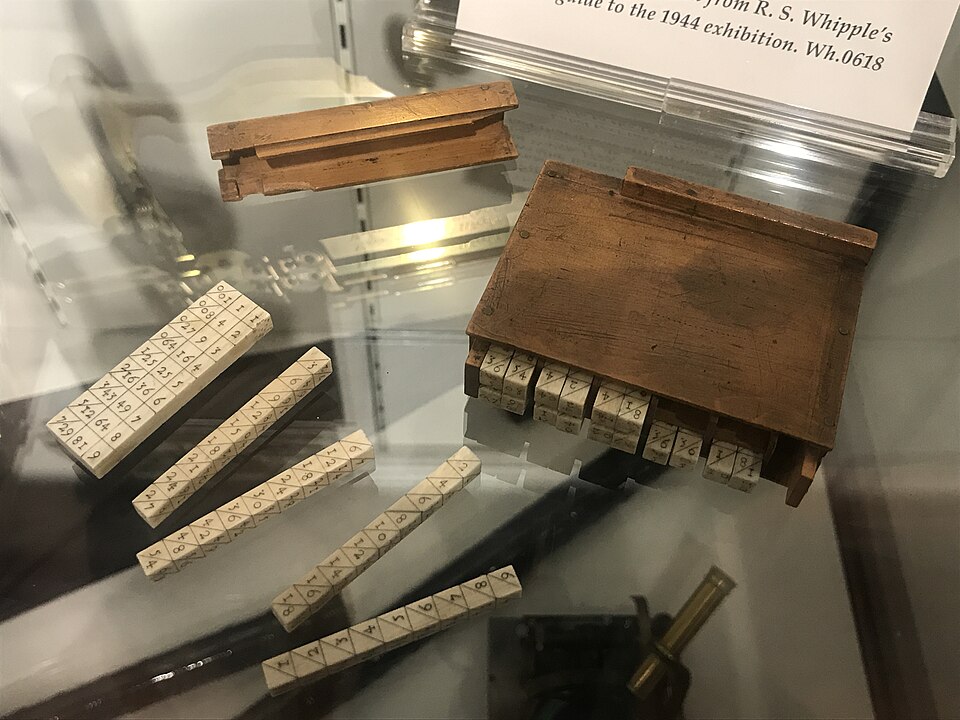
How to multiply
To compute $425\times6$, put the rods for 4, 2 and 5 side by side and look at the sixth row:
$$4\times6=24\ \to\ 2/4,\qquad2\times6=12\ \to\ 1/2,\qquad5\times6=30\ \to\ 3/0.$$Now add along the diagonals, from right to left. The first diagonal has only the 0. The second has the 3 and the 2: that makes 5. The third has the 1 and the 4: 5. The last has only the 2. The result is
$$425\times6=2550.$$The diagonals automatically do the “carrying” of ordinary multiplication: the tens of each product fall on the same diagonal as the units of the next one. When a diagonal goes past 9, the excess passes to the next, as in addition.
Large multipliers
To multiply by a number of several digits, such as $425\times36$, one reads row 6 and row 3, one at a time, and adds the results in the right places:
$$425\times36=425\times30+425\times6=12{,}750+2{,}550=15{,}300.$$The great advantage was that nobody needed to know the times table by heart: it was enough to read and add. The bones spread across Europe within a few years and were used until the nineteenth century. In the Rabdologia Napier also described the promptuary, a more sophisticated box of strips that did larger multiplications without any written addition.
Exercise: compute 736 × 8 with the bones.
The rods for 7, 3 and 6, in the eighth row, show $5/6$, $2/4$ and $4/8$. The diagonals, from right to left, give: 8; $4+4=8$; $2+6=8$; 5. So $736\times8=5888$.
Exercise: in the calculation 87 × 9, what happens when a diagonal goes past 9?
The rods for 8 and 7, in the ninth row, show $7/2$ and $6/3$. The diagonals: 3; $6+2=8$; 7. Result: $783$. In $98\times7$ the rods show $6/3$ and $5/6$, and the diagonals give 6, $5+3=8$ and 6: $686$. If a diagonal came to, say, 13, we would write the 3 and add 1 to the next diagonal, exactly as in carrying in addition.
Sources: John Napier, Rabdologiae, seu numerationis per virgulas libri duo (Edinburgh, 1617) · William Frank Richardson (trans.), Rabdology (MIT Press, 1990) · Julian Havil, John Napier: Life, Logarithms, and Legacy (2014).
All topics on John Napier · ← Briggs and base-10 logarithms · The slide rule: logarithms that slide →