
Euler's Eyes
2026-10-11
Exercises from chapter 13 — Similarity of triangles and point powers
Exercises and resolutions
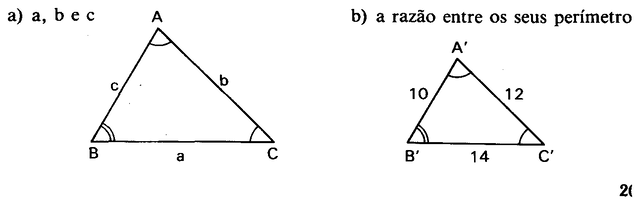
The triangles $ABC$ and $A^{\prime}B^{\prime}C^{\prime}$ in the figure are similar. If the similarity ratio of the 1st to the 2nd is $\dfrac{3}{2}$, determine: a) $a$, $b$ and $c$; b) the ratio between their perimeters.
Ver resposta
a) $a = 21$, $b = 18$ e $c = 15$ · b) $\dfrac{3}{2}$
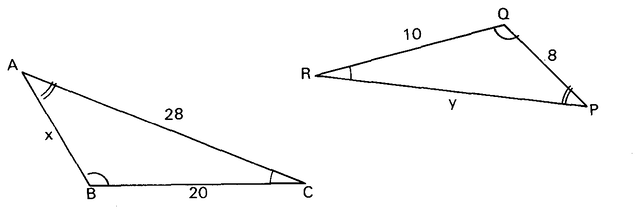
Triangles $ABC$ and $PQR$ are similar. Determine $x$ and $y$.
Ver resposta
$x = 16$ e $y = 14$
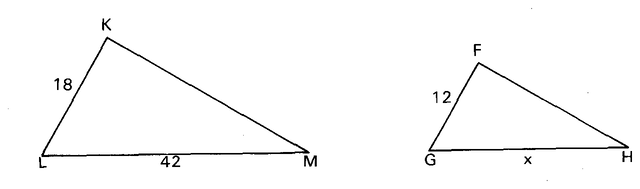
If $\triangle KLM$ is similar to $\triangle FGH$, determine $x$.
Ver resposta
$x = 28$
The three sides of a triangle $ABC$ measure 8 cm, 18 cm and 16 cm. Determine the sides of a triangle $A^{\prime}B^{\prime}C^{\prime}$ similar to $ABC$, knowing that the similarity ratio of the first to the second is equal to 3.
Ver resposta
$\dfrac{8}{3}$ cm, 6 cm and $\dfrac{16}{3}$ cm
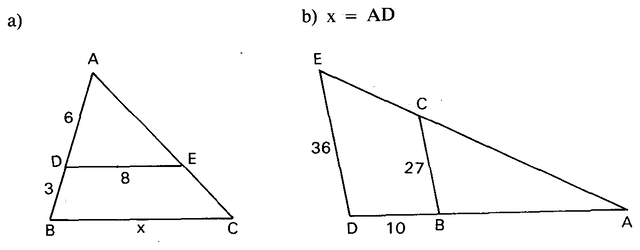
If $\overline{DE}$ is parallel to $\overline{BC}$, determine $x$ in the cases (in b, $x = AD$):
Ver resposta
a) 12 · b) 40
From a $\triangle ABC$ we know that $AB = 20$ m, $BC = 30$ m and $AC = 25$ m. If $D$ is in $\overline{AB}$, $E$ in $\overline{AC}$, $\overline{DE}$ is parallel to $\overline{BC}$ and $DE = 18$ m, determine $x = DB$ and $y = EC$.
Ver resposta
$x = 8$ m e $y = 10$ m
Show that, if the similarity ratio between two triangles is $k$, then the ratio between their perimeters is also $k$.
See the resolution of the book
With $a = ka^{\prime}$, $b = kb^{\prime}$ and $c = kc^{\prime}$:
$$\frac{2p}{2p^{\prime}} = \frac{a + b + c}{a^{\prime} + b^{\prime} + c^{\prime}} = \frac{k(a^{\prime} + b^{\prime} + c^{\prime})}{a^{\prime} + b^{\prime} + c^{\prime}} = k.$$Two triangles $ABC$ and $A^{\prime}B^{\prime}C^{\prime}$ are similar. Knowing that the side $\overline{AB}$ measures 20 cm and that its counterpart $\overline{A^{\prime}B^{\prime}}$ measures 40 cm, determine the perimeter of the triangle $ABC$, knowing that the perimeter of the triangle $A^{\prime}B^{\prime}C^{\prime}$ is 200 cm.
Ver resposta
100 cm
The perimeter of a triangle is 60 m and one of the sides is 25 m. What is the perimeter of the similar triangle whose side opposite to the given side measures 15 m?
Ver resposta
36 m
The sides of a triangle measure 8,4 cm, 15,6 cm and 18 cm. This triangle is similar to a triangle whose perimeter measures 35 cm. Calculate the longest side of the second triangle.
Ver resposta
15 cm
In a triangle $ABC$, the sides measure $AB = 4$ cm, $BC = 5$ cm and $AC = 6$ cm. Calculate the sides of a triangle similar to $ABC$ whose perimeter measures 20 cm.
Ver resposta
$\dfrac{16}{3}$ cm, $\dfrac{20}{3}$ cm and 8 cm
A triangle whose sides measure 12 m, 18 m and 20 m is similar to one whose perimeter measures 30 m. Calculate the length of the smallest side of the smallest triangle.
Ver resposta
7,2 m
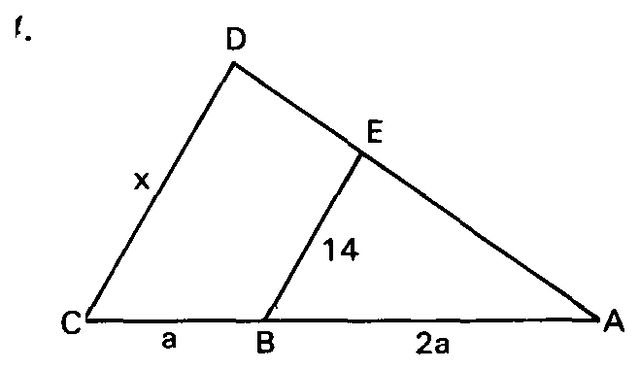
In the figure, $AB = 2 \cdot BC$ and $BE = 14$. Calculate $CD$, knowing that $\overline{BE} \parallel \overline{CD}$.
Ver resposta
$CD = 21$
The bases of a trapezoid measure 12 m and 18 m and the sides oblique to the bases measure 5 m and 7 m. Determine the sides of the smallest triangle that we obtain by extending the sides oblique to the bases.
Ver resposta
10 m, 12 m e 14 m
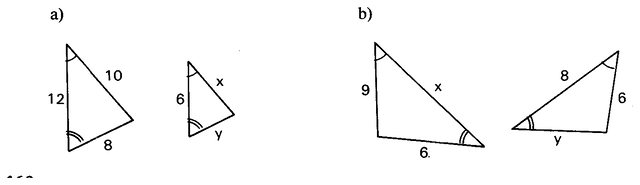
If angles with “equal marks” are congruent, determine the unknowns in the cases:
Ver resposta
a) $x = 5$ e $y = 4$ · b) $x = 12$ e $y = 4$
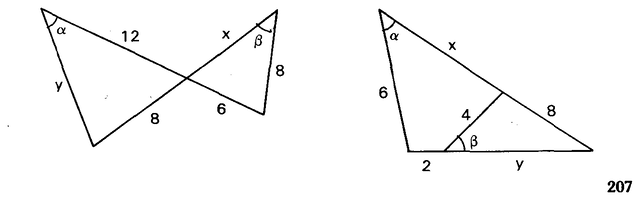
If $\alpha = \beta$, determine $x$ and $y$ in the cases:
Ver resposta
a) $x = 9$ e $y = \dfrac{32}{3}$ · b) $x = 7$ e $y = 10$
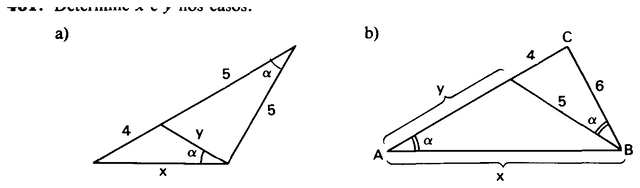
Determine $x$ and $y$ in the following cases:
Ver resposta
a) $x = 6$ e $y = \dfrac{10}{3}$ · b) $x = \dfrac{15}{2}$ e $y = 5$
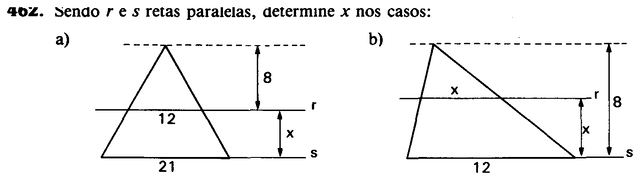
Since $r$ and $s$ are parallel lines, determine $x$ in the cases:
Ver resposta
a) $x = 6$ · b) $x = \dfrac{24}{5}$
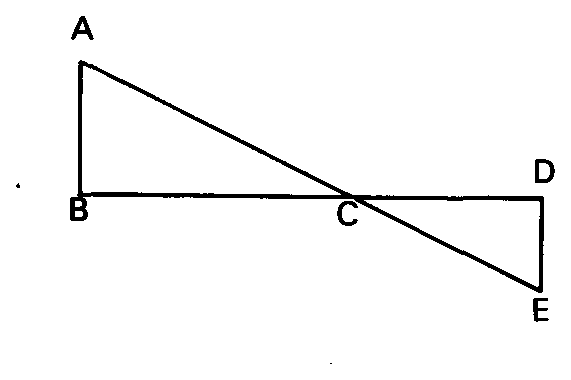
If $\overline{AB} \parallel \overline{ED}$, $DE = 4$ cm, $CD = 2$ cm and $BC = 6$ cm, calculate the measurement of $\overline{AB}$.
Ver resposta
$AB = 12$ cm
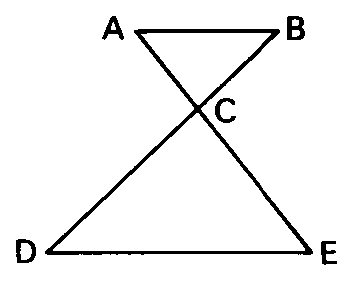
In the figure, $\overline{AB}$ is parallel to $\overline{DE}$. a) Prove that the triangles $ABC$ and $EDC$ are similar. b) Being $AB = 5$, $AC = 6$, $BC = 7$ and $DE = 10$, calculate $CD$.
Ver resposta
a) Use the 1st case of similarity (alternate angles and o.p.v.). b) $CD = 14$
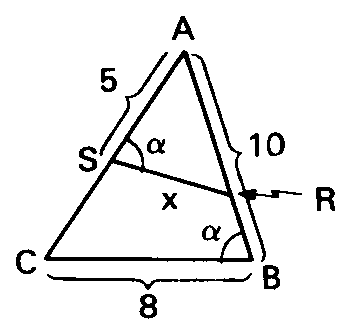
In the figure below, determine the value of $x$.
Ver resposta
$x = 4$
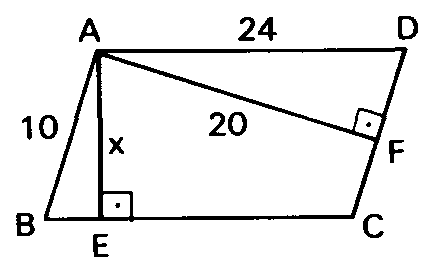
Calculate the value of $x$, knowing that the figure below is a parallelogram.
Ver resposta
$x = \dfrac{25}{3}$
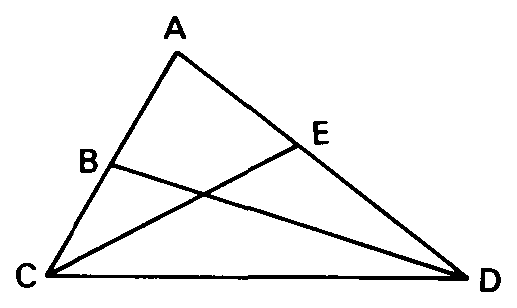
In the figure, $AB = 8$ cm, $BC = 3$ cm and $AE = 5$ cm. Calculate $x = DE$, knowing that $A\hat{C}E \equiv A\hat{D}B$.
Ver resposta
$x = \dfrac{63}{5}$ cm
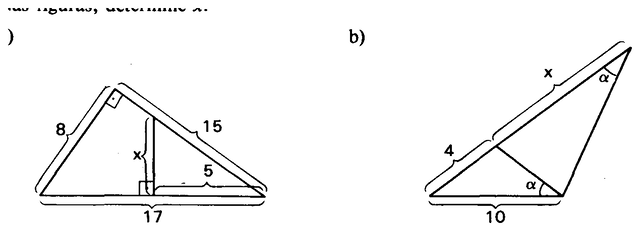
In the figures, determine $x$.
Ver resposta
a) $x = \dfrac{8}{3}$ · b) $x = 21$
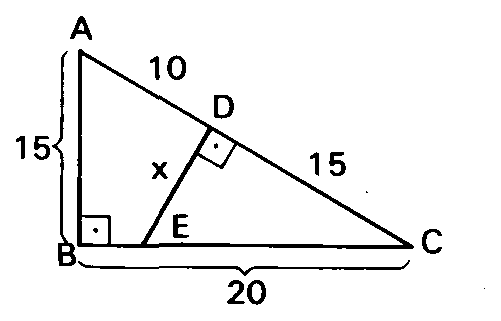
Given the figure, determine the value of $x$.
Ver resposta
$x = \dfrac{45}{4}$
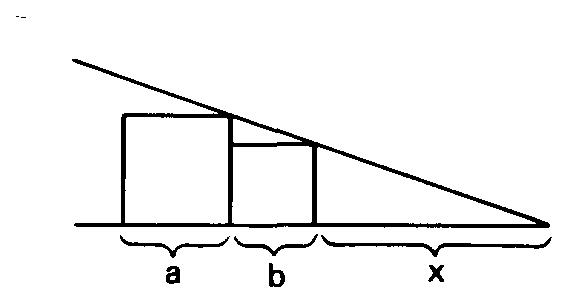
In the figure, let us consider the squares with sides $a$ and $b$ ($a > b$). Calculate the value of $x$.
Ver resposta
$x = \dfrac{b^2}{a - b}$
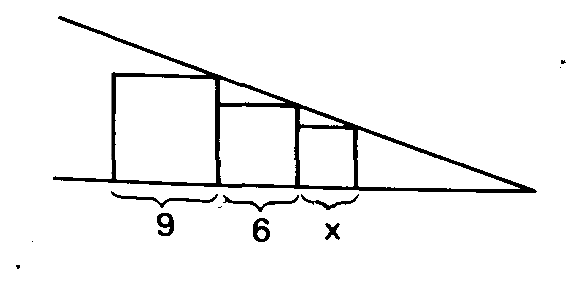
In the figure, let us consider the squares with sides $x$, 6 and 9. Determine the perimeter of the square with side $x$.
Ver resposta
16
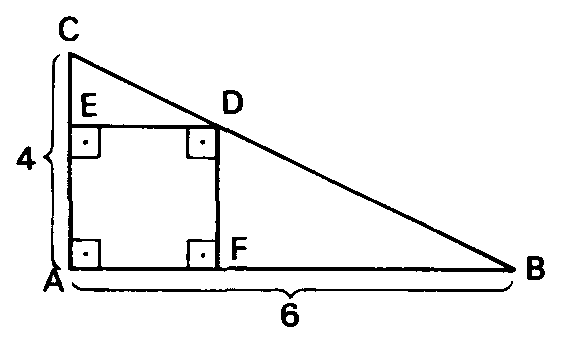
Determine the side length of the square in the figure below.
Ver resposta
$\dfrac{12}{5}$
Extending the oblique sides to the bases of a trapezoid, we obtain a point $E$ and the triangles $ECD$ and $EAB$. Determine the relationship between the heights of the two triangles, relative to the sides that are the bases of the trapezoid, with 12 cm and 4 cm being the measurements of the bases of the trapezoid.
Ver resposta
3
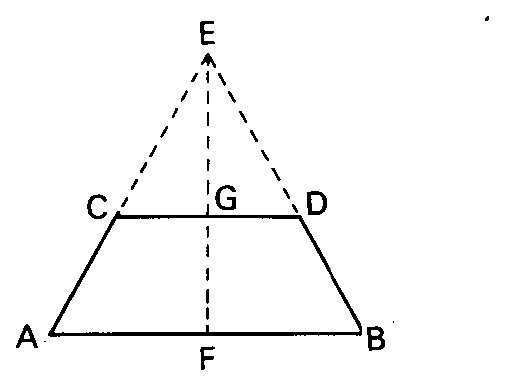
The bases of a trapezoid $ABCD$ measure 50 cm and 30 cm, and the height, 10 cm. Extending the non-parallel sides, they intersect at a point $E$. Determine the height $\overline{EF}$ of the triangle $ABE$ and the height $\overline{EG}$ of the triangle $CDE$.
Ver resposta
$EF = 25$ cm and $EG = 15$ cm
In a isosceles triangle of 20 cm in height and $\dfrac{50}{3}$ cm in base, a rectangle of 8 cm in height is inscribed at the base of the triangle. Calculate the measurement of the base of the rectangle.
Ver resposta
10 cm
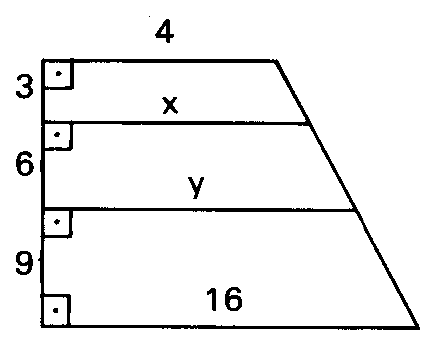
Determine $x$ and $y$.
Ver resposta
$x = 6$ e $y = 10$
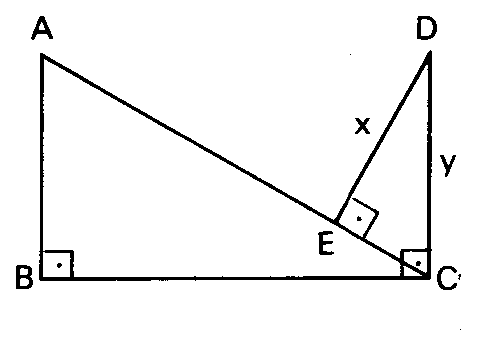
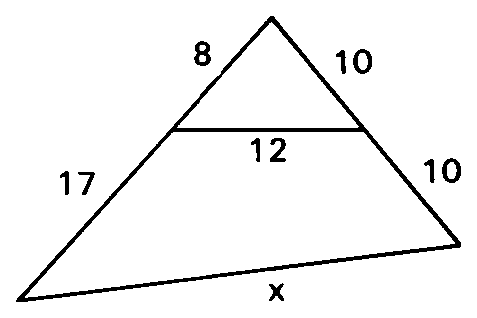
In the figure, we have $AB = 8$, $BC = 15$, $AC = 17$ and $EC = 4$. Determine $x = DE$ and $y = CD$.
Ver resposta
$x = \dfrac{15}{2}$ e $y = \dfrac{17}{2}$
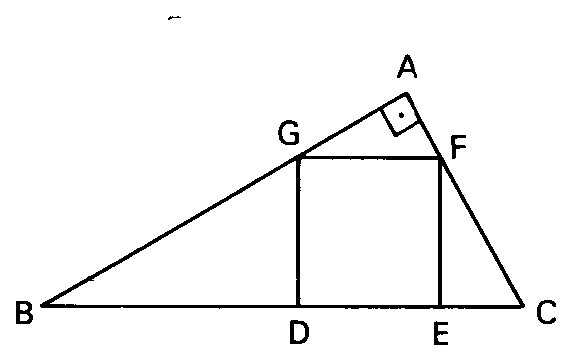
In the figure, the square $DEFG$ is inscribed in the triangle $ABC$. With $BD = 8$ cm and $CE = 2$ cm, calculate the perimeter of the square.
Ver resposta
16 cm
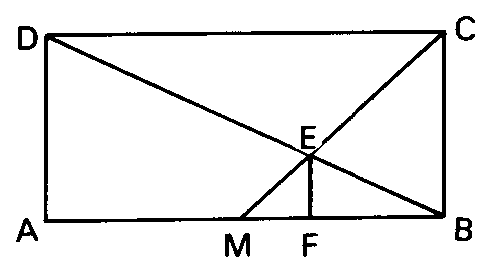
In a rectangle $ABCD$, the sides $\overline{AB}$ and $\overline{BC}$ measure 20 cm and 12 cm. With $M$ being the midpoint of the side $\overline{AB}$, calculate $EF$, the distance from the point $E$ to the side $\overline{AB}$, with $E$ being the intersection of the diagonal $\overline{BD}$ with the segment $\overline{CM}$.
Ver resposta
4 cm
In the figure, determine $x$.
Ver resposta
$x = 30$ (2nd case of similarity)
Let us consider a triangle $ABC$ with side $BC = 10$ cm. Let $\overline{CD}$ be an internal segment of the triangle, with $D$ on the $\overline{AB}$ side. Knowing that $BD = 4$ cm and that the angles $B\hat{A}C$ and $B\hat{C}D$ are congruent, determine the measure of $\overline{AD}$.
Ver resposta
21 cm
Through the points $A$ and $B$ of a straight line, perpendiculars are drawn to the straight line. On them we take the segments $AC = 13$ cm and $BD = 7$ cm. In the segment $AB = 25$ cm, a point $P$ is taken such that the angles $A\hat{P}C$ and $B\hat{P}D$ are congruent. Calculate the measurement of $\overline{AP}$.
Ver resposta
$AP = \dfrac{65}{4}$ cm
Consider the circle circumscribed by a triangle $ABC$. Let $\overline{AE}$ be the diameter of this circle and $\overline{AD}$ be the height of the triangle. Being $AB = 6$ cm, $AC = 10$ cm and $AE = 30$ cm, calculate the height $\overline{AD}$.
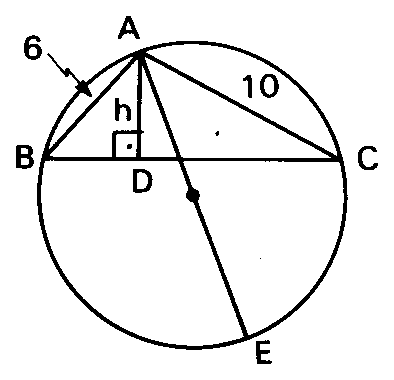
Ver resposta
$\triangle ADB \sim \triangle ACE$, then $AD = 2$ cm.
Calculate $R$, the radius of the circle circumscribed by the triangle $ABC$ in the figure, being $AB = 4$, $AC = 6$ and $AH = 3$.
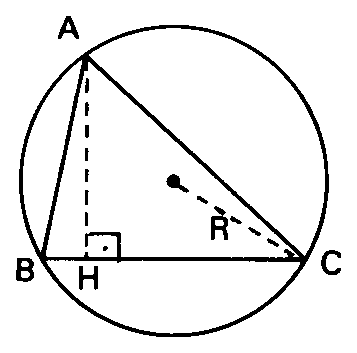
Ver resposta
Draw the diameter $\overline{CD}$; $\triangle ADC \sim \triangle HBA$ gives $R = 4$.
Two circles of radii $R$ and $r$ are tangent externally at the point $A$. Since $C$ and $D$ are the points of tangency of a straight line $t$ external to the two circles, determine the height of the triangle $ACD$ relative to the side $\overline{CD}$.
Ver resposta
$\dfrac{2Rr}{R + r}$
The point $O$ is the intersection of the diagonals $\overline{AC}$ and $\overline{BD}$ of a rhombus $ABCD$. The side $\overline{AD}$ is extended to a point $F$ so that $DF = 4$ m. If $\overline{OF}$ meets $\overline{CD}$ in $E$ and $ED = 2$ m, determine the side of the diamond.
Ver resposta
Extend $\overline{FO}$ and use similarity: the side measures 8 m.
From a triangle $ABC$ we know that the angle $\hat{A}$ is twice the angle $\hat{C}$, $AB = 6$ m and $AC = 10$ m. Determine $BC$.
Ver resposta
Plot the inner angle bisector $\overline{AS}$ and use the similarity between $\triangle ACB$ and $\triangle SAB$: $BC = 4\sqrt{6}$ m.
In the figure, the rays $\overrightarrow{PA}$ and $\overrightarrow{PB}$ are tangents to the circle. If the distances from $Q$ to the tangents are 4 and 9, find the distance from $Q$ to the chord $\overline{AB}$.
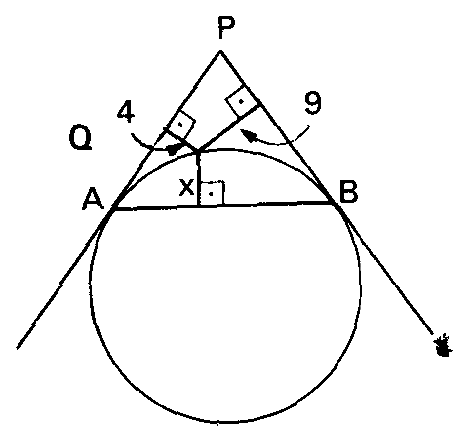
Ver resposta
$x = 6$ (join $A$ and $B$ with $Q$; of the four triangles obtained, the opposite ones are similar)
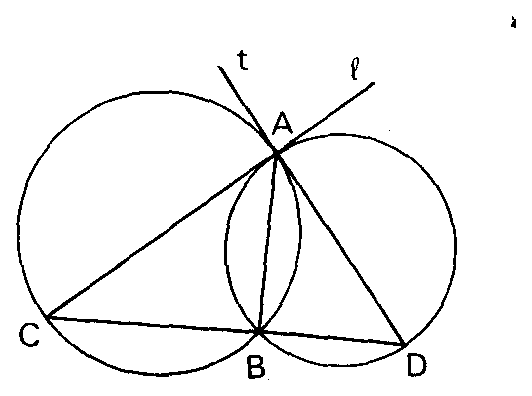
The lines $t$ and $f$ are tangents to the circles in $A$. Determine $AB$ in terms of $a = BC$ and $b = BD$.
Ver resposta
$AB = \sqrt{ab}$
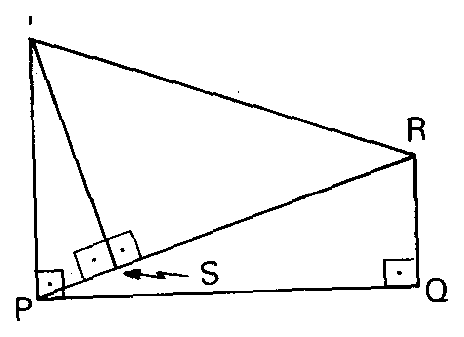
In the figure, $\overline{RQ}$ is perpendicular to $\overline{PQ}$, $\overline{PQ}$ is perpendicular to $\overline{PT}$, and $\overline{TS}$ is perpendicular to $\overline{PR}$. Prove that $TS \cdot RQ = PS \cdot PQ$.
Ver resposta
Prove that $\triangle PST \sim \triangle RQP$.
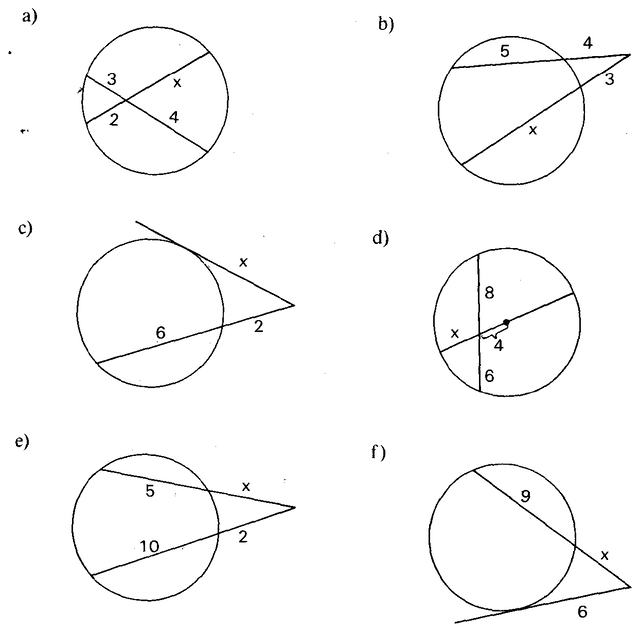
In each case, determine the unknown.
Ver resposta
a) 6 · b) 9 · c) 4 · d) 4 · e) 3 · f) 3
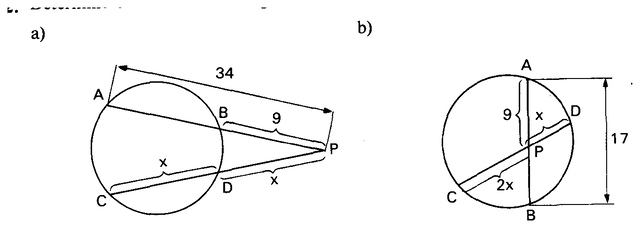
Determine the value of $x$ in the figures below.
Ver resposta
a) $3\sqrt{17}$ · b) 6
Determine $x$ in cases:
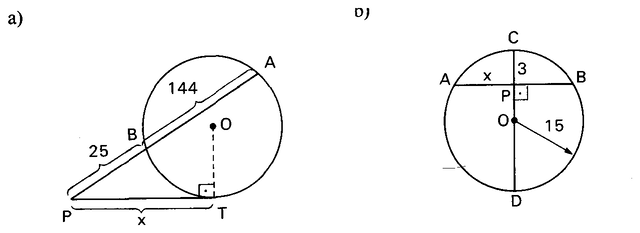
Ver resposta
a) 65 · b) 9
In the figure, calculate the measurements of the strings $\overline{BD}$ and $\overline{CE}$, being $AB = 3x$, $AC = 4x - 1$, $AD = x + 1$ and $AE = x$.
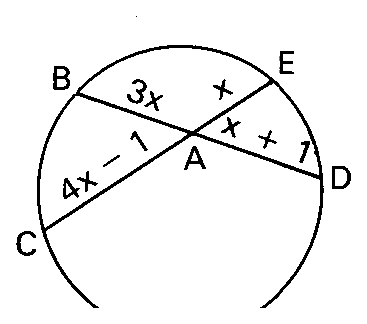
See the resolution of the book
Then $BD = 3x + x + 1 = 17$ and $CE = 4x - 1 + x = 19$.
Determine the value of $x$ in the figures below.
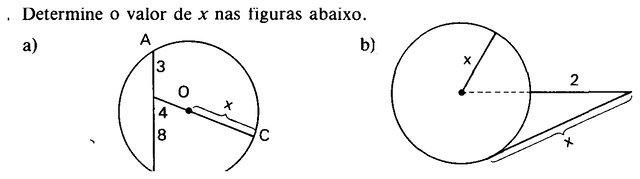
Ver resposta
a) $2\sqrt{10}$ · b) $2(1 + \sqrt{2})$
Determine the radius of the circle in the following cases:
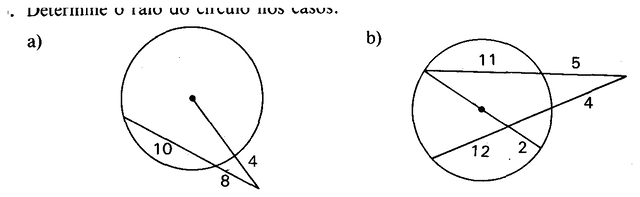
Ver resposta
a) 16 · b) 13
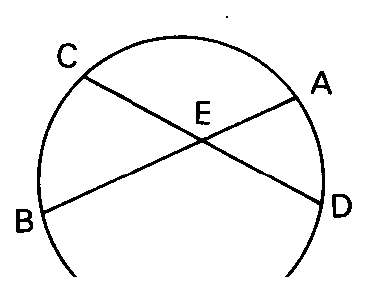
In the figure, being $ED : EC = 2 : 3$, $AE = 6$ and $EB = 16$, calculate the length of $\overline{CD}$.
Ver resposta
$CD = 20$
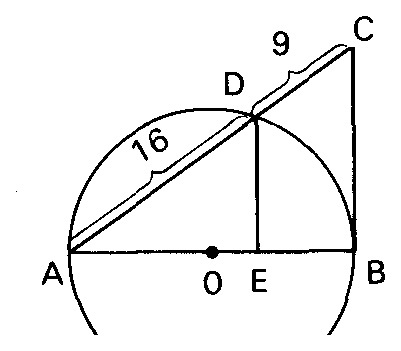
Determine the measurement of the segment $\overline{DE}$, knowing that $\overline{AB}$ is the diameter of the circle, $B$ is the point of tangency of the segment $\overline{BC}$ to the circle and $\overline{DE}$ is parallel to $\overline{BC}$.
See the resolution of the book
Point power: $BC^2 = 9 \cdot 25 \Rightarrow BC = 15$. Similarity: $\dfrac{BC}{DE} = \dfrac{AC}{AD} \Rightarrow \dfrac{15}{DE} = \dfrac{25}{16} \Rightarrow DE = \dfrac{48}{5}$.
Ver resposta
$DE = \dfrac{48}{5}$
Calculate the power of a point $P$ in relation to a circle with center $O$ and radius $r$, as a function of the distance $d$ between $O$ and $P$ and the radius $r$.
See the resolution of the book
Use the string (or secant) that passes through the center:
- $P$ inside: $x = PA \cdot PB = (r + d)(r - d) = r^2 - d^2$;
- $P$ outside: $x = PA \cdot PB = (d + r)(d - r) = d^2 - r^2$.
In both cases, $x = |d^2 - r^2|$.
In the figure in the book, calculate $\text{pot}\,A + \text{pot}\,B + \text{pot}\,C$ (powers in relation to the circumference $\lambda$).
Ver resposta
91
Through a point $P$ distant 18 cm from a circle, a secant is drawn that determines a chord $\overline{AB}$ measuring 10 cm on the circle. Calculate the length of the tangent to this circle drawn from the point $P$, knowing that $\overline{AB}$ passes through the center of the circle.
Ver resposta
$6\sqrt{14}$ cm
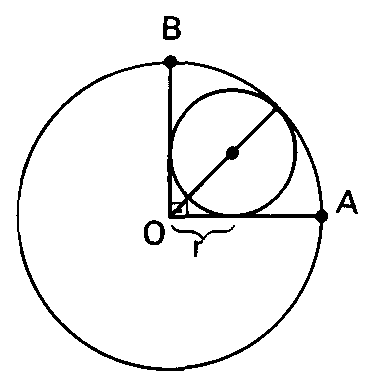
Determine the radius of the smaller circle inscribed in a quadrant of the larger circle in the figure, with $2R$ being the diameter of the larger circle.
Ver resposta
$(\sqrt{2} - 1)R$
Two chords $\overline{AB}$ and $\overline{CD}$ intersect at a point $P$ inside a circle. Determine the measurement of the segment $\overline{BP}$, knowing that the segments $\overline{CP}$, $\overline{DP}$ and the chord $\overline{AB}$ measure, respectively, 1 cm, 6 cm and 5 cm.
Ver resposta
2 cm or 3 cm
In a circle, two ropes cut each other. The product of the two segments of the first string is $25\ \text{cm}^2$. It is known that, in the second string, the smallest segment is worth $\dfrac{1}{4}$ of the largest. Determine the length of the longest segment of this second string.
Ver resposta
10 cm
$\overline{AB}$ and $\overline{AC}$ are two strings of equal measurements, belonging to a circle. A chord $\overline{AD}$ intersects the chord $\overline{BC}$ at a point $P$. Prove that the triangles $ABD$ and $APB$ are similar.
Ver resposta
$\hat{A}$ is common to triangles and $A\hat{D}B \equiv A\hat{B}P$ (because $\overset{\frown}{AB} \equiv \overset{\frown}{AC}$). So they are similar in the 1st case.