
Euler's Eyes
2026-11-04
EJU 2017 (2nd session) – Mathematics Course 2 solved
Source: JASSO – Mathematics paper in English, in Japanese and official answer key. Files on the page for the 2nd session of 2017.
Course 2 is the advanced mathematics paper of the EJU. Each letter $\boxed{\text{A}}$, $\boxed{\text{B}}$, … is a digit from 0 to 9 or the minus sign; in some blanks the answer is the number of a choice. The statements below are summarized from the official English version.
Answer key
| Question | Topic | Answers |
|---|---|---|
| I | Same as Question I of Course 1 | A=1, B=8, C=1, DE=−2, F=4, G=0, HI=−1, JK=−1, LM=−3; N=9, O=7, PQ=54, RS=13, TUV=108, WX=13, YZ=36 |
| II Q1 | Recurrence | A=3, B=6, C=4, D=3, E=1, F=4, G=5, H=4, I=3, J=5, K=4, L=1 |
| II Q2 | Inradius | M=5, N=3, O=3, P=1, Q=1, R=2, S=4, T=1, U=1, V=1, W=4, XY=20, Z=3 |
| III | Logarithmic inequality | A=3, B=6, C=1, D=3, E=0, F=1, G=2, H=7, I=2 |
| IV | Circle and hyperbola | A=2, B=1, C=2, D=1, EF=12, G=5, HI=12, J=5, KL=12, M=1, NO=12, P=1, Q=6, R=2, S=3, T=1, U=4 |
Question I
Question I of Course 2 is identical to that of Course 1 (the minimum of a quadratic under constraints and a ball moving on a triangle). The full solution is in the Course 1 post.
Answers: A=1, B=8, C=1, DE=−2, F=4, G=0, HI=−1, JK=−1, LM=−3; N=9, O=7, PQ=54, RS=13, TUV=108, WX=13, YZ=36.
Question II
Q1: a recurrence with powers of 3
Statement. We want the general term of $a_1 = 18$, $a_{n+1} - 12a_n + 3^{n+2} = 0$. Defining $b_n = \dfrac{a_n}{\boxed{\text{A}}^n}$, we have $b_1 = \boxed{\text{B}}$ and $b_{n+1} - \boxed{\text{C}}\,b_n + \boxed{\text{D}} = 0$, which can be written $b_{n+1} - \boxed{\text{E}} = \boxed{\text{F}}\left(b_n - \boxed{\text{E}}\right)$. With $c_n = b_n - \boxed{\text{E}}$, $(c_n)$ is a geometric progression with first term $\boxed{\text{G}}$ and ratio $\boxed{\text{H}}$. So $a_n = \boxed{\text{I}}^n\left(\boxed{\text{J}}\cdot\boxed{\text{K}}^{n-1} + \boxed{\text{L}}\right)$.
Solution.
1. Dividing the recurrence by $3^{n+1}$, with $b_n = \frac{a_n}{3^n}$: $b_{n+1} - 4b_n + 3 = 0$, and $b_1 = \frac{18}{3} = 6$.
2. The fixed point of $b \mapsto 4b - 3$ is $b = 1$, so $b_{n+1} - 1 = 4(b_n - 1)$. The sequence $c_n = b_n - 1$ is geometric, with $c_1 = 5$ and ratio $4$: $c_n = 5\cdot4^{n-1}$.
3. $a_n = 3^n\left(5\cdot4^{n-1} + 1\right)$. (Check: $a_2 = 9\cdot21 = 189$ and $12\cdot18 - 27 = 189$.)
Answers: A=3, B=6, C=4, D=3, E=1, F=4, G=5, H=4, I=3, J=5, K=4, L=1.
Q2: the inradius of an isosceles triangle
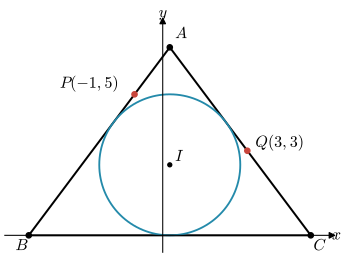
Statement. In the $xy$-plane, the isosceles triangle $ABC$ ($AB = AC$) has base $BC$ on the $x$-axis; side $AB$ passes through $P(-1, 5)$ and side $AC$ through $Q(3, 3)$. Let $\ell_1$ be line $AB$, with slope $a$, and $\ell_2$ line $AC$. Then
$$\ell_1: y = ax + a + \boxed{\text{M}}, \qquad \ell_2: y = -ax + \boxed{\text{N}}\,a + \boxed{\text{O}}.$$The center $I$ and radius $r$ of the inscribed circle satisfy $I = \left(\boxed{\text{P}} - \dfrac{\boxed{\text{Q}}}{a},\ r\right)$ and
$$r = \frac{\boxed{\text{R}}\,a + \boxed{\text{S}}}{\boxed{\text{T}} + \sqrt{a^2 + \boxed{\text{U}}}}.$$In particular, when $r = \frac52$, the vertex $A$ is $\left(\dfrac{\boxed{\text{V}}}{\boxed{\text{W}}}, \dfrac{\boxed{\text{XY}}}{\boxed{\text{Z}}}\right)$.
Solution.
1. The lines. $\ell_1$ passes through $(-1, 5)$: $y = a(x + 1) + 5$. Since $AB = AC$ and $BC$ is horizontal, $\ell_2$ has slope $-a$ and passes through $(3, 3)$: $y = -a(x - 3) + 3$.
2. The axis of symmetry. $A$ is the intersection: $ax + a + 5 = -ax + 3a + 3$ gives $x = 1 - \frac1a$. The incenter lies on the axis of symmetry (the vertical through $A$) at distance $r$ from the $x$-axis: $I = \left(1 - \frac1a, r\right)$.
3. The radius. The distance from $I$ to $\ell_1$ ($ax - y + a + 5 = 0$) is $r$. Since $I$ lies below $\ell_1$, the expression inside the absolute value is positive:
$$\frac{a\left(1 - \frac1a\right) - r + a + 5}{\sqrt{a^2 + 1}} = \frac{2a + 4 - r}{\sqrt{a^2 + 1}} = r \implies r = \frac{2a + 4}{1 + \sqrt{a^2 + 1}}.$$4. With $r = \frac52$. $4a + 8 = 5 + 5\sqrt{a^2 + 1}$, or $4a + 3 = 5\sqrt{a^2 + 1}$. Squaring: $16a^2 + 24a + 9 = 25a^2 + 25$, that is, $9a^2 - 24a + 16 = (3a - 4)^2 = 0$: $a = \frac43$. Then $x_A = 1 - \frac34 = \frac14$ and $y_A = \frac43\cdot\frac14 + \frac43 + 5 = \frac{20}{3}$.
Answers: M=5, N=3, O=3, P=1, Q=1, R=2, S=4, T=1, U=1, V=1, W=4, XY=20, Z=3.
Question III: a logarithmic inequality for all x
Statement. We want the values of $k$ for which
$$\frac{\log3x}{4x + 1} \le \log\left(\frac{2kx}{4x + 1}\right) \quad \text{①}$$holds for all $x > 0$ ($\log$ is the natural logarithm).
- Choose $\boxed{\text{A}}$ and $\boxed{\text{B}}$ from ⓪ $\frac{\log3x}{4x + 1} - \log(4x + 1) - \log2x$, ① $\frac{\log3x}{4x + 1} - \log(4x + 1) + \log2x$, ② $\frac{\log3x}{4x + 1} + \log(4x + 1) + \log2x$, ③ $\frac{\log3x}{4x + 1} + \log(4x + 1) - \log2x$, ④ $\frac{4\log3x}{(4x + 1)^2}$, ⑤ $\frac{3x + 2 + \log3x}{(4x + 1)^2}$, ⑥ $-\frac{4\log3x}{(4x + 1)^2}$, ⑦ $\frac{3x - 2 - \log2x}{(4x + 1)^2}$, ⑧ $-\frac{3\log2x}{(4x + 1)^2}$. Transforming ①, $\log k \ge \boxed{\text{A}}$ ②. Calling the right-hand side of ② $g(x)$, $g'(x) = \boxed{\text{B}}$.
- Choose $\boxed{\text{E}}$, $\boxed{\text{F}}$ and $\boxed{\text{G}}$ from ⓪ increasing, ① decreasing, ② a maximum, ③ a minimum. On $0 < x < \frac{\boxed{\text{C}}}{\boxed{\text{D}}}$, $g$ is $\boxed{\text{E}}$; on $x > \frac{\boxed{\text{C}}}{\boxed{\text{D}}}$, $g$ is $\boxed{\text{F}}$; at $x = \frac{\boxed{\text{C}}}{\boxed{\text{D}}}$, $g$ has $\boxed{\text{G}}$. So ① holds for all $x > 0$ when $k \ge \dfrac{\boxed{\text{H}}}{\boxed{\text{I}}}$.
Solution.
1. Isolating $\log k$. The right-hand side is $\log k + \log2x - \log(4x + 1)$. So
$$\log k \ge g(x) = \frac{\log3x}{4x + 1} + \log(4x + 1) - \log2x \quad (\text{③}).$$2. The derivative. By the quotient rule,
$$g'(x) = \frac{\frac1x(4x + 1) - 4\log3x}{(4x + 1)^2} + \frac{4}{4x + 1} - \frac1x.$$The terms without logarithms cancel: $\frac{1}{x(4x + 1)} + \frac{4}{4x + 1} - \frac1x = \frac{1 + 4x - (4x + 1)}{x(4x + 1)} = 0$. What remains is $g'(x) = -\frac{4\log3x}{(4x + 1)^2}$ (⑥).
3. The maximum. $g' > 0$ for $3x < 1$ and $g' < 0$ for $3x > 1$: $g$ increases on $\left(0, \frac13\right)$, decreases afterwards and has its maximum at $x = \frac13$, with
$$g\left(\tfrac13\right) = 0 + \log\frac73 - \log\frac23 = \log\frac72.$$4. ① holds for all $x > 0$ exactly when $\log k \ge \max g = \log\frac72$, that is, $k \ge \frac72$.
Answers: A=3, B=6, C=1, D=3, E=0, F=1, G=2, H=7, I=2.
Question IV: the unit circle and the hyperbola 4xy = 1
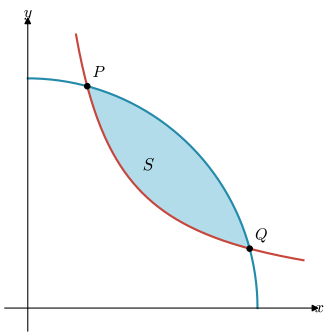
Statement. Consider the curves $x^2 + y^2 = 1$ ① and $4xy = 1$ ②, with $x > 0$, $y > 0$. We want the area $S$ of the region bounded by ① and ②.
- Let $P$ and $Q$ be the intersection points, with $x$-coordinates $p < q$. Setting $x = \cos\theta$, $y = \sin\theta$ ($0 < \theta < \frac\pi2$), ② gives $\sin\boxed{\text{A}}\,\theta = \dfrac{\boxed{\text{B}}}{\boxed{\text{C}}}$. So $\theta = \dfrac{\boxed{\text{D}}}{\boxed{\text{EF}}}\pi$ or $\dfrac{\boxed{\text{G}}}{\boxed{\text{HI}}}\pi$ (the first one smaller), and $p = \cos\dfrac{\boxed{\text{J}}}{\boxed{\text{KL}}}\pi$, $q = \cos\dfrac{\boxed{\text{M}}}{\boxed{\text{NO}}}\pi$.
- Since $S = \int_p^q\left(\sqrt{1 - x^2} - \frac{1}{4x}\right)dx$, we compute $I = \int_p^q\sqrt{1 - x^2}\,dx$ and $J = \int_p^q\frac1x\,dx$. With $x = \cos\theta$, $I = \dfrac{\boxed{\text{P}}}{\boxed{\text{Q}}}\pi$; and $J = \log\left(\boxed{\text{R}} + \sqrt{\boxed{\text{S}}}\right)$. So $S = \dfrac{\boxed{\text{P}}}{\boxed{\text{Q}}}\pi - \dfrac{\boxed{\text{T}}}{\boxed{\text{U}}}\log\left(\boxed{\text{R}} + \sqrt{\boxed{\text{S}}}\right)$.
Solution.
1. The intersections. $4\cos\theta\sin\theta = 2\sin2\theta = 1$, so $\sin2\theta = \frac12$, with $2\theta \in (0, \pi)$: $2\theta = \frac\pi6$ or $\frac{5\pi}{6}$, that is, $\theta = \frac{\pi}{12}$ or $\frac{5\pi}{12}$. The cosine is decreasing, so the smaller $x$-coordinate comes from the larger angle: $p = \cos\frac{5\pi}{12}$ and $q = \cos\frac{\pi}{12}$.
2. $I$. With $x = \cos\theta$, $dx = -\sin\theta\,d\theta$ and $\sqrt{1 - x^2} = \sin\theta$:
$$I = \int_{\pi/12}^{5\pi/12}\sin^2\theta\,d\theta = \left[\frac\theta2 - \frac{\sin2\theta}{4}\right]_{\pi/12}^{5\pi/12} = \frac{\pi}{6} - \frac{\sin\frac{5\pi}{6} - \sin\frac\pi6}{4} = \frac\pi6.$$3. $J$. $J = \log\frac qp = \log\frac{\cos(\pi/12)}{\cos(5\pi/12)} = \log\frac{\cos(\pi/12)}{\sin(\pi/12)} = \log\cot\frac{\pi}{12}$, and $\cot15^\circ = 2 + \sqrt3$. So $J = \log(2 + \sqrt3)$.
4. $S = I - \frac14J = \frac\pi6 - \frac14\log(2 + \sqrt3) \approx 0.194$.
Answers: A=2, B=1, C=2, D=1, EF=12, G=5, HI=12, J=5, KL=12, M=1, NO=12, P=1, Q=6, R=2, S=3, T=1, U=4.