
Euler's Eyes
2026-10-14
Saturn's rings cannot be solid
The only system of rings which can exist is one composed of an indefinite number of unconnected particles, revolving round the planet with different velocities according to their respective distances.
— James Clerk Maxwell, On the Stability of the Motion of Saturn's Rings (1859)
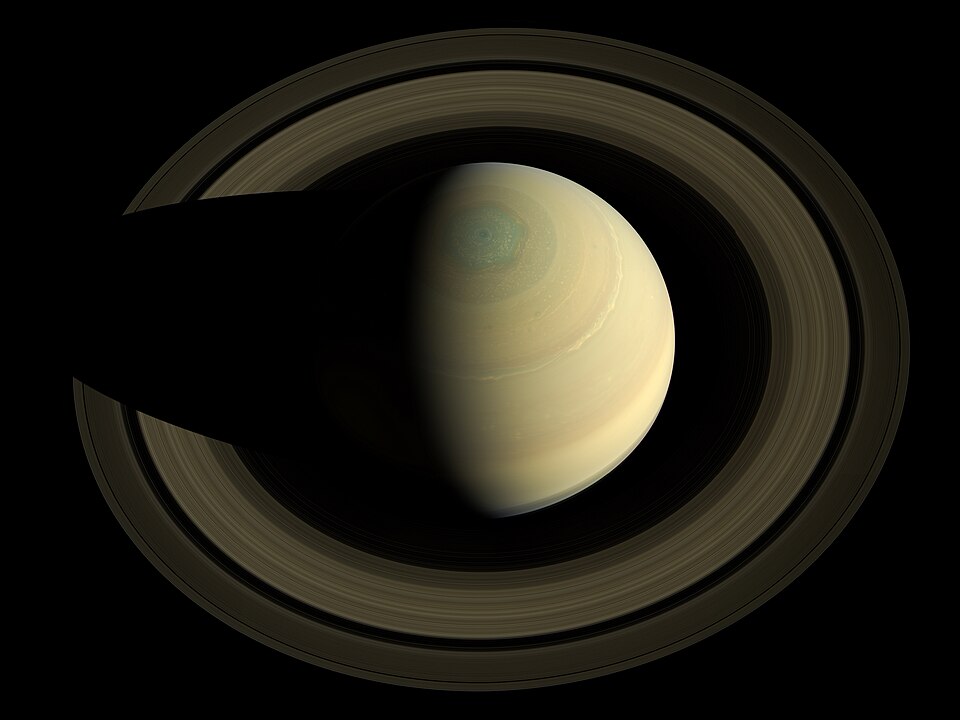
Galileo looked at Saturn through his telescope in 1610 and thought the planet had “ears”. In 1655 Huygens realised they were a thin, flat ring that does not touch the planet. Two hundred years later, nobody knew what the ring was made of. Was it a solid disc, like a vinyl record? A liquid? A cloud of stones?
In 1855 the University of Cambridge chose this question as the subject of the Adams Prize, created in honour of the astronomer John Couch Adams, who had predicted the existence of Neptune. The competitors had to find out what kind of ring could remain stable. Maxwell, then 24, spent two years on the question. He was the only entrant.
Kepler on the ring
Start with what is known of any body in a circular orbit. The gravity of the planet, of mass $M$, provides the centripetal force:
$$\frac{GMm}{r^2}=\frac{mv^2}{r}\quad\Longrightarrow\quad v=\sqrt{\frac{GM}{r}}.$$The farther out, the slower. This is Kepler’s third law, which the planets obey around the Sun. For Saturn, $GM\approx3.79\times10^{16}$ m³/s². The main rings extend from about 74,600 km to about 136,800 km from the centre of the planet. So:
| Distance from Saturn’s centre | Orbital speed | Time for one orbit |
|---|---|---|
| 74,600 km (inner edge) | 22.5 km/s | 5.8 hours |
| 92,000 km | 20.3 km/s | 7.9 hours |
| 117,600 km | 18.0 km/s | 11.4 hours |
| 136,800 km (outer edge) | 16.7 km/s | 14.3 hours |
The inner edge goes round in under 6 hours; the outer edge, in more than 14.
Why a solid ring will not do
In a rigid disc, every point goes round in the same time: the disc turns as a whole, like a wheel. So the speed of each point grows with distance, $v=\omega r$, while gravity would require it to decrease, $v=\sqrt{GM/r}$. There is no way to satisfy both at every point at once.
If the disc turns at the right rate for its middle, the outer part goes too fast, and the force to keep it in orbit would have to come from the rigidity of the disc itself, which would be stretched outwards; the inner part goes too slowly and would be pulled inwards. The whole ring would be under enormous stresses. Maxwell calculated that no known material could withstand them, and he showed something more: even an ideal uniform solid ring would be unstable. The slightest imbalance would make the ring drift and crash into the planet. Huygens had imagined a solid ring; it could not exist.
A liquid ring would not do either: Maxwell showed that waves would form in it, grow and break it into drops. That left a single possibility: the ring is made of countless loose particles, each in its own orbit, with the speed gravity gives it. The inner ones move faster and overtake the outer ones, like cars in different lanes.
Confirmation
Maxwell won the prize, and the Astronomer Royal George Airy called the essay “one of the most remarkable applications of mathematics to physics that I have ever seen”. Observational confirmation came gradually. In 1895 the American James Keeler measured the speed of different parts of the rings by the Doppler effect and saw that the inner part goes round faster, exactly as predicted. In 1980 and 1981 the Voyager spacecraft flew past Saturn, and between 2004 and 2017 the Cassini spacecraft orbited the planet: the rings are made of billions of pieces of water ice, from dust grains to blocks several metres across.
When Voyager confirmed the theory, Maxwell had been dead for a hundred years. Today a gap within the C ring bears his name: the Maxwell Gap.
Exercise: Mimas, a moon of Saturn, orbits 185,500 km from the centre. How long does it take to go round once?
The speed is $v=\sqrt{3.79\times10^{16}/1.855\times10^8}\approx14.3$ km/s. The length of the orbit is $2\pi\cdot185{,}500\approx1.166\times10^6$ km. The period is $\frac{1.166\times10^6}{14.3}\approx81{,}500$ s, about 22.6 hours. By Kepler’s third law, $T\propto r^{3/2}$: compared with the inner edge of the rings, $\left(\frac{185\,500}{74\,600}\right)^{3/2}\approx3.9$ times longer, and $3.9\cdot5.8\approx22.6$ hours.
Exercise: if the ring were a rigid disc turning with the period of the inner edge, 5.8 hours, what would the speed of the outer edge be? Compare with the orbital speed.
In a rigid disc, $v\propto r$: the outer edge would move at $22.5\cdot\frac{136\,800}{74\,600}\approx41.3$ km/s. The orbital speed there is only $16.7$ km/s, and the escape speed is $\sqrt2$ times that, about 23.6 km/s. A loose piece of the outer edge would fly off away from Saturn. Only the rigidity of the material would hold it, and no material can withstand that.
Sources: James Clerk Maxwell, On the Stability of the Motion of Saturn’s Rings (Cambridge, 1859) · biography of Maxwell, MacTutor · Saturn, NASA Science.
All topics on James Clerk Maxwell · ← Colour: the spinning top and the tartan ribbon · The speeds of molecules: the Maxwell distribution →