
Euler's Eyes
2026-11-04
EJU 2018 (1st session) – Mathematics Course 1 solved
Source: JASSO – Mathematics paper in English, in Japanese and official answer key. Files on the page for the 1st session of 2018.
Course 1 is the basic mathematics paper of the EJU. Each letter $\boxed{\text{A}}$, $\boxed{\text{B}}$, … is a digit from 0 to 9 or the minus sign. The statements below are summarized from the official English version.
Answer key
| Question | Topic | Answers |
|---|---|---|
| I Q1 | Roots in an interval | A=4, B=2, C=4, D=5, E=1, F=1, G=4, H=1, I=1, JK=15, LM=11 |
| I Q2 | Coloring cards | NOP=256, QR=24, ST=12, UVW=144, XY=84 |
| II Q1 | $a^3 = 9 + \sqrt{80}$ | AB=18, C=1, D=3, E=3, F=3, G=3, H=6, I=3, J=3, K=5, L=2 |
| II Q2 | Two quadratics | MN=−1, OP=−2, Q=4, R=1, S=2, TU=−2, V=1, WX=17 |
| III | $n^3 \equiv n \pmod{66}$ | AB=66, CD=65, E=2, F=3, G=6, HI=11, J=5, K=5, L=6, MN=16, OP=11, QR=23, ST=43 |
| IV | Triangle and circle | A=1, B=2, C=2, D=3, E=9, F=4, G=2, H=3, I=5, J=2, K=3, L=5, M=7, N=4, O=7, P=9, Q=7, RS=32, T=5 |
Question I
Q1: the roots of a quadratic in an interval
Statement. Let $f(x) = \frac14x^2 - (2a - 1)x + a$, with $a$ real.
- The vertex of the graph is $\left(\boxed{\text{A}}\,a - \boxed{\text{B}},\ -\boxed{\text{C}}\,a^2 + \boxed{\text{D}}\,a - \boxed{\text{E}}\right)$.
- The graph meets the $x$-axis at two distinct points $A$ and $B$ when $a < \dfrac{\boxed{\text{F}}}{\boxed{\text{G}}}$ or $\boxed{\text{H}} < a$.
- The $x$-coordinates of $A$ and $B$ both lie between 0 and 6 (inclusive) when $\boxed{\text{I}} < a \le \dfrac{\boxed{\text{JK}}}{\boxed{\text{LM}}}$.
Solution.
1. $f(x) = \frac14\left(x - 2(2a - 1)\right)^2 - (2a - 1)^2 + a$. The vertex is $\left(4a - 2,\ -4a^2 + 5a - 1\right)$.
2. Two distinct roots: the vertex below the axis, $-4a^2 + 5a - 1 < 0$, or $(4a - 1)(a - 1) > 0$: $a < \frac14$ or $a > 1$.
3. Both roots lie in $[0, 6]$ when, in addition to (2), $f(0) \ge 0$, $f(6) \ge 0$ and the axis is between 0 and 6:
- $f(0) = a \ge 0$;
- $f(6) = 9 - 6(2a - 1) + a = 15 - 11a \ge 0$, or $a \le \frac{15}{11}$;
- $0 < 4a - 2 < 6$, or $\frac12 < a < 2$.
With $a < \frac14$ or $a > 1$, what remains is $1 < a \le \frac{15}{11}$.
Answers: A=4, B=2, C=4, D=5, E=1, F=1, G=4, H=1, I=1, JK=15, LM=11.
Q2: coloring four cards
Statement. We have four cards of different sizes and color each one red, black, blue or yellow (colors may repeat).
- There are $\boxed{\text{NOP}}$ ways in all.
- There are $\boxed{\text{QR}}$ ways using all four colors.
- There are $\boxed{\text{ST}}$ ways to color two cards red, one black and one blue.
- There are $\boxed{\text{UVW}}$ ways using exactly three colors.
- There are $\boxed{\text{XY}}$ ways using exactly two colors.
Solution.
- Each card has 4 choices: $4^4 = 256$.
- The four colors, one on each card: $4! = 24$.
- Choose the two red cards ($\binom42 = 6$) and then which of the other two is black ($2$): $12$.
- Choose the three colors ($\binom43 = 4$). With three colors on four cards, one repeats: choose which ($3$) and proceed as in (3) ($12$). Total $4\cdot3\cdot12 = 144$.
- Choose the two colors ($\binom42 = 6$) and color without using only one of them: $2^4 - 2 = 14$. Total $84$.
Check: $4 + 84 + 144 + 24 = 256$ (one, two, three and four colors).
Answers: NOP=256, QR=24, ST=12, UVW=144, XY=84.
Question II
Q1: the cube root of 9 + √80
Statement. We want the positive number $a$ with $a^3 = 9 + \sqrt{80}$. Let $b > 0$ with $b^3 = 9 - \sqrt{80}$. Then $a^3 + b^3 = \boxed{\text{AB}}$ ① and $ab = \boxed{\text{C}}$ ②. Using ②, ① becomes $(a + b)^3 - \boxed{\text{D}}\,(a + b) = \boxed{\text{AB}}$. With $x = a + b$: $x^3 - \boxed{\text{D}}\,x = \boxed{\text{AB}}$, which can be written $x^3 - 27 = \boxed{\text{D}}\left(x - \boxed{\text{E}}\right)$ and gives $\left(x - \boxed{\text{F}}\right)\left(x^2 + \boxed{\text{G}}\,x + \boxed{\text{H}}\right) = 0$. So $x = \boxed{\text{I}}$, that is, $a + b = \boxed{\text{I}}$ ③. From ②, ③ and $a > b$, $a = \dfrac{\boxed{\text{J}} + \sqrt{\boxed{\text{K}}}}{\boxed{\text{L}}}$.
Solution.
1. $a^3 + b^3 = 18$ and $(ab)^3 = 81 - 80 = 1$, so $ab = 1$ ($9 - \sqrt{80} > 0$, and $b$ is positive).
2. $(a + b)^3 = a^3 + b^3 + 3ab(a + b)$, so $x^3 - 3x = 18$.
3. $x^3 - 27 = 3x - 9 = 3(x - 3)$, and $x^3 - 27 - 3(x - 3) = (x - 3)(x^2 + 3x + 9 - 3) = (x - 3)(x^2 + 3x + 6)$. The quadratic factor has no real root ($9 - 24 < 0$), so $x = 3$.
4. $a$ and $b$ are the roots of $t^2 - 3t + 1 = 0$, and the larger is $a = \frac{3 + \sqrt5}{2}$. It is the golden ratio squared: $\left(\frac{1 + \sqrt5}{2}\right)^2 = \frac{3 + \sqrt5}{2}$.
Answers: AB=18, C=1, D=3, E=3, F=3, G=3, H=6, I=3, J=3, K=5, L=2.
Q2: two quadratics with a parameter
Statement. Let $a \ne 0$ and
$$f(x) = x^2 + 2ax - 4a - 12, \qquad g(x) = ax^2 + 2x - 4a + 4.$$- The solutions of $f(x) = 0$ and $g(x) = 0$ coincide when $a = \boxed{\text{MN}}$, and they are $x = \boxed{\text{OP}}$ and $x = \boxed{\text{Q}}$.
- $g(x) = 0$ has exactly one solution when $a = \dfrac{\boxed{\text{R}}}{\boxed{\text{S}}}$, and it is $x = \boxed{\text{TU}}$.
- $f(x) < g(x)$ for all $x$ when $\boxed{\text{V}} \le a < \boxed{\text{WX}}$.
Solution.
1. Dividing $g$ by $a$, the two monic equations must be equal: $2a = \frac2a$ and $-4a - 12 = \frac{4 - 4a}{a}$. The first gives $a = \pm1$; only $a = -1$ satisfies the second ($-8 = -8$). Then $f(x) = x^2 - 2x - 8 = (x - 4)(x + 2)$: solutions $-2$ and $4$.
2. The discriminant of $g$ is $4 - 4a(4 - 4a) = 4(2a - 1)^2$, zero at $a = \frac12$. The double root is $x = -\frac{2}{2a} = -2$.
3. $g(x) - f(x) = (a - 1)x^2 + 2(1 - a)x + 16$ must be positive for all $x$.
- $a = 1$: it equals $16 > 0$. Works.
- $a < 1$: negative leading coefficient, fails for large $x$.
- $a > 1$: we need a negative discriminant: $4(1 - a)^2 - 64(a - 1) = 4(a - 1)(a - 17) < 0$, that is, $1 < a < 17$.
Together: $1 \le a < 17$.
Answers: MN=−1, OP=−2, Q=4, R=1, S=2, TU=−2, V=1, WX=17.
Question III: the numbers with n³ ≡ n (mod 66)
Statement. Let $n$ be a two-digit natural number such that the remainder of $n^3$ on division by 66 is $n$. We want how many such $n$ there are and which of them are prime.
By the conditions, $n^3 = \boxed{\text{AB}}\,p + n$ ($0 < n \le \boxed{\text{CD}}$), where $p$ is the quotient. So $n(n - 1)(n + 1) = \boxed{\text{AB}}\,p$. Since $n - 1$ or $n$ is a multiple of $\boxed{\text{E}}$ and one of $n - 1$, $n$, $n + 1$ is a multiple of $\boxed{\text{F}}$, with $\boxed{\text{E}}$ and $\boxed{\text{F}}$ coprime, $n(n - 1)(n + 1)$ is a multiple of $\boxed{\text{G}}$ ($1 < \boxed{\text{E}} < \boxed{\text{F}} < \boxed{\text{G}}$). So one of $n - 1$, $n$, $n + 1$ is a multiple of $\boxed{\text{HI}}$. Since $n \le \boxed{\text{CD}}$, there are $\boxed{\text{J}}$ values with $n - 1$ a multiple of $\boxed{\text{HI}}$, $\boxed{\text{K}}$ with $n$ a multiple and $\boxed{\text{L}}$ with $n + 1$ a multiple. There are $\boxed{\text{MN}}$ values, and the primes among them are $\boxed{\text{OP}}$, $\boxed{\text{QR}}$ and $\boxed{\text{ST}}$.
Solution.
1. The remainder is less than 66, so $10 \le n \le 65$, and $66 \mid n^3 - n = (n - 1)n(n + 1)$.
2. A product of three consecutive integers always contains an even number and a multiple of 3, so it is always a multiple of $6$. Since $66 = 6\cdot 11$, the condition is that $11$ divides one of the three factors.
3. Counting in $[10, 65]$.
- $n - 1$ a multiple of 11: $n = 12, 23, 34, 45, 56$ (5 values).
- $n$ a multiple of 11: $n = 11, 22, 33, 44, 55$ (5).
- $n + 1$ a multiple of 11: $n = 10, 21, 32, 43, 54, 65$ (6).
Total $16$. The primes in the list are $11$, $23$ and $43$.
Answers: AB=66, CD=65, E=2, F=3, G=6, HI=11, J=5, K=5, L=6, MN=16, OP=11, QR=23, ST=43.
Question IV: a triangle and a circle
Statement. Triangle $ABC$ has $AB = 4$, $AC = 3$ and $\angle B = 30^\circ$. $D$ is the point on side $BC$ with $AD = AC$, and $O$ is the circumcircle of triangle $ACD$.
- Since $\sin B = \dfrac{\boxed{\text{A}}}{\boxed{\text{B}}}$, $\sin C = \dfrac{\boxed{\text{C}}}{\boxed{\text{D}}}$. The radius of $O$ is $\dfrac{\boxed{\text{E}}}{\boxed{\text{F}}}$.
- $BC = \boxed{\text{G}}\sqrt{\boxed{\text{H}}} + \sqrt{\boxed{\text{I}}}$ and $BD = \boxed{\text{J}}\sqrt{\boxed{\text{K}}} - \sqrt{\boxed{\text{L}}}$. Let $E$ be the intersection of side $AB$ with $O$. Then $BE = \dfrac{\boxed{\text{M}}}{\boxed{\text{N}}}$, and the areas satisfy $\triangle BDE : \triangle ADE = \boxed{\text{O}} : \boxed{\text{P}}$ and $\triangle BDE : \triangle ACD = \boxed{\text{Q}}\left(\boxed{\text{J}}\sqrt{\boxed{\text{K}}} - \sqrt{\boxed{\text{L}}}\right) : \boxed{\text{RS}}\sqrt{\boxed{\text{T}}}$.
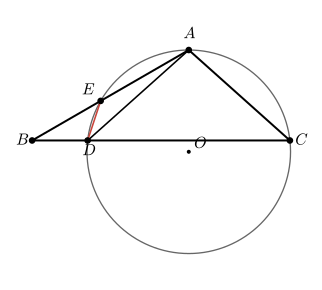
Solution.
1. Law of sines: $\frac{AC}{\sin B} = \frac{AB}{\sin C}$, so $\sin C = \frac{4\cdot\frac12}{3} = \frac23$. In triangle $ACD$, side $AD = 3$ is opposite angle $C$, so the radius is $R = \frac{AD}{2\sin C} = \frac{3}{4/3} = \frac94$.
2. $BC$ and $BD$. The points $X$ on line $BC$ with $AX = 3$ satisfy, by the law of cosines in triangle $ABX$, $9 = 16 + BX^2 - 2\cdot4\cdot BX\cos30^\circ$, that is, $BX^2 - 4\sqrt3\,BX + 7 = 0$, with roots $2\sqrt3 \pm \sqrt5$. The two solutions are $C$ and $D$: $BC = 2\sqrt3 + \sqrt5$ and $BD = 2\sqrt3 - \sqrt5$.
3. $BE$. By the power of point $B$ with respect to $O$, $BE\cdot BA = BD\cdot BC = 12 - 5 = 7$, so $BE = \frac74$.
4. The areas. $BDE$ and $ADE$ share vertex $D$ and have bases $BE$ and $EA$ on the same line: the ratio is $BE : EA = \frac74 : \frac94 = 7 : 9$.
For the other ratio: $\triangle ABD = \frac12\cdot4\cdot BD\cdot\sin30^\circ = BD$ and, likewise, $\triangle ABC = BC$. So $\triangle ACD = BC - BD = 2\sqrt5$ and $\triangle BDE = \frac{BE}{BA}\triangle ABD = \frac{7}{16}BD$. Hence
$$\triangle BDE : \triangle ACD = \frac{7}{16}(2\sqrt3 - \sqrt5) : 2\sqrt5 = 7(2\sqrt3 - \sqrt5) : 32\sqrt5.$$Answers: A=1, B=2, C=2, D=3, E=9, F=4, G=2, H=3, I=5, J=2, K=3, L=5, M=7, N=4, O=7, P=9, Q=7, RS=32, T=5.