Read Euler, read Euler: he is the master of us all.
— Pierre-Simon Laplace
This site is named after him, and for good reason. Leonhard Euler (1707–1783) wrote more mathematics than anyone before or after him. He did most of this with one eye and, in recent years, practically blind. Many of the tools you use at school, such as notation $f(x)$, the number $e$ and the symbol $\pi$ gained their current form in his hands.
In this first chapter of the book History of Mathematics, we tell the life of Euler and redo it, with the accounts in sight, nine of his discoveries. The figures are interactive: drag, click and fiddle with the controls.
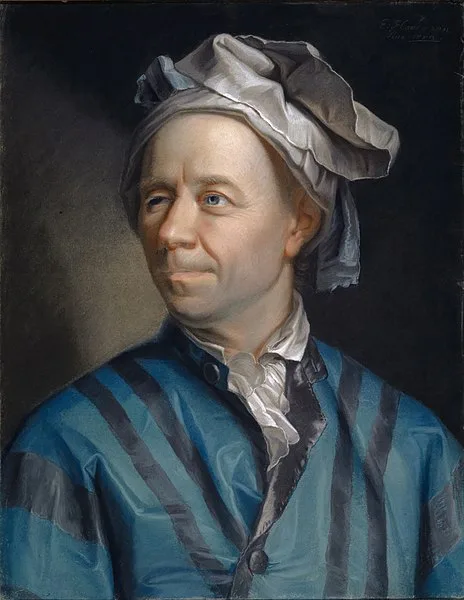
Who was it
Leonhard Euler
- Nascimento
- 15 April 1707, Basel
- Morte
- 18 September 1783, Saint Petersburg
- Origem
- Switzerland
- Áreas
- Analysis, numbers, graphs, mechanics
Reading script
Biography and timeline
Notation and mathematical language
Discovery and demonstration
- The Basel problem
- The number $e$ and compound interest
- Euler’s formula and the “most beautiful equation”
- The spring and differential equations
- The Königsberg bridges and the birth of graphs
- $V - A + F = 2$ and the soccer ball
- Infinite prime numbers from a sum
- Fermat’s number that was not prime
- Euler’s theorem and cryptography