
Euler's Eyes
2026-10-10
History of Mathematics
Page 27 of 191
Other contributions and legacy
Other contributions
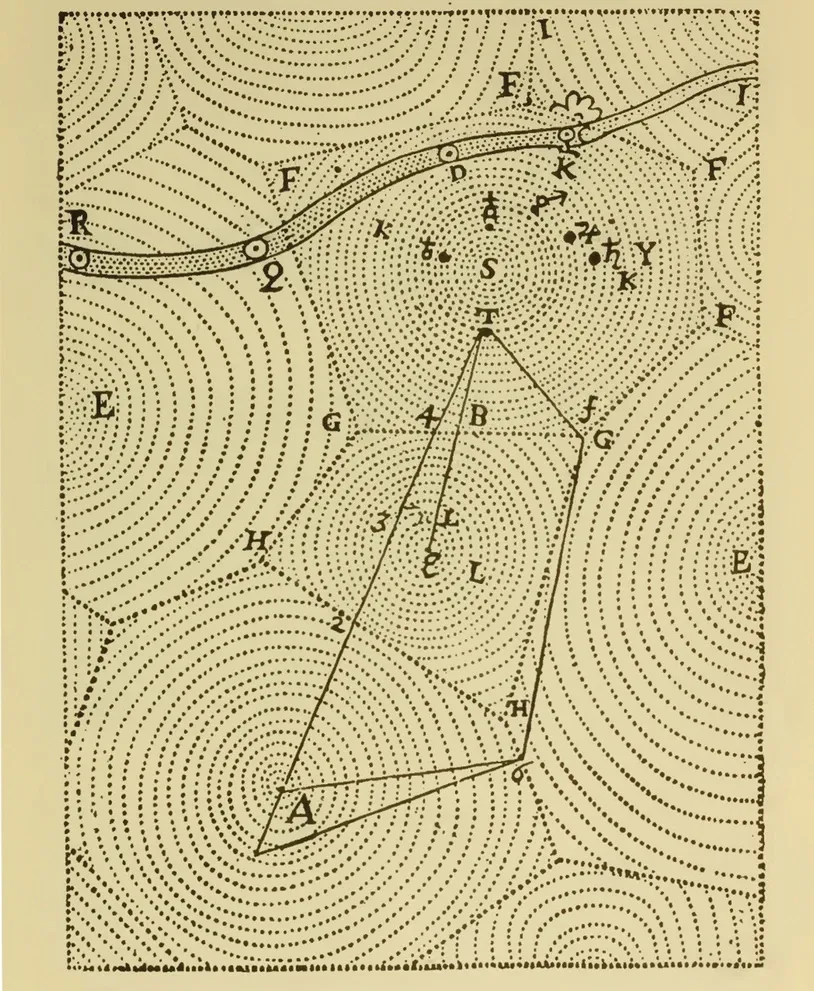
- Optics: in addition to the law of refraction, he studied the ideal shape of lenses, which should have a profile of ellipse or hyperbola to focus light on a point.
- Descartes’ Folio: the curve $x^3 + y^3 = 3axy$, which he proposed as a challenge to Fermat to find tangent lines.
- Physics: formulated a version of the principle of inertia, that a body in motion continues in straight line if nothing gets in your way.
- Philosophy: the Meditations and the Principles of Philosophy made it the starting point of modern philosophy.
To remember
- Descartes lived between France, Holland and Sweden, and wrote the Discourse on the Method in French to be read by everyone.
- He created analytical geometry: points became pairs $(x, y)$ and figures became equations.
- He showed how to construct $\sqrt{a}$ with a ruler and compass and fixed the notation $x$, $y$, $z$ and $x^3$.
- The rule of signs tells how many positive roots a polynomial can have.
- The sum of the vertex defects of a polyhedron is 720°, which leads to the formula $V - A + F = 2$.
- He explained the rainbow: the rays accumulate at 42° from the point opposite the Sun.
- With it comes the idea of function: a rule that “listens” to one number and “speaks” another. The word comes from Latin functus, and the symbol $f(x)$ is Euler (1734).
- There is no $1 \div 0$: close to zero, $\frac{1}{x}$ runs away to $+\infty$ on one side and to $-\infty$ on the other.
All topics by René Descartes · ← Infinity and division by zero · Image credits →