
Euler's Eyes
2026-10-13
+, −, × and =: a short history of the signs
The simplest signs in mathematics are also the youngest. Euclid never wrote a $+$. Al-Khwarizmi never wrote an $=$. Viète, who already used letters, still wrote aequatur in full. Almost all the operation signs a child learns in the first year of school were born in Europe between the end of the fifteenth century and the end of the seventeenth, in a span of about two hundred years.
- 1489Johannes Widmann prints $+$ and $-$ in a book of commercial arithmetic in Leipzig.
- 1525Christoff Rudolff uses $\surd$ for the square root in his algebra book, the Coss.
- 1557Robert Recorde invents $=$ in The Whetstone of Witte.
- 1591François Viète uses letters for known and unknown quantities.
- 1631William Oughtred uses $\times$ for multiplication; in the same year Thomas Harriot’s posthumous book appears with $<$ and $>$.
- 1637René Descartes writes powers as exponents: $x^3$, $x^4$.
- 1659Johann Rahn uses $\div$ for division.
- 1698Leibniz proposes the dot $\cdot$ for multiplication, so as not to confuse $\times$ with the letter $x$.
Plus and minus: warehouse marks
The signs $+$ and $-$ first appear in print in 1489, in an arithmetic manual for merchants written by Johannes Widmann. There they do not quite mean an operation yet: they mark excess and shortfall. A crate of goods that weighed more than it should was marked $+$; one that weighed less, $-$. The most accepted hypothesis is that $+$ is an abbreviation of et (“and”, in Latin), written quickly until it became a cross.
Before that, in Italy, people wrote $\bar{p}$ (for plus) and $\bar{m}$ (for minus). The barred letters lived alongside the German signs for more than a century.
Equals: two twin parallels
Robert Recorde was a physician in London who wrote mathematics books in English, at a time when almost everything was written in Latin. In 1557, in The Whetstone of Witte, tired of writing is equalle to on every line, he explained:
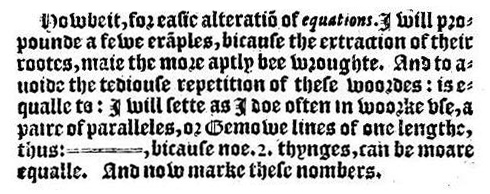
And to avoide the tediouse repetition of these woordes: is equalle to: I will sette as I doe often in woorke use, a paire of paralleles, or Gemowe lines of one lengthe, thus: ═══, bicause noe .2. thynges, can be moare equalle.
— Robert Recorde, The Whetstone of Witte (1557)
Recorde’s argument is a semiotic argument, and a good one: the sign looks like what it stands for. Two exactly equal lines draw the very idea of equality. Right after that he writes the first equation with the new sign:

Recorde’s sign took a long time to win. Descartes, eighty years later, still used another symbol, and on the Continent $=$ was at times used to mean difference or parallelism. Only around 1700, when Leibniz and his followers adopted it, did it become standard.
Times, divide, greater and less
In 1631 two English books completed the picture. In the Clavis mathematicae (The key to mathematics), the clergyman William Oughtred used the cross $\times$ for multiplication. In the same year, ten years after its author’s death, Thomas Harriot’s Artis analyticae praxis was published, with the signs $<$ and $>$. Harriot had been an astronomer, mapmaker and navigator, and spent a year on the English expedition to Virginia, in North America.
Harriot’s signs are, again, icons: the opening faces the larger number. In $3<5$, the wide side faces the $5$. It is a shape you can read without memorising.
The $\div$, called the obelus, was used for division by the Swiss Johann Rahn in 1659. Before that it had marked suspicious passages in ancient manuscripts. Today, outside schools and calculators, hardly anyone uses it: mathematicians prefer the fraction bar, which, as we will see in chapter 2, shows the structure of an expression much better.
The trouble with ×
Oughtred’s cross had a defect that only showed up when Descartes’s algebra spread: it looks just like the letter $x$. In 1698 Leibniz wrote to Johann Bernoulli:
I do not like × as a symbol for multiplication, as it is easily confounded with x. Often I simply relate two quantities by an interposed dot.
— Leibniz, letter to Johann Bernoulli (1698)
Leibniz’s dot caught on among mathematicians, and today we live with all three forms: $3\times4$ at school, $3\cdot4$ in books and, between letters, nothing at all, just juxtaposition: $ab$, $2x$. Each choice has its reasons, and each has its own traps.
None of these signs was invented by a committee. Each was proposed by someone with a practical problem, used in a book, copied by readers, challenged by rivals and sometimes forgotten. A sign only becomes “the” sign when a whole community learns to read it in the same way.
Exercise: solve Recorde's equation
The first equation with an equals sign is $14x+15=71$. Taking $15$ from both sides: $14x=56$. Dividing by $14$: $x=4$. Check: $14\cdot4+15=56+15=71$.
Exercise: Leibniz's problem
Read “$2x \times 3$” aloud. In handwriting it is easy to confuse with $2x\,x\,3$, that is, $2x^2\cdot3$. With the dot, $2x\cdot3=6x$ is unambiguous. And with no sign at all, $2x3$ won’t do, because it looks like a number, or a subscript. That is why we write the number first: $6x$.
Sources: Florian Cajori, A History of Mathematical Notations (1928–1929) · Earliest Uses of Symbols of Operation, Jeff Miller · Robert Recorde, MacTutor.
Chapter index · ← From words to letters: algebra learns to write · Napier and the logarithm: the marvellous abbreviation →