
Euler's Eyes
2026-10-11
Leibniz's notation: a language for change
In signs one observes an advantage in discovery which is greatest when they express the exact nature of a thing briefly and, as it were, picture it; then indeed the labour of thought is wonderfully diminished.
— Leibniz, letter to Tschirnhaus (1678)
Newton reached calculus first, but it was Leibniz who decided how it would be written. And the writing made all the difference.
The letter d
On 11 November 1675, in a manuscript written in Paris, Leibniz began using the letter $d$ for an infinitely small difference. The $d$ comes from the Latin differentia, from the verb differre, “to carry apart”. So:
- $dx$ is a tiny difference between two very close values of $x$;
- $dy$ is the corresponding difference in $y$;
- $\dfrac{dy}{dx}$ is their ratio: how much $y$ changes for each little bit of change in $x$.
Hence the name differential calculus: the calculus of differences.
A calculation with dx
Leibniz treated $dx$ and $dy$ as genuine quantities, only infinitely small. For $y=x^2$, if $x$ changes to $x+dx$, then
$$dy=(x+dx)^2-x^2=2x\,dx+(dx)^2.$$Since $(dx)^2$ is infinitely smaller than $dx$, he neglected it, leaving $dy=2x\,dx$, that is,
$$\frac{dy}{dx}=2x.$$It is the same calculation as Newton’s with fluxions, written differently. Today we justify “neglecting $(dx)^2$” with limits: the ratio of finite differences is $2x+h$, and as $h\to0$ it tends to $2x$.
The 1684 paper
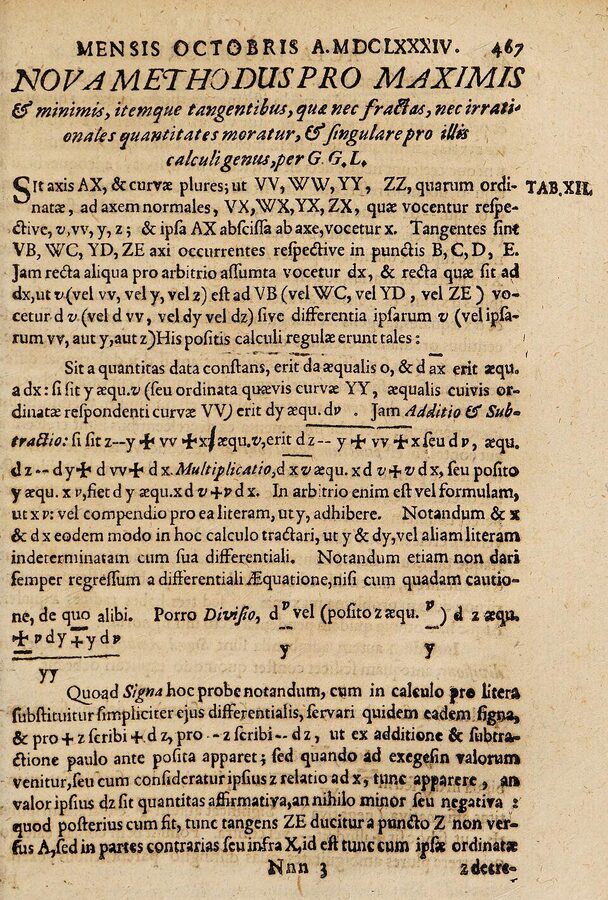
Leibniz published his rules in October 1684 in the Leipzig journal Acta Eruditorum, under an enormous title: A new method for maxima and minima, and also for tangents, which is not hindered by fractional or irrational quantities, and a remarkable type of calculus for them. It was six dense pages full of misprints, and almost nobody understood it. The brothers Jakob and Johann Bernoulli did, and they were the ones who spread calculus across Europe.
The idea of a function gained a name and a symbol little by little:
| Year | Author | How it was written |
|---|---|---|
| 1637 | René Descartes | an equation between $x$ and $y$ |
| 1671 | Isaac Newton | fluent, the flowing quantity |
| 1673 | Leibniz | the word functio |
| 1718 | Johann Bernoulli | the first definition: a quantity made up of a variable and constants |
| 1734 | Leonhard Euler | the symbol $f(x)$ |
The chain rule: a wonderful abbreviation
The great advantage of Leibniz’s notation shows when one quantity depends on another, which depends on a third. Start with ordinary numbers. Notice:
$$\frac34=\frac35\cdot\frac54,\qquad \frac45=\frac43\cdot\frac35.$$The middle number cancels. And it keeps cancelling as the numbers shrink:
$$\frac{0.3}{0.4}=\frac{0.3}{0.5}\cdot\frac{0.5}{0.4},\qquad \frac{0.03}{0.04}=\frac{0.03}{0.05}\cdot\frac{0.05}{0.04}.$$However small the numbers get, the middle one disappears. In general, if $z$, $y$ and $x$ are numbers (with $y\ne0$ and $x\ne0$), then $\dfrac zx=\dfrac zy\cdot\dfrac yx$. It also works for differences:
$$\frac{\Delta z}{\Delta x}=\frac{\Delta z}{\Delta y}\cdot\frac{\Delta y}{\Delta x}.$$And, passing to infinitely small differences, we reach the chain rule:
$$\frac{dz}{dx}=\frac{dz}{dy}\cdot\frac{dy}{dx}.$$The formula looks like simple cancelling of fractions. It is not quite that, because a rigorous proof needs care with limits. But the notation reminds you of the right rule effortlessly. It is what Leibniz meant by an abbreviation that saves the labour of thought.
Here is an example. If $z=y^2$ and $y=3x+1$:
$$\frac{dz}{dy}=2y,\qquad\frac{dy}{dx}=3\qquad\Longrightarrow\qquad\frac{dz}{dx}=2y\cdot3=6(3x+1).$$In Newton’s notation the same rule has to be spelled out in words or written more carefully. In Leibniz’s, it practically writes itself.
Why the notation won
Mathematicians on the Continent adopted Leibniz’s $d$, and with it calculus advanced quickly in the hands of the Bernoullis, Euler and Lagrange. In England, out of loyalty to Newton, people kept the dots for more than a hundred years, and English mathematics fell behind. Today we use both: $\dfrac{dy}{dx}$ in calculus, $\dot x$ in physics.
Exercise: differentiate y = (2x + 5)² with the chain rule
With $u=2x+5$: $\dfrac{dy}{du}=2u$ and $\dfrac{du}{dx}=2$. So $\dfrac{dy}{dx}=2u\cdot2=4(2x+5)$.
Exercise: a spherical balloon has radius r = 2t (in cm, with t in seconds). How fast is its volume growing at t = 1?
$V=\frac43\pi r^3$, so $\dfrac{dV}{dr}=4\pi r^2$ and $\dfrac{dr}{dt}=2$. By the chain rule, $\dfrac{dV}{dt}=4\pi r^2\cdot2$. At $t=1$, $r=2$, and $\dfrac{dV}{dt}=32\pi\approx100.5$ cm³/s.
Sources: Leibniz and the publication of calculus, MacTutor.
All Leibniz topics · ← The life of Gottfried Wilhelm Leibniz · The product rule: two changes in one calculation →