
Euler's Eyes
2026-10-29
The screw, the claw and the mirrors
Plutarch writes that Archimedes considered engineering a lesser activity, and that he left no book about his machines. Even so, it was they that made him famous among his contemporaries. The ancient sources describe several, with very different degrees of reliability.
The screw of Archimedes
An inclined cylinder, with a helix inside or a tube wound spirally around the outside, has its lower end dipped in water. As the cylinder turns, each portion of water is trapped in a fold of the helix and rises, turn by turn, until it comes out at the top. The historian Diodorus of Sicily, in the first century BC, attributes the invention to Archimedes, during a stay in Egypt, where the machine was used to irrigate the fields along the Nile and to drain water from mines.
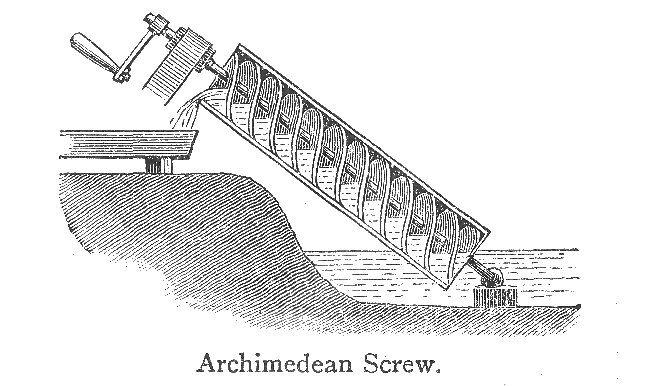
Some historians think the device is older and that Archimedes only improved or popularized it. Either way, the screw is still in use: sewage treatment plants use it to lift sludge, and giant versions, turning backwards, work as small hydroelectric plants on rivers with a low drop.
The defence of Syracuse
Polybius, who wrote less than a century after the siege, is the most reliable source. According to him, Archimedes prepared catapults of various sizes, to hit the Roman ships at any distance; opened in the wall small loopholes, a hand’s breadth wide, through which archers could shoot without exposing themselves; and built cranes that, over the wall, dropped huge stones or blocks of lead onto the vessels.
The most frightening machine was the claw: an arm with an iron hook, attached to a chain, that seized the prow of a ship, lifted it by the counterweight of a lever and then let it go suddenly, making the ship capsize or sink. Polybius tells that Marcellus joked, bitterly, that Archimedes was using his ships as ladles to draw water from the sea.
The planetarium
Cicero tells that, among the spoils of Syracuse, Marcellus took to Rome only one piece for himself: a sphere built by Archimedes that showed the motions of the Sun, the Moon and the planets, and even eclipses. The description became more credible after the discovery, in a shipwreck near the island of Antikythera, of a Greek geared mechanism from the second century BC that computed astronomical positions. There is no proven link between the mechanism and Archimedes, but it shows that this kind of machine was within the reach of Greek engineers.
Exercise: the flow of the screw
A screw of Archimedes makes 30 turns per minute, and each turn of the helix carries 2 litres of water. How many cubic metres of water does it raise in an hour? How many turns are needed to fill a 10 m³ cistern?
Per minute: $30 \times 2 = 60$ litres. Per hour: $60 \times 60 = 3600$ litres, or $3.6$ m³. For 10 m³ = 10 000 litres, $\frac{10\,000}{2} = 5000$ turns are needed, about 2 hours and 47 minutes.
Exercise: the claw as a lever
Suppose the arm of the claw is 12 m long on the ship’s side and 3 m on the counterweight’s side, and that the prow of the ship exerts on the end of the arm a force equivalent to 5 tonnes. What counterweight is needed to lift it?
By the law of the lever, $5 \times 12 = P \times 3$, so $P = 20$ tonnes. A large counterweight, but feasible with blocks of stone or lead, close to the wall. The longer the arm on the sea side, the farther the claw reaches, and the larger the counterweight needed.
Sources: Diodorus of Sicily, Library of History, I, 34, and V, 37 · Polybius, Histories, VIII, 3–7 · Plutarch, Life of Marcellus, 14–17 · Cicero, On the Republic, I, 21–22 · John Tzetzes, Chiliades, II, 103–149 · D. L. Simms, “Archimedes and the Burning Mirrors of Syracuse”, Technology and Culture 18 (1977) · Chris Rorres, Archimedes (website of the Courant Institute, New York University).
All topics on Archimedes · ← The Sand Reckoner · The legacy of Archimedes →