
Euler's Eyes
2026-10-13
Radix quadrati: mathematics has a script too
Ask a student what the square root of 9 is and they will probably say “3”. Ask why it is called a root, and why square, and the conversation usually ends there. The name has become an empty label, and the symbol $\sqrt{\phantom{9}}$ a strange hook that “pulls” something out of the number.
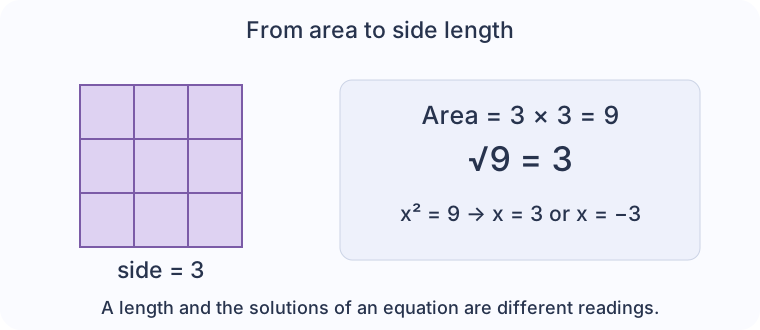
But the name once told the whole story. Greek geometers simply called the number they were looking for the side (pleurá): the side of a square of area 9 measures 3. Arab algebraists called it jidhr, the root from which the square “grows”, and medieval Latin translators wrote radix. A sentence such as
$$\textit{radix quadrati 4 aequalis 2}$$said, with no mystery at all: the side of the square of area 4 is equal to 2.
From Latin to the hook
Nobody decided one fine day to swap the sentence for the symbol. People who copied calculations by hand abbreviated whatever they repeated most, and the abbreviation grew shorter from one generation to the next. The sequence below is schematic, but it follows the path the writing took between medieval manuscripts and the printed books of the sixteenth century:
How radix quadrati became √ (click to go on)
- radix quadrati 4 aequalis 2: “the side of the square of area 4 is equal to 2”.
- rad. quad. 4 aeq. 2: copyists abbreviate the words they repeat most.
- R. q. 4 aeq. 2: almost only the letter R is left, still used by Cardano and Bombelli in the sixteenth century.
- $r\,4 = 2$: in German texts, a small, stretched r marks the root.
- $\sqrt{4}=2$: the stroke of the r stretches and “swallows” the number. Christoff Rudolff printed the sign in 1525, and Descartes, in 1637, added the horizontal bar that covers the number under the root.
The symbol gained speed and lost memory. Whoever reads $\sqrt{4}$ today no longer sees a square. That is why, when a student asks whether $\sqrt{4}$ is $2$ or $-2$, the clearest answer comes from the old name: a side has no negative length. The modern convention that $\sqrt{a}$ is always the non-negative value is a direct inheritance from the geometry the symbol forgot.
Mathematics is made with signs
Open any mathematics book and you will see a mixture of words, digits, letters, signs, arrows, diagrams and blank spaces. We learn to read this mixture almost as if it were natural: we see $3+4=7$, $x^2$, $\frac{a}{b}$ or $\int_a^b f(x)\,dx$ and recognise operations and relations without effort. But this reading was learned, and each of these signs has a date of birth.
Explore the timeline below. It shows six moments when the way of writing changed the way of thinking:
Semiotics is the study of signs: how a mark on paper comes to mean something to someone. This book uses the tools of semiotics to look at mathematics from an unusual angle. Instead of asking only “what does this formula say?”, we also ask: what does this way of writing let us do?
Active notation and sterile notation
Comparing two ways of writing the same content is the best way to see the difference. Isaac Newton and Gottfried Leibniz invented calculus at almost the same time, in the 1660s and 1670s. Newton wrote the rate of change of $y$ with a dot on top, $\dot{y}$. Leibniz wrote $\dfrac{dy}{dx}$. For the content, it makes no difference. For the hand doing the calculation, it does. Look at the chain rule in the two notations:
$$\frac{dz}{dx}=\frac{dz}{dy}\cdot\frac{dy}{dx} \qquad\text{and}\qquad \dot{z}=\ldots\;?$$In Leibniz’s notation the rule almost writes itself: the $dy$ seems to “cancel”, as in a product of fractions. In Newton’s there is nothing to look at; you have to remember the rule. Leibniz’s notation suggests the next step. Newton’s only records a result.
Throughout this book we will call active notation a way of writing whose shape carries the relations of the object and therefore helps us discover new things about it. The old authors of this site had a Latin phrase for it: mirabilis abbreviatio, the marvellous abbreviation, which shortens the text without shortening the thought. We will call sterile notation a way of writing that may record correctly what is already known but points nowhere. Place-value notation with zero is active; Roman numerals, for doing sums, are sterile. Napier’s logarithms, which turn multiplications into additions, are active. The square root, once it loses the memory of the square, risks becoming sterile in the mind of the learner.
By relieving the brain of all unnecessary work, a good notation sets it free to concentrate on more advanced problems, and in effect increases the mental power of the race.
— Alfred North Whitehead, An Introduction to Mathematics (1911)
This does not mean that symbols think for us, or that the truth of a theorem depends on how its signs look. It means that mathematics, as a human activity, is done with signs: we pose problems, do sums and write proofs with them, and the shape of those signs makes some paths easier and hides others. In the next texts we will follow this story: numbers that learned to calculate, the figure that goes with the proof, algebra swapping words for letters, the small signs of the operations and the great dispute between Newton’s dots and Leibniz’s $d$.
Exercise: translate from Latin and draw
Radix quadrati 81 aequalis 9 says that the side of a square of area $81$ measures $9$. In modern notation, $\sqrt{81}=9$, because $9\cdot 9=81$. The drawing is a square of $9\times 9$ little squares.
And the side of a square of area $2$? It exists (it is the diagonal of a square of side $1$), but it is neither a whole number nor a fraction: $\sqrt{2}=1.41421\ldots$
Exercise: the side of the cube
“The side of the cube of volume 27 is equal to 3” in Latin would be radix cubica 27 aequalis 3. In modern writing, $\sqrt[3]{27}=3$, because $3\cdot3\cdot3=27$. The little $3$ in the hook is what is left of the word cubica.
Chapter index · Zero and place value: numbers that calculate →