
Euler's Eyes
2026-09-26
FUVEST 2022 – 1st phase: Mathematics solved
Source: FUVEST – General Knowledge test, version V and rectified official template of the 1st phase (applied in 12/12/2021).
The 1st phase of FUVEST 2022 had 90 questions from all subjects. This post brings the 12 mathematics questions, which in test V are questions 30 to 41. In the others versions (K, Q, X and Z) the same questions appear with different numbering and another order of alternatives, so always check the version of your test.
Template
| Question | Subject | Template |
|---|---|---|
| 30 | Multiplicative principle: license plates | C |
| 31 | Positional number systems | A |
| 32 | Proportion: speed and time | C |
| 33 | Percentage and tables | C |
| 34 | 2nd degree equation: division of a gift | D |
| 35 | Arithmetic progression: cost of a well | B |
| 36 | Polyhedra: Euler relation | E |
| 37 | Trigonometry: law of cosines | A |
| 38 | Polynomials: Girard relations | E |
| 39 | Flat geometry: tape around tanks | B |
| 40 | Order of magnitude and units | D |
| 41 | Logarithms: graph reading | D |
Question 30: Mercosur plates × previous system (multiplicative principle)
Statement
Currently, in Brazil, two identification plate systems coexist. automobiles: the Mercosur standard (the most recent) and the one that started in 1990 (the previous system, still used by most cars in circulation). No previous system, 3 letters were used (in an alphabet of 26 letters) followed by 4 digits (from 0 to 9). In the Mercosur standard adopted in Brazil for automobiles, there are 4 letters and 3 numerals are used, with 3 letters in the first 3 positions and the fourth letter in fifth position, and there may be repetitions of letters or numbers. The figure illustrates the two types of plates.
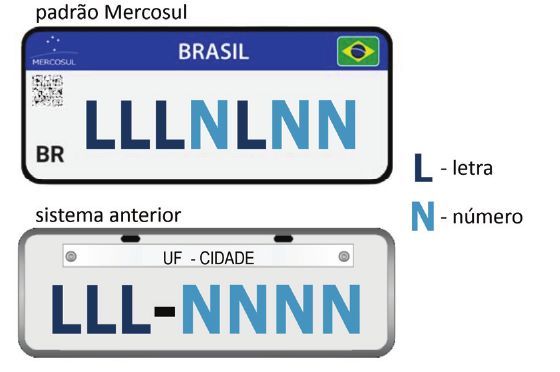
In this way, the number of possible plates of the Brazilian Mercosur standard of automobiles is greater than that of the previous system in
- A) 1,5 times.
- B) 2 times.
- C) 2,6 times.
- D) 2,8 times.
- E) 3 times.
Resolution
1. Previous system boards. These are 7 positions: 3 letters (26 options each) and 4 digits (10 options each). How can there be repetition, by the principle multiplicative:
$$N_{\text{ant}} = 26^3 \cdot 10^4$$2. Mercosul standard plates. They are also 7 positions, but now 4 letters and 3 digits (the position of the fourth letter does not change the count):
$$N_{\text{Merc}} = 26^4 \cdot 10^3$$3. Ratio between the two. There’s no need to do the big math: just divide.
$$\frac{N_{\text{Merc}}}{N_{\text{ant}}} = \frac{26^4 \cdot 10^3}{26^3 \cdot 10^4} = \frac{26}{10} = 2{,}6$$It makes sense: we exchange a position with 10 options (digit) for one with 26 options (letter), and the total is multiplied by $\frac{26}{10}$.
Answer: alternative C (2,6 times).
Question 31: Number 91625 in the Chinese system in bars
Statement
The numbering system known as scientific Chinese (or bars) emerged probably more than two millennia ago. The system is essentially positional, base 10, with the first digit to the right representing the unit. The first horizontal line of symbols in the figure shows how the numbers 1 are represented, 2, 3, 4, 5, 6, 7, 8 and 9 when they appear in odd positions (units, hundreds etc.), and the second line when such digits appear in even positions (tens, thousands, etc.). In this system, a circle began to be used to represent the digit zero from the Sung Dynasty (960-1126).
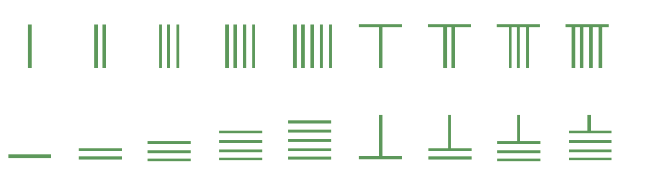
Howard Eves, Introduction to the History of Mathematics. Translation: Hygino H. Domingues. Editora Unicamp, 2011 (5th ed.).
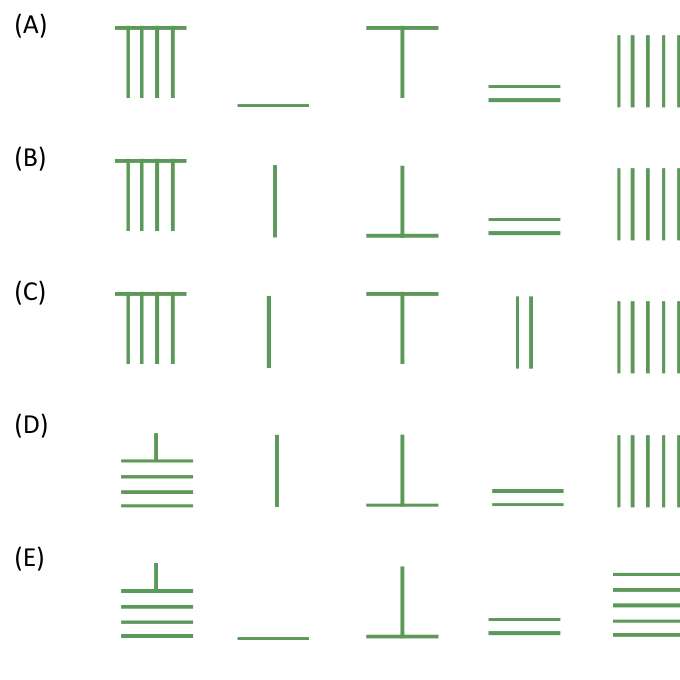
Select the alternative that represents the number 91625 in this numbering system.
Resolution
1. Position of each digit. Counting from right to left, starting from the unit:
| Numeral | 9 | 1 | 6 | 2 | 5 |
|---|---|---|---|---|---|
| Position | 5th (tens of thousands) | 4th (thousand) | 3rd (hundred) | 2nd (decade) | 1st (unit) |
| Parity | odd | pair | odd | pair | odd |
2. Choice of symbol. Odd position uses the first line of the figure (bars vertical; from 6 to 9, a horizontal line at the top). Even position uses the second line (horizontal bars; from 6 to 9, a vertical line at the top).
- 9 in odd position: horizontal line on top of four vertical bars;
- 1 in even position: a horizontal bar;
- 6 in odd position: horizontal line over a vertical bar (“T” shape);
- 2 in even position: two horizontal bars;
- 5 in odd position: five vertical bars.
3. Comparing with the alternatives. Only alternative A has exactly this sequence. The others misspell the form of some digit: B and C write 1 with vertical bar (odd position shape); B writes 6 in even position form; C write 2 with vertical bars; D and E write 9 in even position form, and E still writes 5 with horizontal bars.
Answer: alternative A.
Question 32: Video at speed 1,5×
Statement
A video is three minutes long. If the video plays, from your start, with a speed of 1,5 times the original speed, the playback time of the entire video will be
- A) 1min30s.
- B) 1min50s.
- C) 2min00s.
- D) 2min30s.
- E) 2min50s.
Resolution
1. Speed and time are inversely proportional. The “content” of the video is always the same. If it passes 1,5 faster, the time is divided by 1,5.
2. Counts in seconds. Three minutes are 180 s:
$$t = \frac{180}{1{,}5} = 120 \text{ s} = 2 \text{ min}$$Answer: alternative C (2min00s).
Be careful with the catch: alternative A (1min30s) is what you get dividing by 2, as if the speed were doubled, or subtracting 1,5 from 3. With speed 1,5×, the time is divided by 1,5, not halved.
Question 33: Defective chairs by color (percentage)
Statement
An industry produces three models of chairs (indicated by $M_1$, $M_2$ and $M_3$), each of them in two color options: black and red (indicated by P and V, respectively). The table shows the number of chairs produced weekly depending on color and model:
| P | V | |
|---|---|---|
| $M_1$ | 500 | 200 |
| $M_2$ | 400 | 220 |
| $M_3$ | 250 | 300 |
The percentages of defective chairs are 2% of model $M_1$, 5% of model $M_2$ and 8% of model $M_3$. Chairs that do not have defects are called good.
The table that indicates the number of defective chairs produced weekly (D) and good (B), according to color, is:
A)
| P | V | |
|---|---|---|
| D | 55 | 39 |
| B | 1095 | 681 |
B)
| P | V | |
|---|---|---|
| D | 51 | 40 |
| B | 1099 | 680 |
C)
| P | V | |
|---|---|---|
| D | 50 | 39 |
| B | 1100 | 681 |
D)
| P | V | |
|---|---|---|
| D | 50 | 37 |
| B | 1100 | 683 |
E)
| P | V | |
|---|---|---|
| D | 51 | 39 |
| B | 1099 | 681 |
Resolution
1. Black defectives. We apply the percentage of each model to its production of black chairs:
$$0{,}02 \cdot 500 + 0{,}05 \cdot 400 + 0{,}08 \cdot 250 = 10 + 20 + 20 = 50$$2. Red defects.
$$0{,}02 \cdot 200 + 0{,}05 \cdot 220 + 0{,}08 \cdot 300 = 4 + 11 + 24 = 39$$3. Good. Total black: $500 + 400 + 250 = 1150$; good black ones: $1150 - 50 = 1100$. Total red: $200 + 220 + 300 = 720$; red boas: $720 - 39 = 681$.
The table is: D = 50 (P) and 39 (V); B = 1100 (P) and 681 (V).
Answer: alternative C.
Be careful with the catch: notice that in all alternatives the columns add up 1150 and 720; What differentiates one from the other is just the number of defective ones. Calculate the percentage model to model; use an “average” percentage for all chairs gives wrong values.
To review, see Percentage Basics.
Question 34: Division of the present in the beauty salon (2nd degree equation)
Statement
Employees at a beauty salon bought a gift worth R$ 200,00 to the establishment’s receptionist. At the time of equal division of the value, two of them withdrew from participating and, because of this, each person who remained in the group had to pay R$ 5,00 more than the amount originally planned. The value paid by person who remained in the division of the cost of the gift was:
- A) R$ 10,00
- B) R$ 15,00
- C) R$ 20,00
- D) R$ 25,00
- E) R$ 40,00
Resolution
1. Setting up the equation. Let $n$ be the initial number of employees. The quota predicted was $\frac{200}{n}$; with $n - 2$ people, the quota became $\frac{200}{n-2}$, which is 5 more reais:
$$\frac{200}{n-2} - \frac{200}{n} = 5$$2. Solving. Multiplying everything by $n(n-2)$:
$$200n - 200(n-2) = 5n(n-2) \quad\Rightarrow\quad 400 = 5n^2 - 10n$$$$n^2 - 2n - 80 = 0 \quad\Rightarrow\quad n = \frac{2 \pm \sqrt{4 + 320}}{2} = \frac{2 \pm 18}{2}$$Such as $n > 0$, $n = 10$.
3. Amount paid by those who stayed. $10 - 2 = 8$ people stayed:
$$\frac{200}{8} = 25$$Checking: the expected quota was $\frac{200}{10} = 20$, and $25 = 20 + 5$. ✓
Answer: alternative D (R$ 25,00).
Be careful with the catch: alternative C (R$ 20,00) is the original quota, with 10 people. The question is how much those who remained in the division paid.
To review, see 2th degree equation.
Question 35: Well depth (sum of PA)
Statement
A company built a well to store reused water. The cost to build the first meter was R$ 1.000,00, and each new meter cost R$ 200,00 more than than the one immediately preceding. If the total cost of construction was R$ 48.600,00, the well depth is:
- A) 15 m
- B) 18 m
- C) 21 m
- D) 24 m
- E) 27 m
Resolution
1. The costs form a PA. The cost of each meter is $1000, 1200, 1400, \ldots$: an arithmetic progression with $a_1 = 1000$ and ratio $r = 200$. The cost of the $n$-th meter is
$$a_n = 1000 + 200(n-1) = 800 + 200n$$2. Sum of $n$ first terms.
$$S_n = \frac{(a_1 + a_n) \cdot n}{2} = \frac{(1000 + 800 + 200n) \cdot n}{2} = (900 + 100n) \cdot n$$3. Equating to the total cost.
$$100n^2 + 900n = 48\thinspace 600 \quad\Rightarrow\quad n^2 + 9n - 486 = 0$$$$n = \frac{-9 \pm \sqrt{81 + 1944}}{2} = \frac{-9 \pm 45}{2}$$The positive root is $n = 18$.
Checking: $a_{18} = 800 + 3600 = 4400$ and $S_{18} = \frac{(1000 + 4400) \cdot 18}{2} = 5400 \cdot 9 = 48\thinspace 600$. ✓
Answer: alternative B (18 m).
To review, see Arithmetic Progression.
Question 36: Faces of a deltahedron with 8 vertices (Euler relation)
Statement
A deltahedron is a polyhedron whose faces are all equilateral triangles. If a convex deltahedron has 8 vertices, so the number of faces of this deltahedron is:
- A) 4
- B) 6
- C) 8
- D) 10
- E) 12
Note and adopt: In convex polyhedra, the Euler relation $F - A + V = 2$ holds, where $F$ is the number of faces, $A$ is the number of edges and $V$ is the number of vertices of the polyhedron.
Resolution
1. Counting edges by faces. Each face is a triangle, with 3 edges. Se If we add $3F$, each edge is counted twice (it is shared by two faces). Logo
$$3F = 2A \quad\Rightarrow\quad A = \frac{3F}{2}$$2. Euler relation with $V = 8$.
$$F - \frac{3F}{2} + 8 = 2 \quad\Rightarrow\quad -\frac{F}{2} = -6 \quad\Rightarrow\quad F = 12$$Then $A = 18$. (Such a polyhedron exists: it is the so-called flattened dysphenoid, with 12 triangular faces.)
Answer: alternative E (12 faces).
Be careful with the catch: alternative C (8) repeats the number of vertices; the Regular octahedron has 8 faces, but only 6 vertices.
Question 37: Maximum angle between a square and a circle (law of cosines)
Statement
The figure shows a square and a circle, both centered at the point $O$. The square has a side measuring 1 unit of measurement (u.m.) and the circle has a radius equal to 2 u.m. O point $A$ is on the contour of the square, point $B$ is on the contour of the circle, and the segment $AB$ has size 2 u.m.
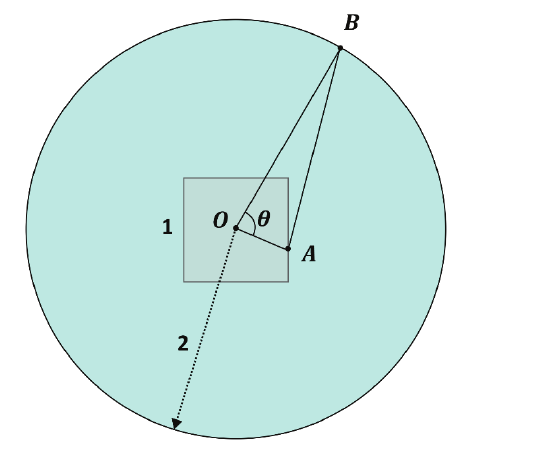
When the angle $\theta = A\hat{O}B$ is maximum, its cosine will be:
- A) $\frac{1}{8}$
- B) $\frac{1}{4}$
- C) $\frac{1}{2}$
- D) $\frac{\sqrt{2}}{2}$
- E) $\frac{\sqrt{3}}{2}$
Resolution
1. Which varies. In the triangle $OAB$ we have $OB = 2$ (radius) and $AB = 2$ (data). O that changes as $A$ moves around the square is $r = OA$. The distance from the center to contour of the side square 1 goes from $\frac{1}{2}$ (midpoint of one side) to $\frac{\sqrt{2}}{2}$ (vertex):
$$\frac{1}{2} \le r \le \frac{\sqrt{2}}{2}$$2. Law of cosines in triangle $OAB$ (angle $\theta$ in $O$, opposite the side $AB$):
$$AB^2 = OA^2 + OB^2 - 2 \cdot OA \cdot OB \cdot \cos\theta$$$$4 = r^2 + 4 - 4r\cos\theta \quad\Rightarrow\quad \cos\theta = \frac{r}{4}$$(Another way of looking at it: like $OB = AB = 2$, the triangle is isosceles with base $OA$; the height by $B$ falls at the midpoint of $OA$, and then $\cos\theta = \frac{r/2}{2} = \frac{r}{4}$.)
3. Maximizing the angle. For $0 < \theta < 180°$, the bigger the angle, smaller the cosine. So $\theta$ is maximum when $\cos\theta = \frac{r}{4}$ is minimum, that is, when $r$ is minimum: $r = \frac{1}{2}$.
$$\cos\theta_{\max} = \frac{1/2}{4} = \frac{1}{8}$$Answer: alternative A ($\frac{1}{8}$).
Be careful with the trick: the tendency is to take the point $A$ at the vertex of the square, “as far as possible.” This gives $\cos\theta = \frac{\sqrt{2}}{8}$, which corresponds to the minimum angle. Maximum angle is minimum cosine.
To review, see Theorem for any triangles.
Question 38: Polynomial with double root (Girard relations)
Statement
Suppose that the polynomial $p(x) = x^3 + mx - 2$, where $m$ is a real number, has a double real root $a$ and a simple real root $b$. The value of the sum of $m$ and $a$ is:
- A) 0
- B) $-1$
- C) $-2$
- D) $-3$
- E) $-4$
Resolution
The roots of $p$ are $a$, $a$ and $b$. By Girard’s relations to $x^3 + 0x^2 + mx - 2$:
1. Sum of roots(the coefficient of $x^2$ is zero):
$$a + a + b = 0 \quad\Rightarrow\quad b = -2a$$2. Product of roots:
$$a \cdot a \cdot b = -\frac{-2}{1} = 2 \quad\Rightarrow\quad a^2(-2a) = 2 \quad\Rightarrow\quad a^3 = -1 \quad\Rightarrow\quad a = -1$$Logo $b = 2$.
3. Sum of products two by two(gives the coefficient $m$):
$$m = a \cdot a + a \cdot b + a \cdot b = a^2 + 2ab = 1 + 2(-1)(2) = -3$$Checking: $p(x) = x^3 - 3x - 2 = (x+1)^2(x-2)$. ✓
4. The requested sum: $m + a = -3 + (-1) = -4$.
Answer: alternative E ($-4$).
Be careful with the catch: alternative D ($-3$) is just the value of $m$; the question asks for $m + a$.
Question 39: Tape around four cylindrical tanks
Statement
Four cylindrical tanks are seen from above (in floor plan) as shown in the figure. They all have 10 m radius and their centers are positioned at the vertices of the two squares adjacent dashed lines, both with 30 m on a side. An insulation tape, stretched and parallel to the ground, it surrounds the 4 tanks, making a complete turn (orange line in the figure).
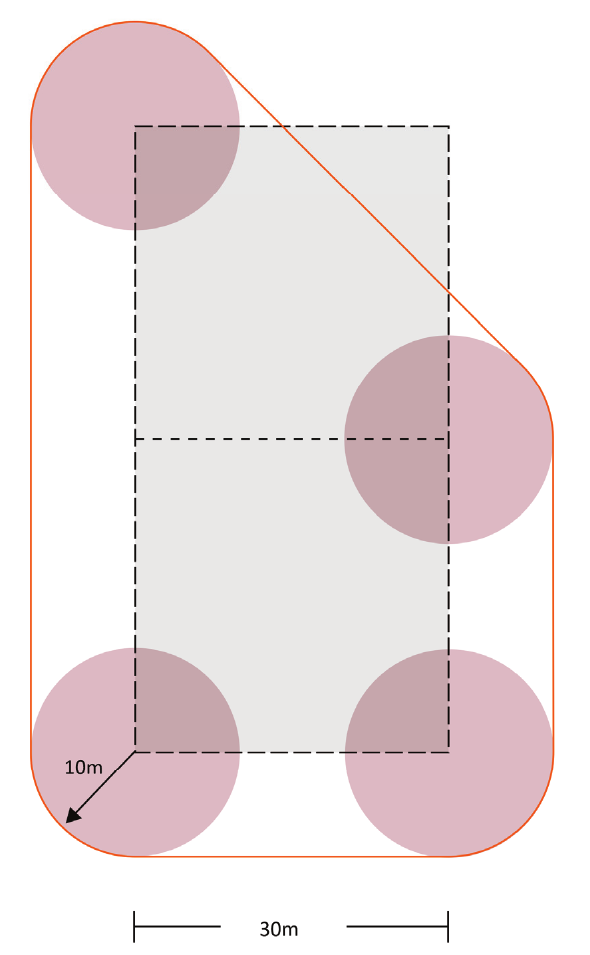
The length of the tape, in meters, is:
- A) $20\pi + 30(3 + \sqrt{2})$
- B) $20\pi + 30(4 + \sqrt{2})$
- C) $25\pi + 15(4 + \sqrt{2})$
- D) $25\pi + 30(4 + \sqrt{2})$
- E) $25\pi + 30(4 + 2\sqrt{2})$
Resolution
The ribbon is formed by straight sections (tangents to two tanks) and arcs circumference(where it touches a tank).
1. Straight sections. Each straight section is parallel to the segment connecting the centers of the two tanks it touches, and has the same length as this segment (the two rays perpendicular to the tape form a rectangle with it). From the figure, the tape passes outside 4 centers: the top one on the left, the two bottom ones and the middle one on the left. right. The segments between consecutive centers are:
- left side: two sides of square, $30 + 30 = 60$;
- bottom side: $30$;
- right side (bottom to middle): $30$;
- diagonal of the top square: $30\sqrt{2}$.
Straight total: $60 + 30 + 30 + 30\sqrt{2} = 120 + 30\sqrt{2} = 30(4 + \sqrt{2})$.
2. Arcs. In each tank, the arc goes from one straight section to the next and its angle center is equal to the angle at which the tape “turns” at that point. Taking a walk complete, the tape turns to full $360°$. Then the four arcs together forma full circumferenceof radius 10:
$$2\pi \cdot 10 = 20\pi$$(Checking: the turning angles are $90°$, $90°$, $135°$ and $45°$, which add up to $360°$.)
3. Tape length.
$$L = 20\pi + 30(4 + \sqrt{2}) \text{ m}$$Answer: alternative B.
Be careful with the catch: it is not necessary to calculate each arc separately: in a ribbon that surrounds convex figures, the arcs always add up to exactly one turn complete. With radius 10, this gives $20\pi$; the $25\pi$ of alternatives C, D and E does not corresponds to this.
To review, see Circumferences.
Question 40: Nanoscope – ratio between micrometer and nanometer
Statement
In February 2021, a group of physicists from the Federal University of Minas Gerais (UFMG) published an article that was on the cover of the important magazine Nature. The text to The following was taken from a report on the UFMG site about the article:
The nanoscope, continues Ado Jorio (professor at UFMG), illuminates the sample with a usual optical microscope. The focus of the light is the size of a 1 circle micrometer in diameter. “What the nanoscope does is insert a nanoantenna, which has a tip with a diameter of 10 nanometers, within this focus of 1 micrometers and scan this tip. The image with nanometric resolution is formed by this nanoantenna scanning process, which locates the electromagnetic field of the light at its peak”, says the professor.
Itamar Rigueira Jr. “UFMG’s Nanoscope makes it possible to understand the structure that makes graphene superconducting”. Adapted. Available at https://ufmg.br/comunicacao/noticias/. Gadelha A C et al. (2021), Nature, 590, 405-409, doi: 10.1038/s41586-021-03252-5.
Based on the data mentioned in the text, the ratio between the diameter of the light focus a usual optical microscope and the diameter of the tip of the nanoantenna used in the nanoscope is of the order of:
- A) 0,0001
- B) 0,01
- C) 1
- D) 100
- E) 10000
Resolution
1. Same unit. $1 \text{ micrômetro} = 10^{-6}$ m e $1 \text{ nanômetro} = 10^{-9}$ m. Logo $1 \text{ µm} = 10^3 \text{ nm} = 1000 \text{ nm}$.
2. The requested reason(focus ÷ tip, in that order):
$$\frac{1000 \text{ nm}}{10 \text{ nm}} = 100$$Answer: alternative D (100).
Be careful with the catch: alternative B (0,01) is the reason inverted (tip ÷ focus). The order of the words in the statement defines the numerator: “ratio between the focus diameter […] and tip diameter”.
Question 41: Growth of bacteria on a logarithmic scale
Statement
The amount of bacteria in a liquid is directly proportional to the measure of turbidity of this liquid. The graph shows, on a logarithmic scale, the growth of turbidity $x$ of a liquid over time $t$ (measured in minutes), i.e. shows $\log_{10} x$ as a function of $t$. Data was collected from 30 at 30 minutes, and an interpolation curve was obtained to infer intermediate values.
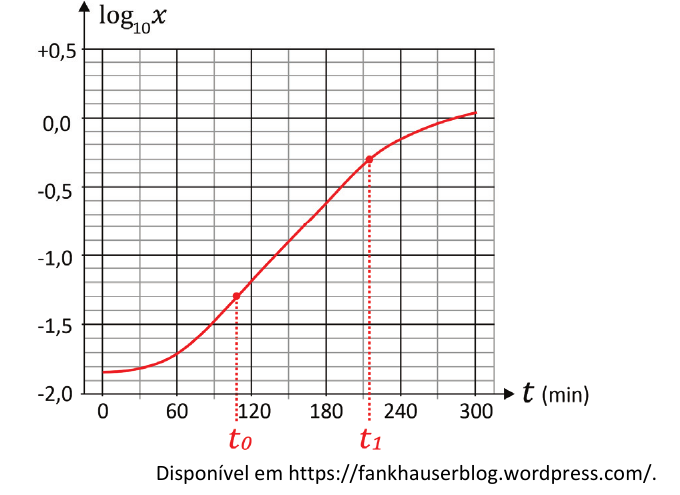
Based on the graph, how many times did the bacterial population increase from the instant $t_0$ to instant $t_1$?
- A) 2
- B) 4
- C) 5
- D) 10
- E) 100
Resolution
1. Reading the graph. The thin horizontal lines are from 0,1 to 0,1. No instant $t_0$ the marked point is at $\log_{10} x_0 = -1{,}3$; at instant $t_1$, in $\log_{10} x_1 = -0{,}3$.
2. Difference of logarithms is ratio. By the property of the logarithm of the quotient:
$$\log_{10} \frac{x_1}{x_0} = \log_{10} x_1 - \log_{10} x_0 = -0{,}3 - (-1{,}3) = 1$$$$\frac{x_1}{x_0} = 10^1 = 10$$3. From turbidities to bacteria. As the amount of bacteria is directly proportional to the turbidity, the ratio between the populations is the same: the population became 10 times larger.
Answer: alternative D (10).
Be careful with the catch: on the vertical axis is $\log_{10} x$, not $x$. Climb 1 unit on this axis means multiply $x$ by 10, and not add 1 or “to bend”.
To review, see Properties of Logarithms.