
Euler's Eyes
2026-11-02
MEXT 2018 – Mathematics (B) solved
Source: MEXT / Study in Japan – Mathematics (B) paper and official answers. Files on the past exams page.
Mathematics (B) is the paper for undergraduate applicants in science and engineering. It has three fill-in questions and is worth 100 points. The statements below follow the original English.
Answer key
| Item | Topic | Answer |
|---|---|---|
| 1 (1) | AM–GM inequality | $3$; $x = 1$, $y = \frac13$ |
| 1 (2) | Exponential equation | $-2$ |
| 1 (3) | Divisibility by $(x - 1)^2$ | $a = -3$, $b = 11$ |
| 1 (4) | Maximum and minimum of $\sin3x$ | $\frac12$; $-1$ |
| 1 (5) | Sixth roots of unity | $-1$ |
| 1 (6) | Volume of a pyramid | $\frac13$ |
| 2 (1) | Circle tangent to the parabola | $0$; $t^2 + \frac12$; $\sqrt{t^2 + \frac14}$ |
| 2 (2) | Area between circle and parabola | $\frac{5}{12} - \frac{\pi}{8}$ |
| 3 (1) | Derivatives | $\frac{1}{1 + x^2}$; $-\frac{1}{1 + x^2}$ |
| 3 (2)–(4) | Values | $\frac\pi4$; $\frac\pi2$; $\frac\pi2$ |
Question 1: six short items
Item (1)
Statement. If $x > 0$, $y > 0$ and $x + 3y = 2$, then $\frac{1}{xy} \ge$ ①, with equality if and only if $x =$ ② and $y =$ ③.
Solution. By AM–GM applied to $x$ and $3y$:
$$2 = x + 3y \ge 2\sqrt{3xy} \implies xy \le \frac13 \implies \frac{1}{xy} \ge 3.$$Equality holds when $x = 3y$, that is, $x = 1$ and $y = \frac13$.
Answer: ① $3$; ② $1$; ③ $\frac13$.
Item (2)
Statement. The real solution of $2^{x+2} - 2^{-x} + 3 = 0$ is $x = \boxed{\phantom{0}}$.
Solution. With $t = 2^x > 0$: $4t - \frac1t + 3 = 0$, or $4t^2 + 3t - 1 = (4t - 1)(t + 1) = 0$. Only $t = \frac14$ is positive, so $x = -2$.
Answer: $-2$.
Item (3)
Statement. Let $a, b$ be constants. If $x^4 + ax^3 + ax^2 + bx - 6$ is divisible by $(x - 1)^2$, then $a =$ ① and $b =$ ②.
Solution. $p(x)$ is divisible by $(x - 1)^2$ when $1$ is a double root, that is, $p(1) = 0$ and $p'(1) = 0$:
$$p(1) = 1 + 2a + b - 6 = 0, \qquad p'(1) = 4 + 3a + 2a + b = 0.$$So $2a + b = 5$ and $5a + b = -4$: $a = -3$ and $b = 11$.
Answer: ① $-3$; ② $11$.
Item (4)
Statement. For $\frac{5}{18}\pi \le x \le \frac23\pi$, the maximum of $\sin3x$ is ① and the minimum is ②.
Solution. $3x$ ranges over $\left[\frac{5\pi}{6}, 2\pi\right]$. On that interval the sine starts at $\frac12$, falls to $-1$ at $\frac{3\pi}{2}$ and rises to $0$. Maximum $\frac12$, minimum $-1$.
Answer: ① $\frac12$; ② $-1$.
Item (5)
Statement. For the complex number $z = \cos\frac13\pi + \sqrt{-1}\sin\frac13\pi$, $z + z^2 + z^3 + z^4 + z^5 = \boxed{\phantom{0}}$.
Solution. By De Moivre’s formula, $z^6 = \cos2\pi + i\sin2\pi = 1$. Since $z \ne 1$, $1 + z + \dots + z^5 = \frac{z^6 - 1}{z - 1} = 0$, and the required sum is $-1$.
Answer: $-1$.
Item (6)
Statement. Let $S$ be a square of side 1, $T$ a triangle with sides $1, 1, \sqrt2$ and $R$ a triangle with sides $1, \sqrt2, \sqrt3$. The pyramid $C$ has base $S$ and lateral faces made of two triangles $T$ and two triangles $R$. The volume of $C$ is $\boxed{\phantom{0}}$.
Solution. $T$ and $R$ are right triangles ($1 + 1 = 2$ and $1 + 2 = 3$). Let the base be $ABCD$ and the apex $P$ directly above $A$, with $PA = 1$. Then:
- $PAB$ and $PAD$ have sides $1, 1, \sqrt2$: they are the triangles $T$;
- $PBC$ has $PB = \sqrt2$, $BC = 1$ and $PC = \sqrt{1 + 2} = \sqrt3$, and so does $PDC$: they are the triangles $R$.
The height is $PA = 1$, and $V = \frac13\cdot 1\cdot 1 = \frac13$. (It is a third of the unit cube: three such pyramids make up the cube.)
Answer: $\frac13$.
Question 2: a circle tangent to the parabola
Statement
In the $xy$-plane, a circle with center $(a, b)$ and radius $r$ is tangent to the parabola $y = x^2$ at two distinct points.
- If one of the points of tangency is $(t, t^2)$, express $a$, $b$ and $r$ in terms of $t$.
- If one of the points of tangency is $\left(\frac12, \frac14\right)$, find the area $S$ of the bounded region enclosed by the circle and the parabola.
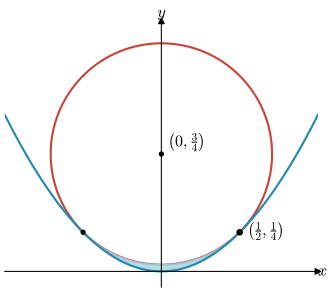
Solution
1. The intersection polynomial. Substituting $y = x^2$ into $(x - a)^2 + (y - b)^2 = r^2$:
$$q(x) = x^4 + (1 - 2b)x^2 - 2ax + (a^2 + b^2 - r^2) = 0.$$Tangency at two distinct points $t_1$ and $t_2$ means two double roots, so $q(x) = (x - t_1)^2(x - t_2)^2$. The coefficient of $x^3$ in $q$ is zero, so $t_1 + t_2 = 0$: the points are $\pm t$ and $q(x) = (x^2 - t^2)^2 = x^4 - 2t^2x^2 + t^4$.
2. Comparing coefficients.
- $x$: $-2a = 0$, so $a = 0$;
- $x^2$: $1 - 2b = -2t^2$, so $b = t^2 + \frac12$;
- constant: $b^2 - r^2 = t^4$, so $r^2 = \left(t^2 + \frac12\right)^2 - t^4 = t^2 + \frac14$.
3. The area with $t = \frac12$. Center $\left(0, \frac34\right)$ and radius $r = \frac{\sqrt2}{2}$. The bounded region lies between $x = -\frac12$ and $x = \frac12$, above the parabola and below the lower arc of the circle, $y = \frac34 - \sqrt{\frac12 - x^2}$:
$$S = \int_{-1/2}^{1/2}\left(\frac34 - x^2\right)dx - \int_{-1/2}^{1/2}\sqrt{\frac12 - x^2}\,dx.$$The first integral is $\frac34 - \frac{1}{12} = \frac23$. The second is the area under an arc of a circle: a sector of angle $\frac\pi2$ (the chord from $x = -\frac12$ to $x = \frac12$ subtends $2\cdot\frac\pi4$ at the center) plus two triangles, that is, $\frac12 r^2\cdot\frac\pi2 + \frac12\cdot\frac12\cdot\frac12\cdot2 = \frac\pi8 + \frac14$. Hence
$$S = \frac23 - \frac14 - \frac\pi8 = \frac{5}{12} - \frac\pi8 \approx 0.024.$$Answer
- ① $a = 0$; ② $b = t^2 + \frac12$; ③ $r = \sqrt{t^2 + \frac14}$.
- $S = \frac{5}{12} - \frac{\pi}{8}$.
Question 3: the arctangent defined by an integral
Statement
Let $f(x) = \int_0^x \frac{1}{1 + t^2}\,dt$ ($x > 0$) and $g(x) = f\left(\frac1x\right)$.
- Compute $f'(x)$ and $g'(x)$.
- Compute $f(1)$.
- The function $f(x) + g(x)$ is a constant $C$. Find $C$.
- Find $\lim_{x\to\infty} f(x)$.
Solution
1. Derivatives. By the fundamental theorem of calculus, $f'(x) = \frac{1}{1 + x^2}$. By the chain rule,
$$g'(x) = f'\left(\frac1x\right)\cdot\left(-\frac{1}{x^2}\right) = \frac{1}{1 + 1/x^2}\cdot\left(-\frac{1}{x^2}\right) = -\frac{1}{x^2 + 1}.$$2. $f(1)$. With $t = \tan u$, $dt = (1 + \tan^2u)\,du$, and the integrand becomes $1$:
$$f(1) = \int_0^{\pi/4} du = \frac\pi4.$$(In general, $f(x) = \arctan x$.)
3. The constant. $(f + g)' = 0$, so $f + g$ is constant, and $C = f(1) + g(1) = 2f(1) = \frac\pi2$. This is the identity $\arctan x + \arctan\frac1x = \frac\pi2$ for $x > 0$.
4. The limit. $f(x) = \frac\pi2 - f\left(\frac1x\right)$, and $f\left(\frac1x\right) \to f(0) = 0$ as $x \to \infty$. So $\lim_{x\to\infty} f(x) = \frac\pi2$.
Answer
- ① $\frac{1}{1 + x^2}$; ② $-\frac{1}{1 + x^2}$.
- $\frac\pi4$.
- $\frac\pi2$.
- $\frac\pi2$.