
Euler's Eyes
2026-10-20
Right triangles: measuring without reaching
In the interactive book: complete chapter IX, with all demonstrations and exercises.
The height of the tree
You are 6 m from a tree, on horizontal ground, and you see its top with an elevation angle of $45°$. It is possible to find out the height without climbing it. We need to set up a triangle and say exactly where we observed it from.
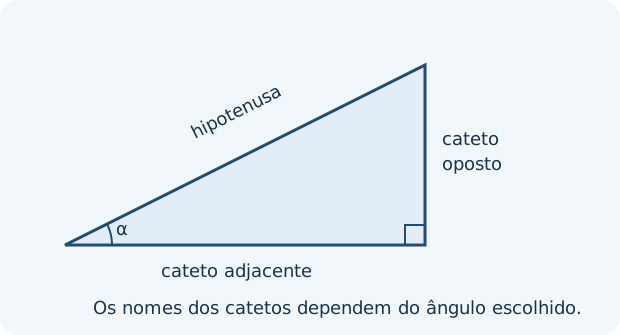
A right triangle has an angle of $90°$. The side opposite to it is the hypotenuse; the others are the cathetes. In relation to a chosen acute angle, one side is opposite and the other adjacent.
Demonstration of Pythagoras with areas
Cut out four equal right-angled triangles, with legs $a,b$ and hypotenuse $c$. Arrange them within a square of side $a+b$, with the right angles at the corners and the hypotenuses forming a central square of side $c$.
The central square has right angles because the two acute angles of each triangle add up to $90°$. The large area is the sum of the four triangular areas and the central area:
$$\begin{aligned} (a+b)^2&=4\frac{ab}{2}+c^2,\\ a^2+2ab+b^2&=2ab+c^2,\\ a^2+b^2&=c^2. \end{aligned}$$This demonstration explains equality for any right triangle, not just for a drawing of integer measurements.
Why do the ratios depend only on the angle?
Two right-angled triangles with the same acute angle have all three angles equal. They are similar: their corresponding sides are in the same proportion. If we multiply all sides by the same number, the quotients do not change. We define:
$$\operatorname{sen}\alpha=\frac{\text{oposto}}{\text{hipotenusa}},\qquad \cos\alpha=\frac{\text{adjacente}}{\text{hipotenusa}},$$$$\tan\alpha=\frac{\text{oposto}}{\text{adjacente}}.$$
When reducing the hypotenuse to 1 and placing the angle at the origin of the plane, the two legs are the coordinates of the cycle point. Thus, the definitions of the previous chapters and those of the triangle agree.
The height that creates three similar triangles
Call the hypotenuse $c$. The height $h$ drawn from the right angle divides $c$ into parts $p$ and $q$. Let $a$ be the side whose projection onto the hypotenuse measures $p$, and $b$ be the side associated with $q$.
The similarity of the triangles gives $a/c=p/a$ and $b/c=q/b$. Multiplying crosswise:
$$a^2=cp,\qquad b^2=cq.$$Comparing the areas, $ab/2=ch/2$, then $h=ab/c$. Logo:
$$h^2=\frac{a^2b^2}{c^2}=\frac{cp\,cq}{c^2}=pq.$$We also have $p+q=c$. These are the metric relationships of the right triangle.
Worked example: the tree and its eyes
If the eyes are 1,4 m from the floor, the vertical leg goes from eye height to the top. Calling this difference $d$:
$$\tan45°=\frac d6\quad\Rightarrow\quad d=6\text{ m}.$$The tree measures $6+1{,}4=7{,}4$ m. The measurement depends on the assumptions: flat terrain, vertical tree and horizontal distance of 6 m. A rough estimate of the angle produces an approximate height.
How to choose the tool
If you know two sides and want the third, use Pythagoras. If you know an acute angle and a side, choose the ratio that involves the known and sought-after side. The other acute angle is $90°-\alpha$. Write the units in the result and check if the hypotenuse is greater than each side.
In everyday life
- Height of trees and buildings. Using a protractor or a cell phone application, measure the angle to the top and the distance to the base; the tangent gives the height.
- Airplane landing. The final descent of an airplane makes about $3^\circ$ the ground; the tangent tells you how high it should be at each distance from the track.
- Works. The bricklayer checks the square of a wall with the triangle 3-4-5.
Exercises
Try solving it in your notebook before opening the solution. Exercises 1 and 2 are input; 3 and 4, for practice; 5 and 6, for deepening.
1. A right-angled triangle has legs 9 and 12 cm. What is the hypotenuse?
See resolution 1
$c=\sqrt{81+144}=\sqrt{225}=15$ cm.
2. A 10 m ladder makes $60°$ the ground. How high does it reach on the wall?
See resolution 2
$h=10\operatorname{sen}60°=5\sqrt3$ m, approximately 8,66 m.
3. A streetlight casts a shadow of 4 m when the Sun’s elevation is $30°$. How tall is it?
See resolution 3
$h/4=\tan30°=\sqrt3/3$, then $h=4\sqrt3/3$ m, approximately 2,31 m.
4. The hypotenuse is 10 cm and a leg is 6 cm. Calculate the other side and the height relative to the hypotenuse.
See resolution 4
The other side is $\sqrt{100-36}=8$ cm. The height is $h=6\cdot8/10=4{,}8$ cm.
5. The height divides the hypotenuse into 4 and 9 cm. Calculate the hypotenuse, height and legs.
See resolution 5
$c=13$ cm; $h=\sqrt{4\cdot9}=6$ cm. The legs measure $\sqrt{13\cdot4}=2\sqrt{13}$ cm and $\sqrt{13\cdot9}=3\sqrt{13}$ cm.
6. An observer with eyes 1,5 m above the ground sees the top of a pole at $45°$, 8 m away horizontally. How tall is the post?
See resolution 6
The difference in level is $8\tan45°=8$ m. Adding the height of the eyes, the post is 9,5 m.