
Euler's Eyes
2026-10-11
Exercises from the chapter 11 — Angles on a circle
Exercises and resolutions
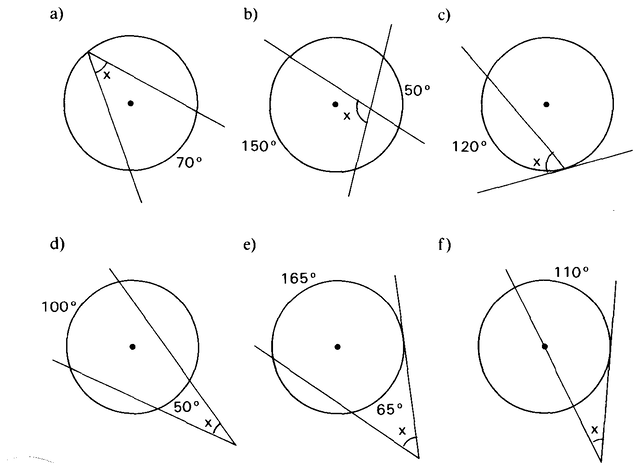
Determine the value of the angle $x$ in the following cases:
Ver resposta
a) $35^{\circ}$ · b) $100^{\circ}$ · c) $60^{\circ}$ · d) $25^{\circ}$ · e) $50^{\circ}$ · f) $20^{\circ}$
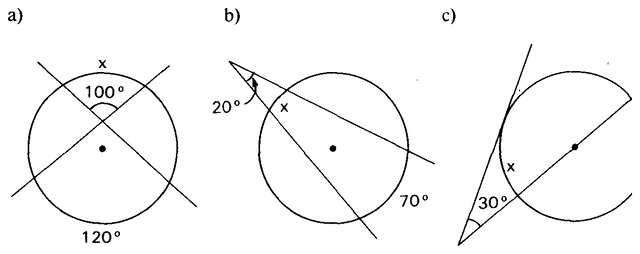
Determine the value of the arc $x$ in the following cases:
Ver resposta
a) $80^{\circ}$ · b) $30^{\circ}$ · c) $60^{\circ}$
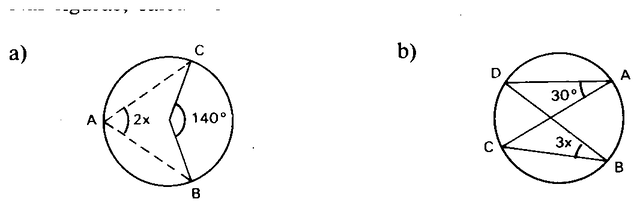
In the figures, calculate the value of $x$.
Ver resposta
a) $35^{\circ}$ · b) $10^{\circ}$
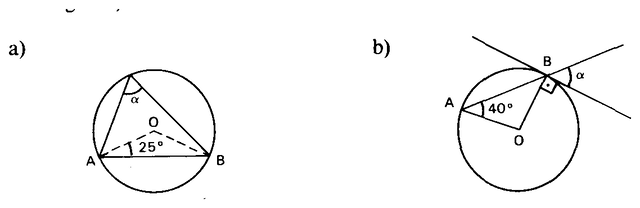
In the figures, calculate the value of $\alpha$.
Ver resposta
a) $65^{\circ}$ · b) $50^{\circ}$
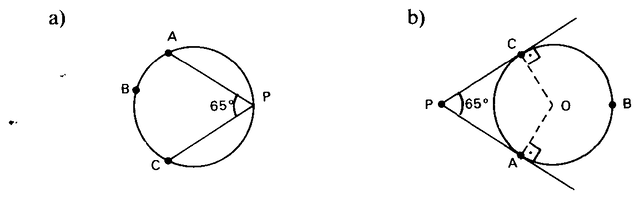
In the figures, calculate the value of the arc $\overset{\frown}{ABC}$.
Ver resposta
a) $130^{\circ}$ · b) $245^{\circ}$
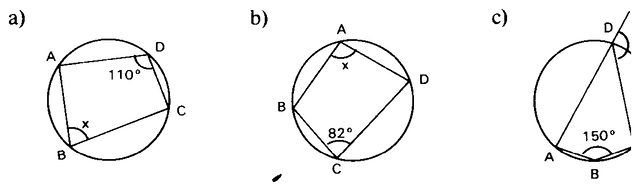
In the figures, calculate $x$.
Ver resposta
a) $70^{\circ}$ · b) $98^{\circ}$ · c) $150^{\circ}$
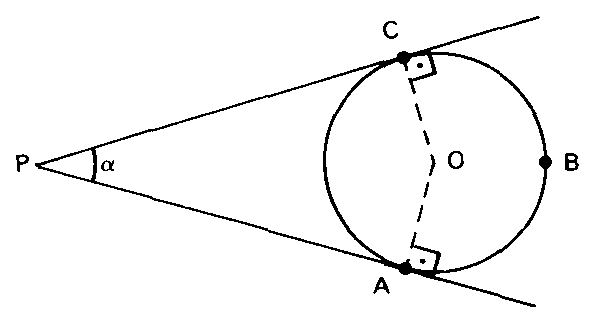
In the figure, with $\overset{\frown}{ABC} = 260^{\circ}$, calculate the value of $\alpha$.
Ver resposta
$\alpha = 80^{\circ}$
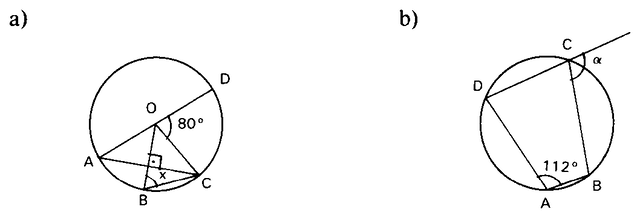
Calculate the value of $x$.
Ver resposta
a) $65^{\circ}$ · b) $112^{\circ}$
The arc $\overset{\frown}{CD}$ in the figure measures $105^{\circ}$. Calculate the value of $x$.
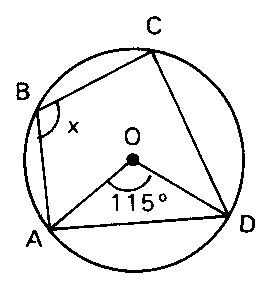
Ver resposta
$x = 110^{\circ}$
On the circumference, the arc $\overset{\frown}{CFD}$ exceeds the arc $\overset{\frown}{AEB}$ by $50^{\circ}$. Determine its measurements, knowing that the angle $\alpha$ measures $70^{\circ}$.
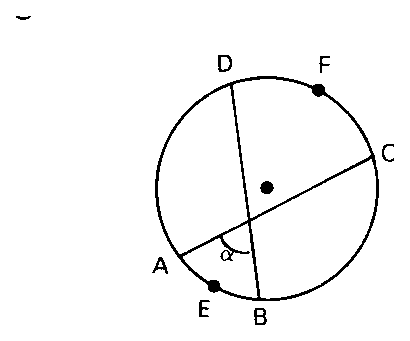
Ver resposta
$\overset{\frown}{AEB} = 45^{\circ}$ e $\overset{\frown}{CFD} = 95^{\circ}$
In the figure, angle $A\hat{C}D$ is equal to $70^{\circ}$ and angle $A\hat{P}D$ is equal to $110^{\circ}$. Determine the measure of the angle $B\hat{A}C$.
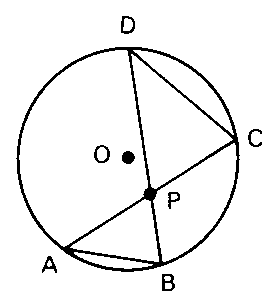
Ver resposta
$B\hat{A}C = 40^{\circ}$
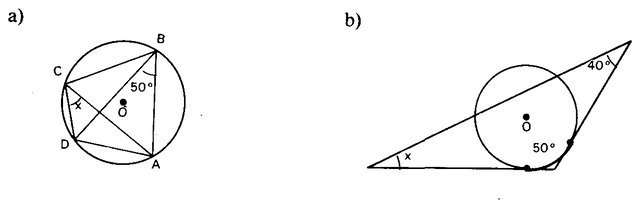
Calculate $x$ in the figures:
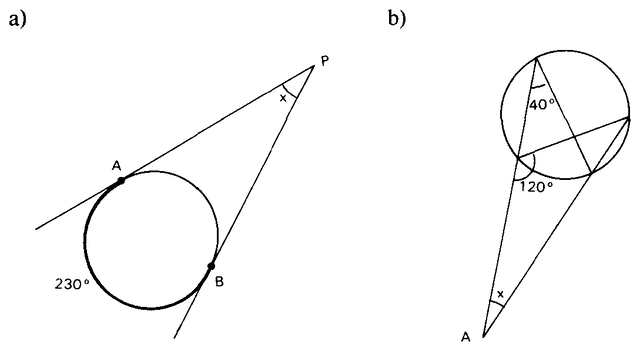
Ver resposta
a) $50^{\circ}$ · b) $20^{\circ}$
Calculate $x$ in the figures:
Ver resposta
a) $50^{\circ}$ · b) $10^{\circ}$
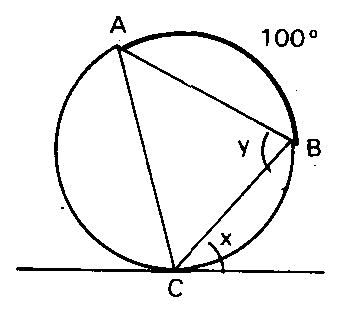
If $y = 75^{\circ}$ and $\overset{\frown}{AB} = 100^{\circ}$, calculate $x$.
Ver resposta
$x = 55^{\circ}$
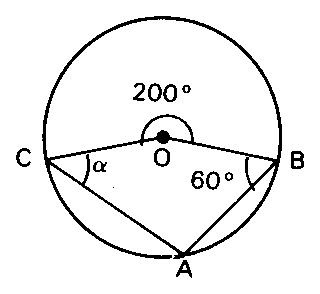
In the figure, what is the value of $\alpha$?
Ver resposta
$\alpha = 40^{\circ}$
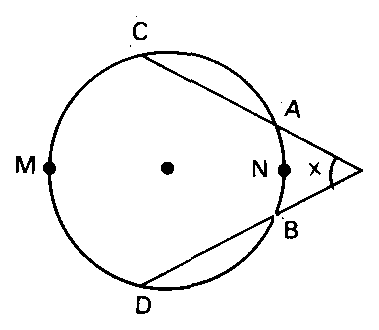
In the figure, the arc $\overset{\frown}{CMD}$ is equal to $100^{\circ}$ and the arc $\overset{\frown}{ANB}$ measures $30^{\circ}$. Calculate the value of $x$.
Ver resposta
$x = 35^{\circ}$
Determine the measure of the angle $\alpha$, knowing that, in the figure, $CD = R$.
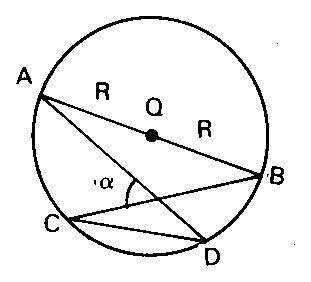
Ver resposta
$\alpha = 60^{\circ}$
Calculate $x$ in the figures:
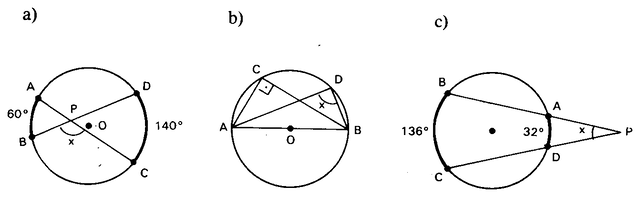
Ver resposta
a) $80^{\circ}$ · b) $90^{\circ}$ · c) $52^{\circ}$
Calculate $x$ in the figures (in b, $ABCDE$ is a regular pentagon):
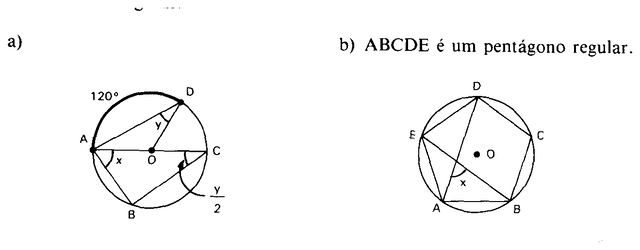
Ver resposta
a) $75^{\circ}$ · b) $72^{\circ}$
In the figure, the arc $\overset{\frown}{BEC}$ measures $60^{\circ}$ and $\overline{OB}$ is perpendicular to $\overline{AC}$. Determine the arc measure $\overset{\frown}{AFB}$ and the angle measure $A\hat{D}C$.
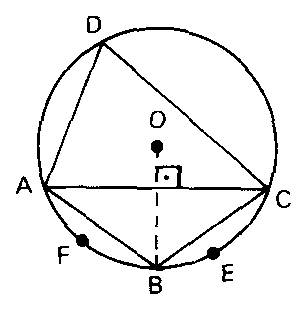
Ver resposta
$\overset{\frown}{AFB} = 60^{\circ}$ e $A\hat{D}C = 60^{\circ}$
Determine the measurements of the angles of the triangle obtained by the points of tangency of the circle inscribed with the sides of a triangle $ABC$, being $\hat{A} = 60^{\circ}$, $\hat{B} = 40^{\circ}$ and $\hat{C} = 80^{\circ}$.
Ver resposta
$70^{\circ}$, $60^{\circ}$ e $50^{\circ}$
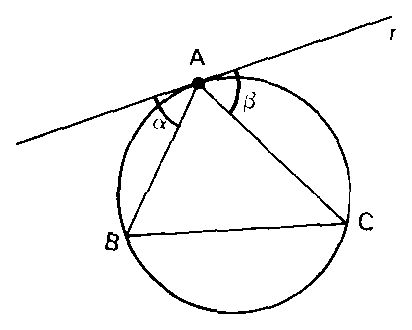
Determine the ratio between the angles $\alpha$ and $\beta$ in the figure, knowing that the straight line $r$ tangents the circle at the point $A$ and that the arcs $\overset{\frown}{AB}$, $\overset{\frown}{BC}$ and $\overset{\frown}{AC}$ are proportional to the numbers 2, 9 and 7.
Ver resposta
$\dfrac{\alpha}{\beta} = \dfrac{2}{7}$
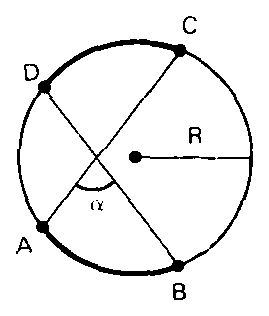
In the figure, determine the measure of the angle $\alpha$, knowing that the arc $\overset{\frown}{AB}$ measures $100^{\circ}$ and that the chord $\overline{CD}$ measures $R$, with $R$ being the radius of the circle.
Ver resposta
$\alpha = 80^{\circ}$
Determine the smallest angle formed by two straight lines secant to a circle, led by an external point $P$, knowing that these secants determine two arcs on the circle whose measures are worth $30^{\circ}$ and $90^{\circ}$.
Ver resposta
$30^{\circ}$
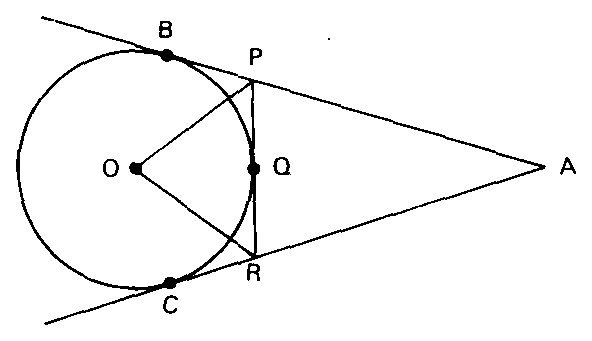
In the figure, $\overline{AB}$ and $\overline{AC}$ are tangents to the center circle $O$ and $Q$ is a point on the minor arc $\overset{\frown}{BC}$. $\overline{PQR}$ is tangent to the circle, and $\hat{A} = 28^{\circ}$. Find $P\hat{O}R$.
Ver resposta
$P\hat{O}R = 76^{\circ}$
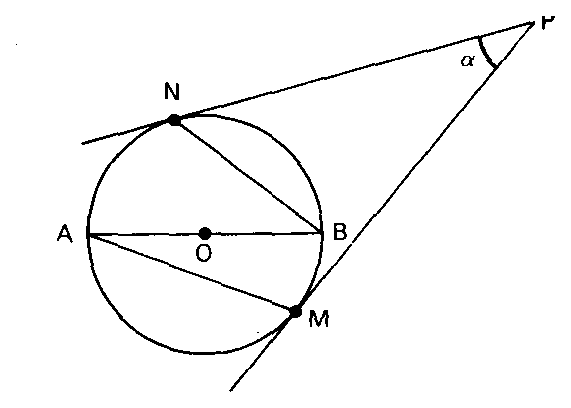
In the figure, $\overline{AB}$ is a diameter, the chord $\overline{AM}$ is the side of the inscribed equilateral triangle and $\overline{BN}$ is the side of the inscribed square. Calculate the angle $\alpha$, formed by the tangents $\overline{PM}$ and $\overline{PN}$.
Ver resposta
$\alpha = 30^{\circ}$
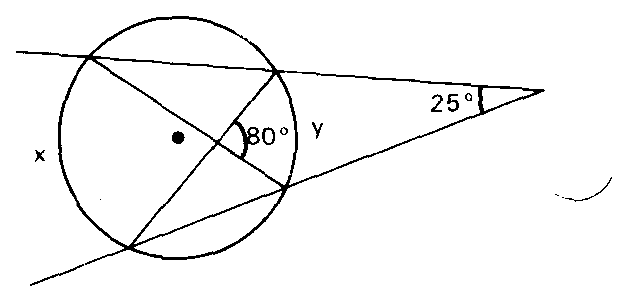
Determine the measurements $x$ and $y$.
Ver resposta
$x = 105^{\circ}$ e $y = 55^{\circ}$
Let us consider a equilateral triangle $ABC$ inscribed in a circle. Determine the smallest angle formed by the tangent lines to this circle at points $A$ and $B$.
Ver resposta
$60^{\circ}$
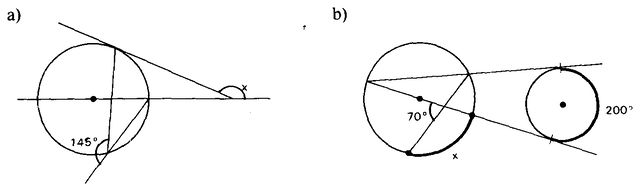
Determine the value of $x$ in the following cases:
Ver resposta
a) $160^{\circ}$ · b) $80^{\circ}$
Show that, if $\overset{\frown}{AB}$ and $\overset{\frown}{CD}$ are arcs of equal length on a circle, then the chords $\overline{AB}$ and $\overline{CD}$ are congruent.
See the resolution of the book
With $O$ being the center, consider the triangles $AOB$ and $COD$: $OA = OB = OC = OD$ (radii) and $A\hat{O}B \equiv C\hat{O}D$ (because $\overset{\frown}{AB} = \overset{\frown}{CD}$). In the LAL case, they are congruent, therefore $\overline{AB} \equiv \overline{CD}$. The reciprocal is also valid.
Prove that distinct parallel lines, secant to a circle, determine on the circle, between the parallel lines, arcs of the same size.
Ver resposta
Join opposite points (one from each parallel) and use inscribed angles: alternate angles are congruent, so the arcs they see are also congruent.
Prove that a trapezoid inscribed in a circle is isosceles.
Ver resposta
Use the exercises 407 and 406: parallel bases determine equal arcs between them, and equal arcs have equal chords (the non-parallel sides).
Let $r$ and $R$ be the radii of the circles inscribed and circumscribed to a right-angled triangle of legs $a$ and $b$. Prove that $a + b = 2(R + r)$.
Ver resposta
The hypotenuse is the diameter of the circumscribed circle ($c = 2R$) and $r = \dfrac{a + b - c}{2}$; logo $a + b = 2r + c = 2(R + r)$.
Prove that the sum of the diameters of the inscribed and circumscribed circles of a right-angled triangle is equal to the sum of the legs of that triangle.
Ver resposta
See exercise 409: $2r + 2R = a + b$.
If the sides $\overline{AB}$ and $\overline{AC}$ of a triangle are diameters of two circles, prove that the other point common to the circles is at $\overline{BC}$.
See the resolution of the book
Let $P$ be the other intersection point. The triangles $APB$ and $APC$ are inscribed in semicircles, so they are rectangles: $A\hat{P}B$ and $A\hat{P}C$ are straight. Therefore $\overrightarrow{PB}$ and $\overrightarrow{PC}$ are opposite rays, that is, $P$ is in $\overline{BC}$.
Let $ABC$ be an acute triangle and $H_1$, $H_2$, $H_3$ be the feet of the heights. Prove that orthocenter $H$ of triangle $ABC$ is incenter of triangle $H_1H_2H_3$.
Ver resposta
$A\hat{B}H_2 \equiv A\hat{C}H_3$ (respectively perpendicular sides); $A\hat{B}H_2 \equiv A\hat{H_1}H_2$ (considering the arc $AH_2$ in the diameter circle $\overline{AB}$) and $A\hat{C}H_3 \equiv A\hat{H_1}H_3$ (arc $AH_3$ in the diameter circle $\overline{AC}$). Therefore $\overline{H_1A}$ is angle bisector of $H_2\hat{H_1}H_3$; the same goes for the other vertices.